
A Test of Man and Humanity
Religion, Ethnicity, Community, Ideology, Nationality: A Human Test
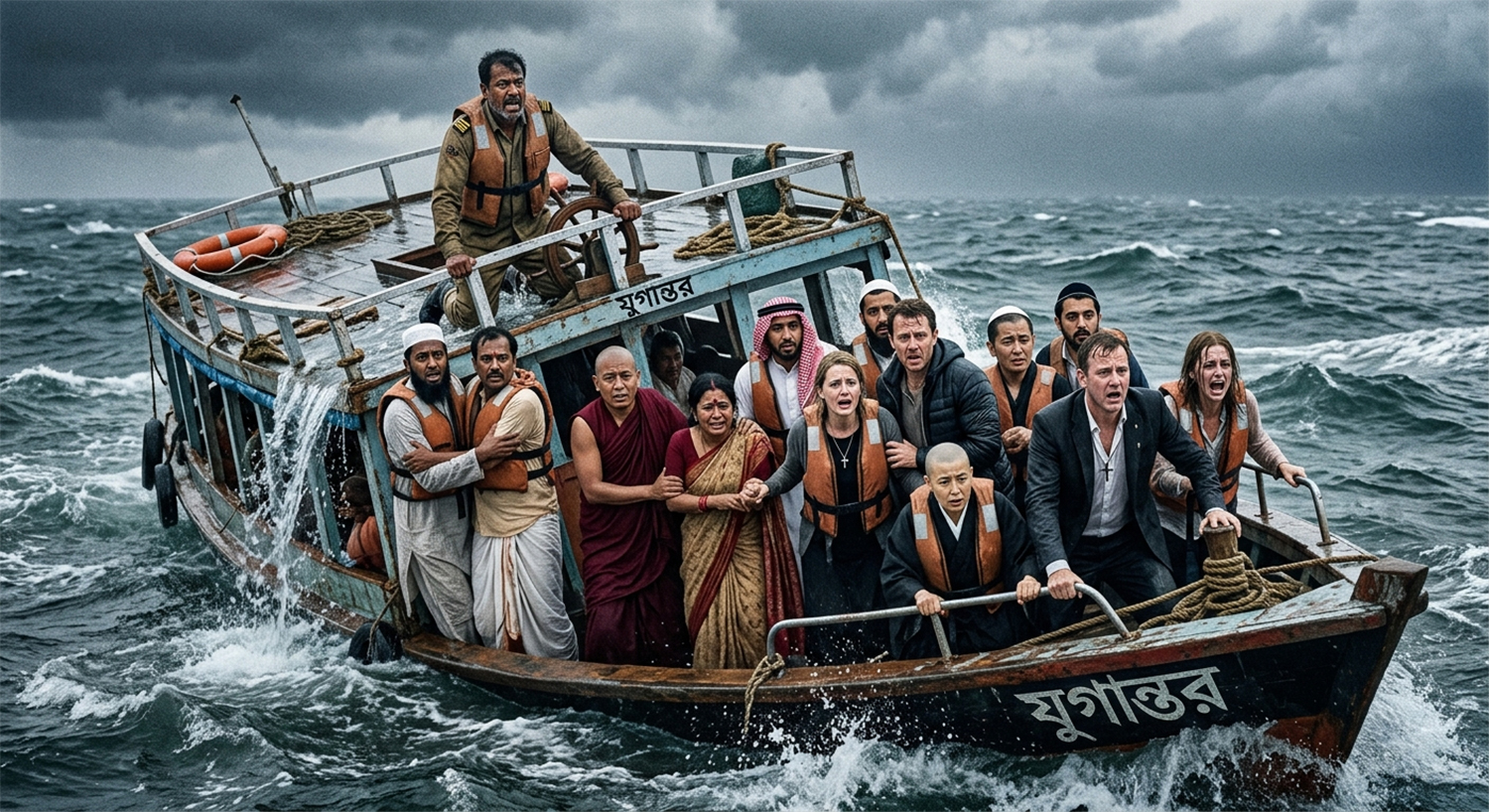
A small ship set out on a journey with a captain and 12 passengers. Among the 12, there were two people from each nationality and two from each religious ideology. When the ship met with an accident in the middle of the sea and began to sink, the captain announced — there is only one life vest on the ship, only two people can survive. As a humanist, he himself does not care about saving his own life; there will be a lottery among the passengers, and whoever’s name is drawn can take one person with them.
The passengers were —
- One Bengali Muslim and one Bengali Hindu
- One Nepali Buddhist and one Nepali Hindu
- One Arab Muslim and one Arab Jew
- One German Christian and one German atheist
- One Japanese Buddhist and one Japanese Jew
- One English Christian and one English atheist
# If everyone potentially wins the lottery, whom will each person choose to save?
# If someone wants to sacrifice themselves to save another, who will propose it first?
# If someone tries to break the rules and seize the life vest, who will do it first?
I once discussed this with a couple from West Bengal and their daughter studying at Bhubaneswar University, whom I met during a backwater tour in Kerala. In a crisis moment where life is at stake, people usually don’t pretend — they act according to what truly lies in their mind. A person’s real identity emerges then. From a neutral perspective, if we analyze evolution and human psychology, what might the answers look like?
These questions and their possible answers are not just a fictional scenario — they reveal the most honest question inside a human being. In extreme crisis, who is a person really — religious, nationalist, or simply a creature that wants to survive?
If they win the lottery, whom will they take?
Evolutionary psychology says that in crisis, people first look for their “in‑group” — the person they feel most familiar with, whose language they understand, with whom they share memories. So the first and most important truth is — in most cases, national and linguistic identity will outweigh religious identity.
| Passenger | Likely Choice | Main Reason | Confidence Level |
|---|---|---|---|
| 🇧🇩Bengali Muslim Islam | Bengali Hindu | Language, culture, and geographic memory outweigh religious differences — legacy of 1971 | 75%Alternative: Arab Muslim (25%) |
| 🇧🇩Bengali Hindu Hinduism | Bengali Muslim | Shared linguistic identity, literature, and cultural bonds are strongest | 78%Alternative: Nepali Hindu (22%) |
| 🇳🇵Nepali Buddhist Buddhism | Nepali Hindu | Historical coexistence of Buddhist–Hindu traditions in the Himalayas; national identity strong | 80%Alternative: Japanese Buddhist (20%) |
| 🇳🇵Nepali Hindu Hinduism | Nepali Buddhist | National identity and language override religion; in Nepal these two religions are sibling-like | 82%Alternative: Bengali Hindu (18%) |
| 🇸🇦Arab Muslim Islam | Arab Jew | In the face of death, Semitic linguistic-cultural ties may melt political hostility | 45%Alternative: Bengali Muslim (55%) — uncertain |
| 🇮🇱Arab Jew Judaism | Arab Muslim | Geographic-cultural closeness; shared Arabic language may create unexpected bonding in crisis | 48%Alternative: German atheist (32%), Japanese Jew (20%) |
| 🇩🇪German Christian Christianity | English Christian | Shared Western civilizational values and Christian heritage | 70%Alternative: German atheist (30%) |
| 🇩🇪German atheist Atheism | English atheist | Secular humanist ideology + Western identity; nonreligious people value ideology most | 72%Alternative: German Christian (28%) |
| 🇯🇵Japanese Buddhist Buddhism | Japanese Jew | Japanese identity comes first; Jews in Japan are deeply integrated into Japanese culture | 85%Alternative: Nepali Buddhist (15%) |
| 🇯🇵Japanese Jew Judaism | Japanese Buddhist | National identity is paramount; religious identity is secondary in Japanese society | 88%Alternative: Arab Jew (12%) |
| 🇬🇧English Christian Christianity | German Christian | European Christian heritage and Western civilizational unity | 68%Alternative: English atheist (32%) |
| 🇬🇧English atheist Atheism | Anyone | Secular humanist thinking reduces in‑group bias; most likely to choose a stranger or the most endangered | 40%German atheist 35% · Random 25% |
The Bengali Muslim and Bengali Hindu pair has the highest chance of a surprising outcome. Both will choose each other, because the same language, same songs, same smell of food, same memories of rivers — these are deeper than religious differences. In 1971, this truth was proven with blood.
Similarly, the Nepali Buddhist and Nepali Hindu will choose each other, because in the Himalayan region Buddhists and Hindus were never enemies — they were neighbors.
The German Christian will choose the English Christian — an invisible thread of Western civilization will pull them together.
The German atheist and English atheist will choose each other, because nonreligious rational people value ideological similarity the most.
The most complex situation will arise with the Arab Muslim and Arab Jew. Politically, they are among the most divided communities on earth. But in the face of death? The same Arabic language, same desert culture, same taste of food — how strong will that pull be? Research suggests that in the final moment of fear, even hostility melts, because what remains are simply two human beings.
The Japanese Buddhist and Japanese Jew combination is rare in the world. The Jewish population in Japan is extremely small and deeply integrated into Japanese culture. These two will likely choose each other based on national identity — because the “Japanese” identity is deeper for both than religious identity.
Highest certainty: Japanese pair, 85–88% · National identity dominant
Most uncertain: Arab pair, 45–48% · Language vs politics
Most humane: English atheist, lowest in-group bias
Main conclusion: In 8 out of 10 cases, national and linguistic identity outweighs religious identity. The only exception is the Arab pair — where political history fights against linguistic bonding.
Self‑sacrifice — who will step forward first?
The captain has already made this decision, and it is the most credible form of self‑sacrifice — because there is no promise of heaven behind it, no reward in the afterlife, only pure human morality. A humanist’s sacrifice is therefore the most selfless.
Next most likely are the Nepali Buddhist and Japanese Buddhist. In Buddhist philosophy, the ego is transient, death is merely a transformation. In the Bodhisattva ideal, giving up one’s own liberation for others is the highest morality — this philosophy is theoretically the most refined and practiced for thousands of years. But a sincere warning must be given — there is always a gap between ideals and real behavior. Researchers Zimbardo and Milgram repeatedly showed that under extreme pressure, people abandon their beliefs.
German and English atheists may also step forward — without fear of the afterlife, death sometimes feels lighter, and secular humanist values may inspire saving another person.
Breaking the rules — who will seize the vest first?
This is the hardest and most honest question. And the answer is the most uncomfortable.
Evolution says — self‑preservation comes before all morality. This is a fundamental truth of biology, and no religion or ideology has ever fully erased it. An analysis of Titanic sinking statistics showed that those who seized lifeboats first were not from any particular religion or nationality — they were the people who could make quick decisions and ignore social pressure.
So the real answer is — religion or nationality does not determine this; personality type does. Dark Triad personality — high narcissism, low empathy, high impulsivity — people with these traits exist in every religion and every nation. They are the ones who will step forward first. Blaming any specific religion or nationality here is not scientifically valid.
The deepest truth
Throughout life, people carry identities — I am Muslim, I am Hindu, I am Buddhist, I am atheist, I am Bengali, I am Arab. But when death stands in front of them, these identities fall away one by one — and inside remains only a frightened human being who wants to live, wants to love, and sometimes can show extraordinary courage.
Religion and ideology either shine brightest in extreme crisis, or they fall away first. Which one happens — depends on the person’s lifelong practice, not just their belief.
Related Posts
Why do Islamist clerics consider Bengali cultural festivals their enemy?
This year, unlike many previous years, the major Hindu religious festival Durga Puja in BangladeshRead More
ইসলামিস্ট মোল্লারা কেন বাঙালিদের আনন্দ উৎসবকে তাদের শত্রু মনে করে?
এবার বাংলাদেশে অন্যবারের তুলনায় বেশ শান্তিপূর্ণ, উৎসবমুখর পরিবেশে হিন্দু ধর্মের বড় ধর্মীয় উৎসব দূর্গাপূজা হয়েRead More
Why do Islamist cyber‑jihadis insult, threaten, and file false reports against people with different opinions?
Maulana Azhari once advised Islamists that sharing his Facebook posts is also an Islamic act;Read More
Comments are Closed