
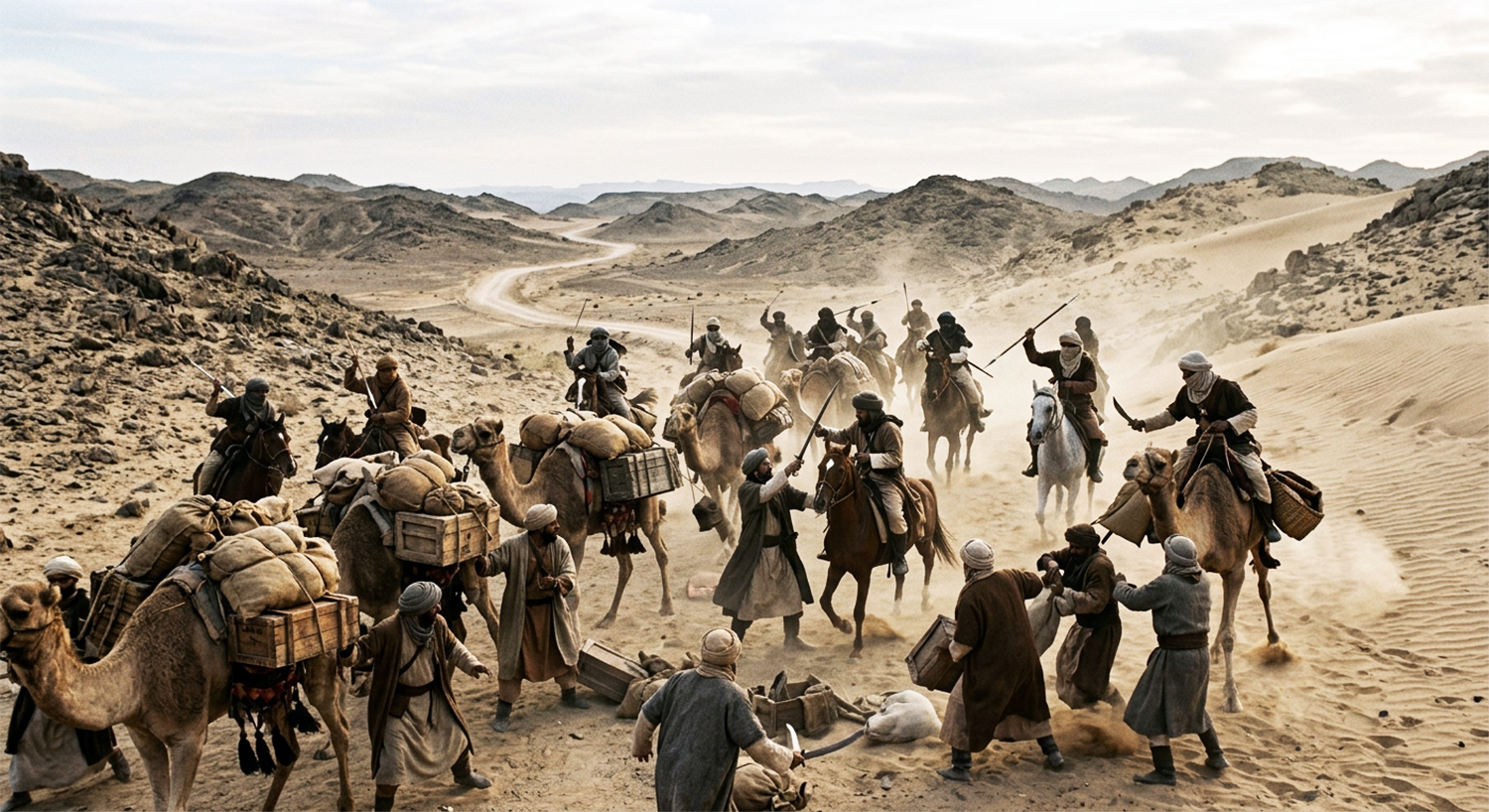
A religion that began with robbery
Fourteen hundred years ago, desert bandits even looted the trade caravan of the Prophet’s own son‑in‑law
In 632, during the Hajj (the Farewell Hajj of Prophet Muhammad), the number of participating Muslims was approximately 120,000. At the birthplace of what is now such an influential religion, during the lifetime of its original preacher, it had only this many followers. Around 632, the total population of the entire Arabian Peninsula was approximately 5 to 5.3 million. According to historical data by Colin McEvedy and Richard Jones, and in light of modern historical research, this demographic picture of Arabia at that time emerges. I am providing this calculation for ease of understanding. Therefore, one cannot claim that during the lifetime of Prophet Muhammad, even in the very birthplace of Islam, people were flocking in masses to Islam out of love.
The sixth year of prophethood, meaning nearly six years after the start of Islam, when the number of Muslims was approximately around 40, Umar accepted Islam. He was later appointed the second caliph of Islam. As you know, Umar was both the father-in-law of Prophet Muhammad—his daughter Hafsa was the Prophet’s wife. Umar was also the Prophet Muhammad’s grandson-in-law, having married Kulthum, the daughter of Fatima and Ali, thus becoming the Prophet’s grandson-in-law in his old age. They even had a child at an old age. Again, after Umar’s death, Umar’s widowed wife Ummul Banin bint Hazar was married by Ali, who was Umar’s father-in-law and also the Prophet’s son-in-law. Muhammad’s father-in-law was Umar, again Umar was Muhammad’s grandson-in-law, and Muhammad was Umar’s maternal grandfather-in-law. Muhammad’s son-in-law was Ali, and again Ali was Umar’s father-in-law. Ali married the sister-in-law of his daughter—what this relationship is called is unknown. If your head spins, take a break—this is not the main discussion. The main discussion is different.
What do Islamic sources say? Umar was a ferocious bandit. He had set out with a sword to kill Muhammad when, on the way, the companion Naim bin Abdullah informed him that his sister and brother-in-law had accepted Islam. Enraged, he went to their house, heard Qur’anic verses, became fascinated, and his heart changed. He then went to Dar al-Arqam and publicly accepted Islam. This is the Islamic narrative, isn’t it? Now think with common sense.
The important people of Mecca used to call Prophet Muhammad mad. Even today, if someone claims prophethood, people would call him mad. This made Prophet Muhammad very depressed; he even attempted suicide several times by jumping from a mountain . Allah revealed multiple verses in the Qur’an to console him, saying that he was not mad (68:2, 81:22). Thus, the word “mad” appears a total of 11 times in the Qur’an. Among the people of Mecca, Muhammad held little importance; if the verses of the Qur’an he introduced were so attractive, they would have captured the attention of many scholars and ordinary people as well.
In the first six years of Islam, there were only 40 followers; in 10 years, around 100; in 13 years, at most 300! Who were these followers? Aside from Khadijah and a few professional people, most were vagrants and desert bandits—whose main occupations were theft, robbery, and looting trade caravans. It was the attraction of these that led them to join Islam. Did Umar accept Islam because he was attracted by its great beauty? He essentially joined Islam hoping for robbery and so-called jihad—anti-human wars—seeking women obtained as spoils, looted wealth, and such gains. This is the reality.
Even after fleeing to Medina due to persecution by the people of Mecca, they had no respectable profession. They fought their Jewish benefactors, enslaved and exploited their women, and looted their property. Looting trade caravans traveling from Syria to Mecca was their primary means of livelihood. Because this group of vagrants did no work at all—so how did they eat?
When the companions who joined Prophet Muhammad’s group began asking where the promised prosperity and wealth was, Muhammad said that his livelihood was under his sword. They would have to sustain themselves by the sword. This sword meant attacking non-believing tribes in the name of jihad and looting trade caravans heading toward distant settlements. Here is a link to Sahih Bukhari; see page 108 (PDF page 109), point number 88. Before twisting things, check footnote number 1 below, where it is clearly written that the source of Prophet Muhammad’s livelihood was war spoils or booty. And this loot was supposedly Allah’s gift to them!
Robbery and banditry were the main professions of Prophet Muhammad and his early team. If you disagree, then tell us—what was their profession? To own such wealth without labor, many people—especially thieves and robbers—began joining his group. At that time in Mecca and Medina there were many wise people, poets, writers, artists, and businessmen, yet none joined Prophet Muhammad’s group. The person whom Prophet Muhammad mockingly called Abu Jahl actually had high honor—he was known to Meccans as Abu Hakam, the father of wisdom. Because Abu Jahl opposed Muhammad’s bandit group, Muhammad named him Abu Jahl, meaning father of ignorance. When even Allah could not bring him into line, verses were transferred to Muhammad—Surah Al-Alaq (96:9–19). Did it stop there? Muhammad also failed to bring Abu Lahab into the fold. How astonishing—Allah, the creator of this vast universe, then helplessly mocks and curses him by revealing an entire surah (Surah Al-Lahab, 111): “Tabbat yada Abi Lahabin…” Read it with the meaning, and you’ll understand how trivial the Qur’an is, not something worth giving importance to!
Do you know what this desert bandit group of Muhammad once did? They looted a trade caravan of 170 camels belonging to Abu al-As, the husband of Muhammad’s eldest daughter Zaynab. When Abu al-As secretly came from Mecca to Medina to tell his wife about being robbed and left helpless, Zaynab went crying to her father, begging him to release the goods. Here Muhammad again followed a democratic method—although speaking against his decision meant certain death. He told the companions, “This property is now your rightful booty. But if you kindly return it, I will be pleased.” The believers saw this as great generosity. The companions agreed with Muhammad and voluntarily returned all the goods to Abu al-As. You don’t have to believe me—read it yourself. You’ll find it in Ibn Hisham, Volume Two (an abridged version of Ibn Ishaq’s Sirah), page 337.
When people talk about the Prophet’s daughter, they usually mean Fatima; the eldest daughter Zaynab remains in the shadows. Because if Zaynab were discussed, these stains of Muhammad and Islam would be exposed. To preserve the history of desert banditry, Zaynab remains unmentioned in history.
Below I have provided two videos; references are included in the video descriptions. Those interested can watch the videos to learn more—
This video must be watched directly on YouTube: https://youtu.be/awIB-GYQBW4
Related Posts

Operation Entebbe – the story of one night, and the Islamic execution suffered by Nazrul Islam and Sweety Akter
What can a state do to save the lives of its citizens abroad? Are thereRead More
অপারেশান এন্টেবে – এক রাতের গল্প এবং নজরুল ইসলাম ও সুইটি আক্তারের ইসলামি হত্যার শিকার হওয়া!
একটি রাষ্ট্র বিদেশে তার নাগরিকদের জীবন বাঁচাতে কী করতে পারে? এর কোন টেক্সটবুক উদাহরণ আছে?Read More
A random page from Muhammad’s self‑made book Qur’an and its unscientific statements
Sometimes I flip through random pages of Muhammad’s self‑made book Qur’an, and today this pageRead More
Comments are Closed