
Salton City - The Dead Dream
The fate of Salton City teaches that trying to control nature can lead to the opposite of what is intended
Salton Sea: The Story of a Haunted Dream
After almost a 300‑kilometer drive in three hours, through rows of date palm groves, when I reached the shore of the Salton Sea on a scorching July afternoon, the only visitors were myself, two Chinese tourists and someone far away; a little later two young women got out of a car. Yet once upon a time, a grand project had begun here to build the planned residential town of Salton City on the shores of the Salton Sea, which had been created as a miracle. There was a tourism boom; people came from far and wide to water‑ski, there were dozens of luxury resorts, and rows of glittering casinos. Now people have moved away from there, and are still leaving. Today it is a desolate desert, with a few fragments standing as witnesses of time! How did this sea originate? What is its area? Why did this sea and its shoreline town end up as a development disaster?
A sea born from an engineering mistake
The history of the Salton Sea begins in the first decade of the twentieth century, but its story is not one of any natural miracle – rather the result of a man‑made catastrophe. This area of California has for many thousands of years been a vast lowland known as the “Salton Sink,” located about 226 feet below sea level. Looking into geological history, we find that the Colorado River has repeatedly changed course and flooded this sink, creating the ancient lake “Lake Cahuilla,” which has also dried up many times.
Around 1900, to expand agriculture in the Imperial Valley, engineers planned to supply water by cutting irrigation canals from the Colorado River. But in 1905, under the pressure of heavy spring rains and snowmelt, the canal’s control system collapsed. The result – the entire flow of the Colorado River changed course and began to flow directly into the Salton Sink. For almost two years, from 1905 to 1907, the full flow of the river kept entering this dry desert basin, until engineers finally managed to bring the river’s course back under control. By then, California’s largest lake had formed – the Salton Sea.
Size and geographical features
The Salton Sea is currently the largest lake in California, although its area is steadily shrinking every year. According to current estimates, its area is about 343 to 350 square kilometers – roughly 55 kilometers in length and about 24 kilometers in width. It lies about 234 feet below sea level, making it one of the lowest places on Earth. The lake has no natural outlet – only excess irrigation water from surrounding farmland flows into it, and water leaves through intense evaporation in the heat. This very characteristic later became the main cause of the lake’s destruction.
When it was “California’s Riviera”
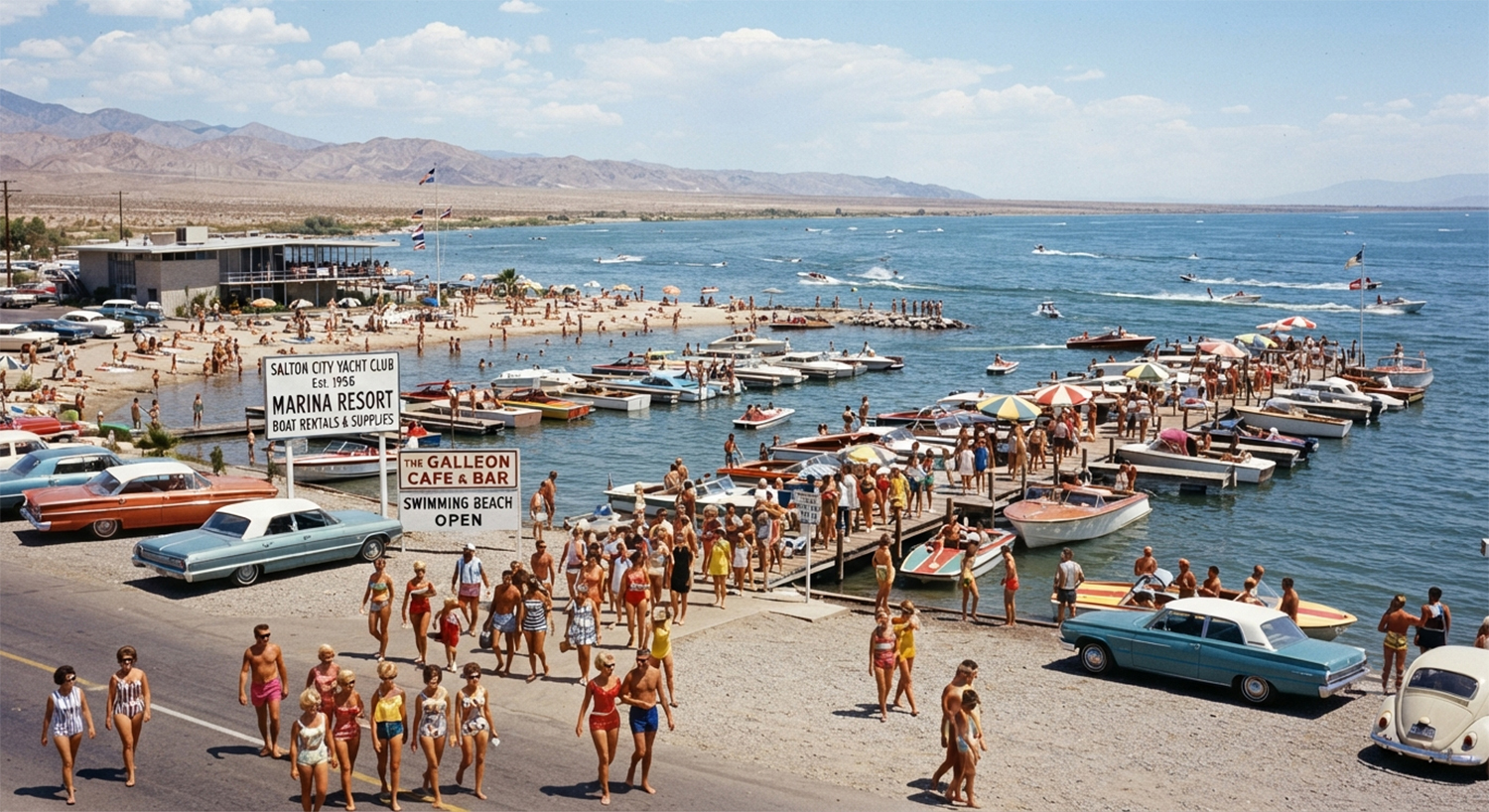
In the 1950s and 60s, the Salton Sea transformed into one of America’s most popular tourist destinations. Investors and developers saw it as a gold mine – a vast body of water in the middle of the desert where a luxury resort town could be built. Thus were born planned residential areas like Salton City, Bombay Beach, North Shore and Desert Shores.
At that time, thousands of people flocked here for water‑skiing, boating, fishing and swimming. It is said that stars like Frank Sinatra, Bob Hope and The Beach Boys also spent time on these shores. It was marketed as the “Salton Sea Riviera” – with the promise of attracting more visitors than Palm Springs. Dozens of motels, yacht clubs, marinas and luxury resorts sprang up around the lake. Land prices soared, and developers began to dream of turning it into a second Las Vegas or Palm Springs.
The beginning of the fall: why the dream collapsed
This dream of a glittering future did not last long. A combination of multiple factors gradually destroyed the entire area.
Salinity and ecological disaster: Since the lake has no natural outlet, water can leave only through evaporation, while all the salts and chemical substances remain behind. Over time, the lake’s water became more saline than the ocean. In addition, water containing fertilizers and pesticides from surrounding farmland brought an excess of nutrients (eutrophication) into the lake, causing massive algal blooms. As a result, oxygen levels in the water dropped and repeated mass fish die‑offs occurred – millions of dead fish would wash up on the shores.
The stench that drove tourists away: The intense stench caused by dead fish, rotting algae and hydrogen sulfide gas could be felt from miles away; it is reported that complaints about the smell reached as far as Los Angeles. This stench began to erase the dream of a “Riviera” from tourists’ minds.
The blow of floods: In the 1970s and 80s, heavy rains and storms caused the lake’s water level to rise abnormally, flooding shoreline houses, motels and resorts. Many investors lost their properties and were ruined, and one business after another shut down.
Water shortage and toxic dust: In recent decades, agreements have reduced the amount of irrigation water used in the Imperial Valley, which has also decreased the inflow of water into the lake. Combined with rising temperatures due to climate change and increased evaporation, the lake is shrinking rapidly. The lakebed, where pesticides and heavy metals had accumulated for years, is now exposed. From this dry lakebed, fine toxic dust is being carried into the air, which, according to various studies, is increasing rates of respiratory problems and asthma among nearby residents – especially children.
Today’s Salton Sea: the silence of a ghost town
Today, when someone drives toward Salton City or Bombay Beach, they see the skeletons of abandoned motels, rusted boats, broken jetties and dust‑covered roads – mere shadows of a once bustling Riviera. Where thousands of tourists once crowded, now only a handful of visitors, local artists and nature lovers come – some out of curiosity, others to witness this symbol of the failure of the “American Dream.”
Yet there is some hope: the California state government and various environmental organizations have now undertaken several projects to restore the Salton Sea – including creating wetlands, suppressing dust, and even plans to harness the vast lithium deposits in the lakebed for economic potential. The possibility of extracting lithium for electric vehicle batteries has made this region newly significant, though how successful these plans will be remains uncertain.
Thus the Salton Sea is not just the story of a lake – it is a living lesson in human ambition, nature’s revenge and unplanned development, which still stands silently in the heart of the desert as a witness of time.
Related Posts

Everything is a Gift from Allah …
The day of bride-seeing in a Bengali household is like an unwritten stage play—where everyRead More
সবই আল্লাপাকের দান …
বাঙালি ঘরে কনে দেখার দিনটিও যেন এক অলিখিত নাট্যমঞ্চ – যেখানে প্রতিটি সংলাপ, প্রতিটি অঙ্গভঙ্গিRead More

When a Loved One Suddenly Feels Like a Stranger: What Causes This Neglect?
Siam met Liza in the second year of university. For the first six months, SiamRead More
Comments are Closed