
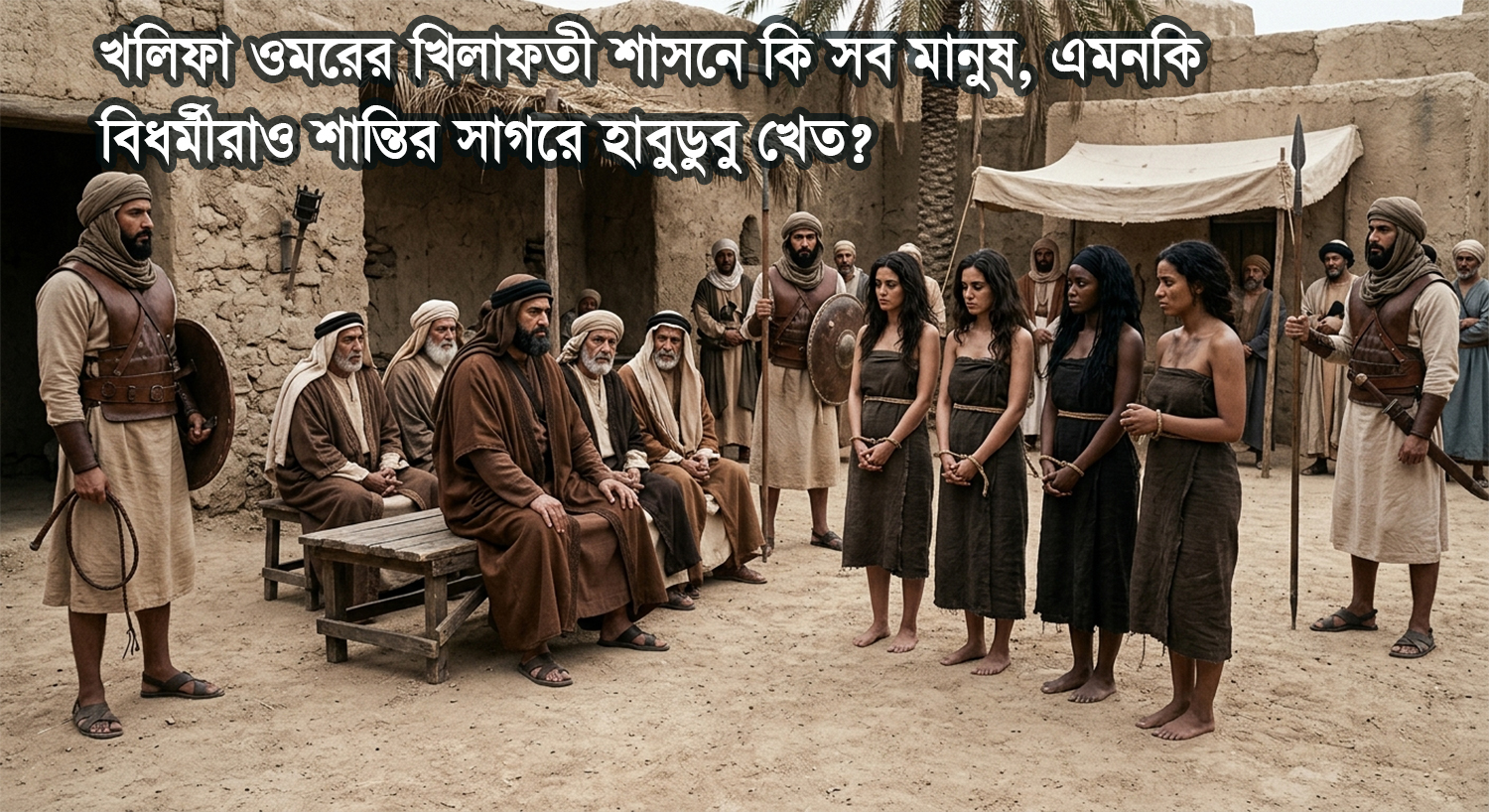
Umar’s Ruling and Islamist Myths
Under the caliphate rule of Caliph Umar, did all people – even non‑believers – drown in an ocean of peace?
When asked to show where Islam and Prophet Muhammad’s Sharia have been successfully implemented anywhere, the believing brothers start slipping away. Saudi Arabia is the birthplace of Islam and Prophet Muhammad, where the Quraysh are the leaders of the Muslims and the custodians of the Kaaba – Allah has declared that – yet the believing brothers will say that Saudi Arabia does not follow Sharia. Afghanistan, Pakistan, Iran, Sudan, Indonesia’s Aceh province – whatever name you mention, when the injustice, human rights violations, inhumane activities, and especially the deprivation of women’s rights and freedoms there are pointed out, the believing brothers claim that they too do not follow true Islam and Sharia. At one point their slipping stops at Umar Miya’s Caliphate. Finally, they claim that Caliph Umar’s Caliphate was the ideal example of Islamic and Sharia rule where all people, even non-believers, were immersed in an ocean of peace.
Is that really the case? Was Umar’s rule so humane and full of rights? Was Umar really such an ideal person? Look at the points below and judge for yourselves how correct the Islamists’ claim is. There are countless other criticisms besides these, which would turn into several books if one sat down to write them.
Who was Umar?
In the sixth year of prophethood, meaning about six years after the start of Islam, when the number of Muslims was approximately 40, Mr. Umar accepted Islam. He was later appointed as the second Caliph of Islam. As you know, Umar was at once the father-in-law of Prophet Muhammad, as his daughter Hafsa was the Prophet’s wife. Umar was also the grandson-in-law of Prophet Muhammad, having forcefully married and sexually abused the child Kulthum, daughter of Fatima-Ali, and in old age became the grandson-in-law of Prophet Muhammad. They even had children in his old age. Again, after Umar’s death, Ali, who was Umar’s father-in-law and the Prophet’s son-in-law, married Umar’s widow Ummul Banin bint Hajar. Muhammad’s father-in-law Umar, again Umar is Muhammad’s grandson-in-law, Muhammad is Umar’s maternal grandfather-in-law. Muhammad’s son-in-law Ali, again Ali is Umar’s father-in-law. Marrying his daughter’s sister-in-law, what this relationship is called is unknown. If your head spins, stop; this is not the main discussion. The main discussion is different.
What do Islamic sources say? Umar was a ferocious bandit. He had set out with a sword to kill Muhammad, but on the way, Sahabi Naim bin Abdullah informed him that his sister and brother-in-law had accepted Islam. He angrily went to their house, heard Quranic verses, became enchanted, and his heart changed. After that, he went to Darul Arqam and publicly accepted Islam. This is the Islamic narrative, isn’t it? Anyway, let’s not talk about the attacks and robberies on trade caravans by Prophet Muhammad’s bandit gang to accumulate wealth. If you have common sense, you can understand why Umar joined Prophet Muhammad’s desert bandit force.
Umar followed and harassed the Prophet’s wives at night
In ancient Arabia, there were no modern toilets inside houses. Therefore, the women of Medina, especially the wives of Prophet Muhammad, would hold their urine and feces all day and go to the open field of Medina called ‘Al-Manasi’ at night for defecation or urination. Umar wanted the Prophet’s wives to remain behind the veil and not go out. For this reason, he would follow them at night and harass them.
Sahih Bukhari (Hadith No. 146): Narrated from Hazrat Aisha (ra.), “The wives of the Prophet would go out at night to Al-Manasi (an open place) for relieving themselves. Umar (ra.) would say to the Prophet (sa.), ‘Have your wives observe purdah.’ But the Messenger of Allah (sa.) did not do so. One night, during Umar’s strict surveillance, the Prophet’s wife Sawda bint Zam’ah (who was quite tall) went out after Isha prayer. Umar recognized her and shouted, ‘O Sawda! Know that we have recognized you!’ Umar’s intention was to enforce purdah through this embarrassment.”
Sahih Muslim (Hadith No. 2170): This narration clearly mentions that due to Umar’s sudden shout and comment, the Prophet’s wife Sawda became extremely embarrassed and ashamed, and quickly went to Muhammad and strongly complained about Umar’s behavior.
Power-hungry Umar did not care for the Prophet’s family
After Muhammad’s death, there was intense conflict with the Prophet’s family or Banu Hashim over the political leadership of the Caliphate and economic rights with Caliph Abu Bakr and Umar. This policy was strictly maintained even during Umar’s rule.
After the Battle of Khaybar, Muhammad’s personally owned fertile garden land called ‘Fadak’ was claimed by his daughter Fatima as inheritance. But Abu Bakr and Umar seized it as state property on the pretext that “prophets have no heirs.” According to Shia and modern secular historians, this was a well-planned state oppression to politically and economically weaken and sideline the Prophet’s lineage.
Sahih Bukhari (Hadith No. 4240 and 6725) – Here it is clearly mentioned that Hazrat Fatima, not getting the property of Fadak, became extremely angry with the Caliphs and did not speak to them until her death (for 6 months).
Al-Imamah wa al-Siyasah (Ibn Qutaybah Dinawari) – This famous historical book mentions that when the people of Banu Hashim took a stand against Abu Bakr’s allegiance in Hazrat Ali’s (ra.) house, Umar went to that house and threatened, “By the one in whose hand is Umar’s life! If you do not come out to pledge allegiance, I will burn this house with the people inside.” Although it is said the house was not burned, Shia and modern historians consider Umar’s aggressive and violent attitude as extreme authoritarian injustice.
Umar sexually abused women in disguise
Atika, daughter of Zayd ibn Amr ibn Nufayl (who was Umar’s cousin), was married to Caliph Umar ibn al-Khattab. She loved going to the mosque to offer prayers very much. Although Umar did not explicitly forbid her – since the Prophet had said, ‘Do not prevent the female servants of Allah (women) from going to the mosque’ – due to his strict and ultra-conservative nature, Umar did not like the matter at all.
One dark night, Umar was lying in wait on the way to the mosque. When Atika was passing by that path, Umar took advantage of the darkness and touched (or lightly struck) her buttocks from behind. Shocked and feeling extremely humiliated, Atika returned home and said, ‘Surely people’s morals have declined (people have become corrupt)!’ After this incident, she never left the house again to go to the mosque.
Al-Bidayah wa al-Nihayah, Islamic Foundation Bangladesh, Volume 6, Page 533 – You will find the details of this incident here.
Atika bint Zayd was one of the most beautiful and learned women of Arabia. But her life was full of tragedy. A proverb was created in Medina society that, “Whoever wants to be a martyr should marry Atika.” Because her successive 4 husbands (Abdullah, Zayd, Umar, and Zubayr) died as victims of war or murder. When Hazrat Ali proposed marriage to her, Atika mainly rejected the proposal thinking about the safety of Ali’s life.
Umar was sexually attracted to children and, like Muhammad, forcefully married and consummated with a child
According to the narration in Ibn Sa’d’s ‘Al-Tabaqat al-Kubra’, Caliph Umar ibn al-Khattab proposed marriage to Hazrat Ali ibn Abi Talib for his daughter Umm Kulthum. Ali initially rejected the proposal and said that the girl was very young (saghira/minor) and had not yet reached puberty. But Umar remained firm in his demand and insisted that there was no worldly purpose behind his wish, but he only wanted to create a family bond of kinship with the holy lineage of the great Prophet (sa.) (Ahlul Bayt).
To assess the situation, Ali sent a shawl (garment) with Umm Kulthum to Umar and told her to ask if Umar liked this shawl. Historical accounts say that when Umm Kulthum reached Umar, Umar pulled her garment or touched her leg/ankle to examine or observe her. Umm Kulthum became extremely angry and annoyed, pulled herself away, and scolded Umar saying: “Leave me! If you were not the Amir al-Mu’minin (Leader of the Believers), I would have broken your nose (or hit you in the eye)!” After that, she returned to her father and complained about Umar’s behavior. Nevertheless, the marriage was completed in Dhul-Qadah, 17 AH (approximately November/December 638 AD).
Historically, Umm Kulthum was born between approximately 627-630 AD. According to that calculation, at the end of 638 AD when this marriage took place, her age was only around 8 to 11 years; on the other hand, Umar’s age was in the mid-fifties. Traditional Sunni sources mention that after this marriage, their marital life (sexual relations) began and later Umm Kulthum gave birth to two children named ‘Zayd’ and ‘Rukayyah’.
Umar and his son together raped the same sex slaves
According to Islamic law (Fiqh), if a person has physical relations with a slave girl, it is mandatory to ensure her ‘istibra’ (استبراء) or clearance from pregnancy before handing her over or selling her to someone else. That is, one must wait at least until one menstrual cycle (period) occurs, so that it can be confirmed that the slave girl is not pregnant by the previous owner. This is referred to in Islam as “becoming pure” or iddah.
According to Imam Malik’s ‘Muwatta’ (Hadith No. 2253/ Kitabul Buyu), Umar (ra.) gave a slave girl who was in his own use or whom he had touched as a gift to his son. Since he himself had undressed the slave girl or had physical relations with her, according to Islamic law he instructed his son not to have physical relations with the slave girl until the iddah or period was over. This prevents any confusion regarding the child’s paternity. (https://sunnah.com/urn/511300)
Ibn Abi Shaybah’s ‘Al-Musannaf’ (Hadith No. 18334) – This book also mentions Umar’s this personal family decision.
Umar destroyed the culture of the regions he conquered
In his famous book “History of the Arabs”, Philip K. Hitti does not view the military expansion during Caliph Umar’s rule merely as a religious frenzy or sudden event, but identifies the economic crisis and population pressure in Arabia as the main drivers behind it. In Hitti’s analysis, the rapid military victories during Umar’s time have been evaluated in many cases through the lens of imperialist expansion, where the attraction of Arab nomadic or Bedouin warriors to the wealth and fertile lands of conquered regions was intense. The vast territories included in the Islamic Empire due to Umar’s strict administrative and military control permanently curtailed the local political independence of the conquered regions and fundamentally changed the power structure of a huge area.
Hitti presents a mixed and critical opinion regarding the process of destruction or transformation of the culture of the conquered regions. On one hand, he clarifies that the Arabs of the time did not immediately completely destroy the rich Byzantine or Persian culture of the conquered regions, but initially kept the previous administrative and cultural structures intact due to their inexperience. However, in the long term, the strict policy of jizya and kharaj taxes introduced by Umar and the process of keeping the conquered populations away from the military as ‘dhimmis’ or protected created a kind of psychological and structural pressure on the local culture. As a result, the languages, religions, and thousand-year-old ancient cultural heritages of the conquered regions gradually declined, initiating a far-reaching process of Islamization and Arabization that permanently changed the fundamental character of ancient Persian and Semitic civilizations.
Umar, like Prophet Muhammad, imposed oppressive jizya tax on non-believers
From the perspective of historians (such as Philip K. Hitti or Patricia Crone), the imposition of jizya tax during Caliph Umar’s time was not any liberal social security system, but a tool of systematic discrimination and economic oppression imposed on the conquered non-Muslim populations. According to critics, this ‘Fixed Poll Tax’ system created by Umar was essentially a state strategy to force the conquered populations to accept subjugation to Islam, where the tax rate (annual 48, 24, or 12 dirhams) seemed apparently specified but was extremely burdensome for ordinary people compared to the economic downturn of the time. The method of paying this tax was extremely humiliating, as according to the rules of the time, non-Muslims had to present themselves as inferior and submissive compared to taxpayers when paying jizya, which turned them into ‘second-class citizens’ (dhimmis) in society. Moreover, to escape this tax and get economic relief from the tax burden, thousands of people in the conquered regions were forced to abandon their original religion and culture and start accepting Islam; thus, in the eyes of critics, Umar’s jizya policy was an indirect and skillful psychological pressure that accelerated the disappearance and forced transformation of ancient non-Muslim civilizations.
Although Umar’s jizya policy mentioned exemptions for the poor, there are instances of extreme oppression on the people of conquered regions in field-level tax collection. Many non-Muslim subjects in Persia and Syria faced physical torture and imprisonment for paying taxes, which was an indirect result of Umar’s strict revenue policy as the central ruler.
Umar did not consider Muslims outside the Quraysh of Arabia as equals
According to critical and revisionist historians (such as Goldziher or Patricia Crone), Caliph Umar’s state policy and ‘diwan’ (financial allowance system) were built mainly on Arab-centric nationalism and the superiority of the Quraysh lineage, where newly converted Muslims from outside Arabia (mawali) were virtually made second-class citizens. The leadership of Islam would remain limited only within the Quraysh lineage – Umar’s historical role was prominent in establishing this theory of Allah and Prophet Muhammad; in the Saqifa Bani Sa’ida debate, he himself took a strong stand in favor of Quraysh leadership, and later the 6-member Caliphate election committee (Shura) he formed was also completely Quraysh-dependent. In the state allowance system (diwan) introduced by Umar, kinship with the Messenger, the status of the Quraysh lineage, and the earliness of accepting Islam were given priority over merit or taqwa, as a result of which a pure Arab Muslim would receive many times more state allowance than a non-Arab mawali Muslim. Additionally, according to references from historian Ibn Sa’d’s ‘Kitab al-Tabaqat al-Kubra’ and Baladhuri’s ‘Ansab al-Ashraf’, during Umar’s rule, mawalis were not considered equal to Arabs; for example, Arab men were allowed to marry non-Arab (mawali) women as per Umar’s orders, but there was a strict prohibition so that no non-Arab man could marry an Arab-born woman, which clearly shows that in Umar’s state and social structure, people outside Arabia never received equal status to Arabs.
Was Umar a just ruler?
From the lens of legal decisions and human rights, many of Umar’s steps are considered authoritarian and unjust. He ignored the basic rules of Islam and gave legal recognition to making ‘triple talaq’ given in one sitting immediately effective, which pushed women into extreme helplessness and unilateral deprivation of rights in the society of the time. Umar’s behavior towards slaves and slave girls was also extremely harsh and discriminatory; he took away the right of slave girls to observe hijab or purdah like free women and physical torture was inflicted on them for violating the law. At the same time, Shia and many modern historians have identified Umar’s aggressive policy towards Banu Hashim or the Prophet’s lineage (Ahlul Bayt) in the power struggle immediately after Muhammad’s death and the decision to seize Fadak property as deep political and personal injustice.
Sahih Muslim (Hadith No. 1472): Narrated from Ibn Abbas (ra.), “During the time of the Messenger of Allah (sa.), Abu Bakr (ra.), and the first two years of Umar’s Caliphate, triple talaq was considered as one talaq. Then Umar ibn al-Khattab said, people are hastening in a matter in which they should have been patient. So if we make it effective upon them (it would be good). Then he made it effective.”
Al-Musannaf (Ibn Abi Shaybah) – This book contains details of the context of Umar’s introduction of this strict law and criticism of its social impact.
Umar was cruel towards slaves and slave girls
Although hijab or purdah is mandatory for free women according to Islamic law, Umar adopted a completely different and discriminatory policy for slave girls. He made a law that slave girls could not cover themselves like free women. Islamic scholars say in such a way that if Caliph Umar saw a slave girl covering anything other than her chest and buttocks while walking in the street, he would lift her butt cloth and beat her with a whip (durra), because slave girls are not like free women who are dignified, so they cannot observe purdah. Who were the slave girls? Islamic jihadis would attack a tribe, defeat them, and make their women and children slaves. Slave girls were also sold. After working like donkeys all day without wages or salary, the slave girls had to have intercourse with the master whenever he wished. Umar continued this permitted provision of Islam and created examples of such torture for those unfortunate women. Many Islamic soldiers learn the argument that unveiled women on the street can be raped – from this example of Caliph Umar, because to them an unveiled woman is equivalent to a sex slave, who can be raped.
There are lectures by renowned Mufti Qazi Ibrahim and Ahmadullah on this subject. There is a video here, you can watch – https://facebook.com/reel/939905695471790
Sunan al-Bayhaqi al-Kubra (Hadith No. 3218): It is narrated here that once Caliph Umar saw a slave girl walking with a shawl or veil on her head, struck her with a whip (durra), and said, “Take off the veil! O slave girl, do you want to resemble free women?”
Ibn Taymiyyah’s ‘Majmu’ al-Fatawa’ (Volume 22, Page 110): Ancient Islamic scholars also acknowledged that during Umar’s time, there was a rule for slave girls to walk in the market with their heads and chests uncovered, which from a modern lens is extreme gender and class injustice.
Related Posts

The Iranian court sentenced them to death solely because they became Christians!
2009. Two young Iranian women, Marziyeh Amirizadeh and Maryam Rostampour, were sentenced to death byRead More
শুধুমাত্র খ্রিস্টান হওয়ার কারনে ইরানের আদালত তাদের মৃত্যুদন্ডের আদেশ দিয়েছিল!
২০০৯ সাল। ইরানের দুই তরুণী মারজিয়েহ আমিরিজাদে ও মরিয়ম রোস্তামপুরের বিরুদ্ধে ঝুলিয়ে ফাঁসি দেওয়ার রায়Read More
Spending the night in Umm Hani’s house and then meeting Allah in the heavens – he named it Mi’raj
Mi’raj is a central event in Islamic belief. On the night of Mi’raj, the ProphetRead More
Comments are Closed