

10 fallacies in the Qur’an
Is the Qur’an a divine book? Then why does it contain so many fallacies? 10 fallacies in the Qur’an!
Religious scriptures each claim, in their own way, ultimate authority over truth, morality, and the destiny of humankind. While followers of most other religions do not obsess over this, a large portion of Muslims not only preach the superiority of their Qur’an but also create social unrest and violence to establish that superiority. For those hundreds of millions of people, the Qur’an is an unchangeable divine revelation, although we know it contains many irrational, inhumane, unscientific, human‑rights‑violating, and logically inconsistent statements. According to Islam, true believers have no right to question or doubt any Islamic ruling. One must blindly believe in Allah, His Qur’an, and Prophet Muhammad—that is Islam. In the eyes of Islam, moderate Muslims are not Muslims at all. Either you are a strict Muslim, or you are a kafir, mushrik, or murtad—there is nothing in between. According to these strict supporters, if the Qur’an is truly true, then it should not be beyond intellectual criticism. We see that alongside many inconsistencies, the Qur’an contains numerous logical fallacies.
Below are ten logical fallacies found in the so‑called “Great Book,” the Qur’an.
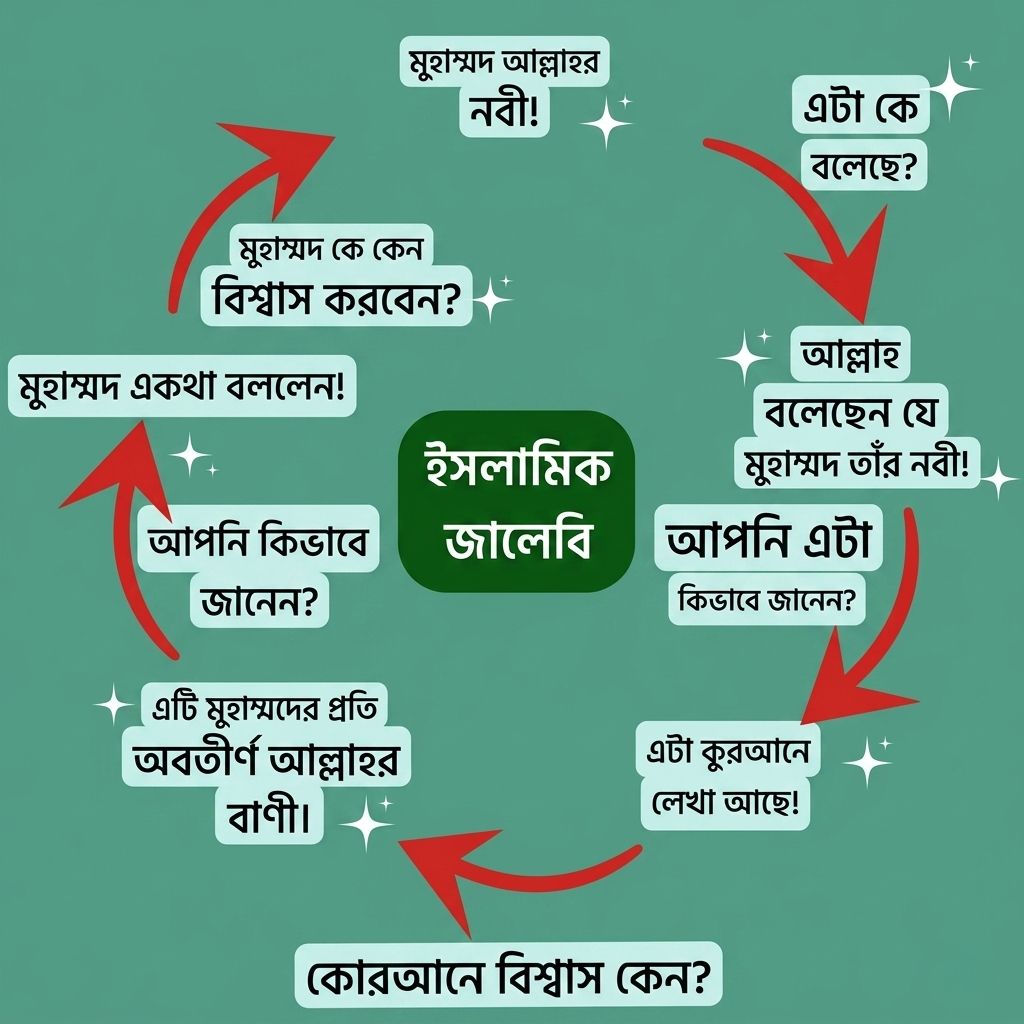
1. Circular Reasoning: The Qur’an is true because the Qur’an says so
– What is the proof that Islam is the only true religion?
– Because it is stated in the Qur’an.
– What is the proof that the Qur’an is true?
– Because the Qur’an is the word of Almighty Allah.
– What is the proof that the Qur’an is Allah’s word?
– Because Allah Himself says so in the Qur’an.
Circular Reasoning is a logical fallacy where the argument used to prove a claim already assumes that the claim is true. In other words, the conclusion is taken as a premise.
“Alif Lam Meem. This is the Book about which there is no doubt, a guidance for the righteous.” — Qur’an 2:2
Here, the book itself claims that it contains no doubt. But without external evidence, self‑assertion cannot prove truth. Elsewhere (4:82), it is said that the Qur’an is divine because it contains no contradictions—but this claim too is made by the Qur’an itself. Critics argue that truth must be proven from external sources, not self‑claims. If I write a book and claim inside it that I am the greatest human being on earth, would that be logical? If someone asks for proof, I cannot simply say, “Look, it’s written in my book.”
2. False Dichotomy: Either believe, or go to hell
When all possibilities are ignored and only two options are presented, it is called a False Dichotomy.
“He is the One who created you; among you are disbelievers and among you are believers.” — Qur’an 64:2
According to the Qur’anic author, all humanity is divided into only two groups: believers and disbelievers. Critics argue that this ignores the reality of diverse religions, philosophies, and morally upright non‑religious truth‑seekers. Think about it: a friend asks you, “Have you stopped drinking alcohol?” without even knowing whether you ever drank in the first place. Your friend is defining you as a drunkard by default.
3. Appeal to Fear: Obey, or burn forever
Using fear instead of reason to gain compliance is called Argumentum ad Baculum or Appeal to Fear.
“Those who disbelieve and deny My revelations—they are the inhabitants of Hell, where they will remain forever.” — Qur’an 64:10
Here, instead of addressing the reasoning behind disbelief, fear of punishment is used. Truth must be proven, not enforced through threats.
Almost everything in Islam is taught through fear. Children are taught that lying is a sin, stealing is a sin, disrespecting others is a sin, and Allah will send them to hell for these. But they are not asked why, as human beings, they should avoid these actions. If children understood the moral reasons, they would avoid wrongdoing out of conscience. That is why you will see that many major corrupt individuals and predators are outwardly religious. Religion does not change them. They only pretend to be good out of fear of Allah, but internally they remain potential criminals. If you would commit wrongdoing unless Allah punished you, what kind of person are you? Where is your humanity or conscience? Yet Islam and the Qur’an rely on this culture of fear to keep people in line—something that does not work for honesty or civilization.
4. Special Pleading: Separate rules for the Prophet
When a rule applies to everyone except a particular person, it is called Special Pleading.
“O Prophet! We have made lawful for you… any believing woman who offers herself to the Prophet… This is only for you, not for the other believers.” — Qur’an 33:50
While ordinary Muslims have restrictions on the number of marriages, the Prophet is exempted. Critics see this as a clear example of special privilege and evidence of human authorship. If a country’s constitution gave special privileges to the lawmakers themselves, would that be a good law? And if such a law is supposedly from an all‑powerful being, questions will naturally arise.
5. Equivocation: Contradictory use of “People of the Book”
Using the same term with different meanings in different contexts is called Equivocation.
“Those who believe, those who are Jews, Christians… whoever believes in Allah and the Last Day… will have their reward.” — Qur’an 2:62
“O believers! Do not take Jews and Christians as friends.” — Qur’an 5:51
The same group of people is described as rewarded in one verse and forbidden in another. Critics point to this inconsistency. The Qur’an is said to have been preserved in the “Guarded Tablet,” yet verses appear to have been revealed as needed for the Prophet’s circumstances, and some verses were later abrogated. Is this realistic for a pre‑written eternal scripture?
6. Strawman: Misrepresenting Christian doctrine
A Strawman fallacy occurs when someone attacks a distorted or simplified version of an opponent’s argument.
“They have certainly disbelieved who say: Allah is the third of three.” — Qur’an 5:73
In reality, Christian Trinitarian doctrine does not claim three separate gods—it describes one God in three persons. Critics argue that the Qur’an attacks a misrepresentation of Christian belief. They say such doctrinal misunderstanding is unexpected from an omniscient deity. Not only this, but the Qur’an contains many inaccuracies about Christianity, Judaism, and Zionism, which challenge its claim of divine origin.
7. Self-Contradiction: No compulsion in religion, yet fight disbelievers
A self‑contradiction fallacy occurs when two statements from the same source contradict each other and cannot both be true.
“There is no compulsion in religion.” — Qur’an 2:256
“Fight those who do not accept what Allah and His Messenger have forbidden… until they are humbled and pay jizya.” — Qur’an 9:29
“No compulsion in religion” (2:256) and “fight them until they submit” (9:29) directly contradict each other, critics argue. Islamic scholars explain this through the doctrine of Naskh (abrogation). But critics ask: why would the eternal word of an omniscient God change based on circumstances? And this scripture was supposedly written long before creation and preserved in the Guarded Tablet!
8. Appeal to Ignorance: If you can’t imitate it, it must be divine
“Since there is no proof against it, it must be true”—this reasoning shifts the burden of proof onto others.
“If you are in doubt about what We have revealed to Our servant, then produce a surah like it.” — Qur’an 2:23
Critics argue that inability to imitate something does not prove divinity. Literary uniqueness does not equal divine origin. Can anyone perfectly imitate Rabindranath Tagore’s writing style? Every person has a unique style. Many say the Qur’an was written in the poetic style of Arab poets of that era and borrowed heavily from Christianity, Judaism, Zoroastrianism, and folklore. Even then, many people have written verses similar to Qur’anic style—but who decides whether they are “equal”? Today, even an AI model can generate similar verses. Does that prove the Qur’an is divine?
9. Ad Hominem: Calling critics blind and deaf
An ad hominem fallacy attacks the person instead of addressing their argument.
“Indeed, those who disbelieve—it is the same whether you warn them or not—they will not believe. Allah has set a seal upon their hearts and upon their hearing.” — Qur’an 2:6–7
Critics argue that instead of addressing skeptics’ arguments, the Qur’an dismisses them as inherently incapable of understanding. You will see Islamists using this tactic everywhere. Even under this article, many will comment: “You are illegitimate, you are ignorant, you are stupid, your mother…”—their most common tactic to silence criticism through insult.
10. Tautology: Allah guides whom He wills—because He wills
In this fallacy, the conclusion merely repeats the premise without adding new information.
“Allah misguides whom He wills and guides whom He wills.” — Qur’an 14:4
Critics argue that if Allah predetermines belief and disbelief, then punishing disbelievers is unjust. This explanation is problematic because it challenges either Allah’s infinite knowledge or human free will. According to Islamic doctrine, nothing happens without Allah’s will—not even my questioning the Qur’an’s truth. He will punish me for questioning, yet the very act of questioning is also determined by Him. In Islam, “Taqdeer” (predestination) is a major concept, and without accepting it, one cannot remain a Muslim. Now whether you want to call Allah a “taut” (one who repeats tautologies) is entirely up to you!
A brief note on the logic of criticism and counter‑arguments
So what do we see? The ten logical fallacies discussed above demonstrate that the Qur’an, being a human‑authored text, cannot sustain its proclaimed divine status without question. Is it even conceivable to raise such questions about a truly divine scripture? It is also true that Islam allows no room for questioning the Qur’an—anyone who wants to remain within Islam must accept everything blindly, without the slightest opportunity to ask questions. Islamists claim that every verse of the Qur’an must be understood through its context, background, and circumstances of revelation. But the question is: if that is the case, how can the Qur’an be a universal guide for all eras? Why would a divine scripture contain so many inconsistencies?
Related Posts

Operation Entebbe – the story of one night, and the Islamic execution suffered by Nazrul Islam and Sweety Akter
What can a state do to save the lives of its citizens abroad? Are thereRead More
অপারেশান এন্টেবে – এক রাতের গল্প এবং নজরুল ইসলাম ও সুইটি আক্তারের ইসলামি হত্যার শিকার হওয়া!
একটি রাষ্ট্র বিদেশে তার নাগরিকদের জীবন বাঁচাতে কী করতে পারে? এর কোন টেক্সটবুক উদাহরণ আছে?Read More
A random page from Muhammad’s self‑made book Qur’an and its unscientific statements
Sometimes I flip through random pages of Muhammad’s self‑made book Qur’an, and today this pageRead More
Comments are Closed