

Is rape less common in Islamic countries?
Why is rape reported more in America/Europe/Canada, and less in Saudi Arabia/India/Bangladesh?
Hundreds of marital‑rape complaints are officially recorded in Europe and America. Saudi Arabia does not even acknowledge the concept of marital rape. In Europe, even an unauthorized touch on someone’s body is recorded as sexual harassment. How many cases of sexual harassment or rape are officially recorded in Bangladesh or India? In Saudi Arabia, victims don’t even go to seek justice, because there are many documented cases where the victim herself was punished — even with the death penalty. Medical examination is not accepted in many countries; instead, four male witnesses must be produced, which is impossible. And in trying to make the impossible possible, which woman would risk her life?
Let’s start with India. Interestingly, in rape statistics per thousand people (2010), India ranks tenth among the ten lowest countries, with a rape rate of only 1.8%. But we all know the real picture in India is not that good. The positive side is that women there are relatively more independent, and in some states, quite empowered. Public awareness is also increasing. They do not blame women’s clothing; they blame the rapist and the culture of impunity. Millions of Indians take to the streets demanding justice, putting immense pressure on police and administration to ensure accountability. So why is the statistical rate so low? We’ll return to that — but first, a few words about the Saudi–US comparison.
Hundreds of thousands of female migrant workers have returned from Saudi Arabia and reported horrific experiences. They were raped daily by their employers, repeatedly; fathers and sons raped them together; groups of friends raped them; they were physically and mentally tortured — and even the women of those households did nothing to stop it. Thousands of Bangladeshi women who returned from Saudi Arabia have shared their cries and testimonies in the media; we have all seen these reports in mainstream news. Those who managed to escape said that those who couldn’t are living in a living hell. They want to survive; they want diplomatic intervention. Yet statistics claim there is no rape in Saudi Arabia — because none of these are recorded as rape. Many Saudi employers believe having sex with maids is their right, because they “bought” them, and Islam permits sex with slaves without requiring consent. Statistics also claim there is no rape in Bangladesh. Mu ha ha ha ha. Take a moment to laugh. Meanwhile, we all know the Western world is far more developed and safer, yet their statistics make it seem like they do nothing but rape.
Now let’s return to why these statistics are so distorted. The answer lies in capability, state structure, and women’s freedom. American statistics are reliable because American women are independent and empowered, and the state is competent in receiving complaints and delivering justice. In America, even if someone forces a sex worker, it is recorded; the sex worker gets justice. A wife can also go to court and receive justice for forced sex by her husband. American statistics therefore reflect reality and help policymakers take effective steps to reduce rape.
On the other hand, in Saudi Arabia, even a dying woman cannot go to a hospital alone without permission from her husband or male guardian. Police will arrest and punish her regardless of her condition — whether she is in labor or bleeding to death. So whether she is raped or assaulted, there is no opportunity to seek justice. Where will statistics come from? And even if a case somehow reaches the legal system, the law requires four male witnesses to prove rape. Where will a rape victim find four witnesses? And even if she does, the witnesses themselves face danger: they may be accused of not intervening or of looking at a woman without lowering their gaze. So who will testify and risk being beaten or punished? Since there are no witnesses, the blame shifts to the victim — followed by lashes, stoning, etc. In such an environment, who will seek justice? And statistics will proudly claim Saudi Arabia is rape‑free, while YouTube is full of videos of sexual abuse in Saudi Arabia. How many Bangladeshi women who return pregnant after being raped get justice? Has anyone? These thousands of cases remain hidden.
In Bangladesh, madrassas have a pandemic of child rape — some cases surface, most do not. Beyond that, the situation of rape and justice for women in Bangladesh and India is almost identical. Families or communities settle cases privately; police refuse to file cases; even if a case is filed, justice rarely happens. The Noakhali incident proved that the victim did not dare file a case. If the video had not gone viral, it would never have been counted. Do you really think the reality matches the few cases we hear about? And in this region, a rape victim is treated as the criminal — called a whore, a slut — so they don’t want to seek justice or even speak. As a result, statistics show zero rape in Bangladesh and only a few in India.
Rape in the United States is defined by the Department of Justice as: “Penetration, no matter how slight, of the vagina or anus with any body part or object, or oral penetration by a sex organ of another person, without the consent of the victim.”
If Bangladesh, India, or Saudi Arabia were to compile statistics using this definition, they would undoubtedly score full marks — without any doubt.
Related Posts

Why do Islamist clerics consider Bengali cultural festivals their enemy?
This year, unlike many previous years, the major Hindu religious festival Durga Puja in BangladeshRead More
ইসলামিস্ট মোল্লারা কেন বাঙালিদের আনন্দ উৎসবকে তাদের শত্রু মনে করে?
এবার বাংলাদেশে অন্যবারের তুলনায় বেশ শান্তিপূর্ণ, উৎসবমুখর পরিবেশে হিন্দু ধর্মের বড় ধর্মীয় উৎসব দূর্গাপূজা হয়েRead More
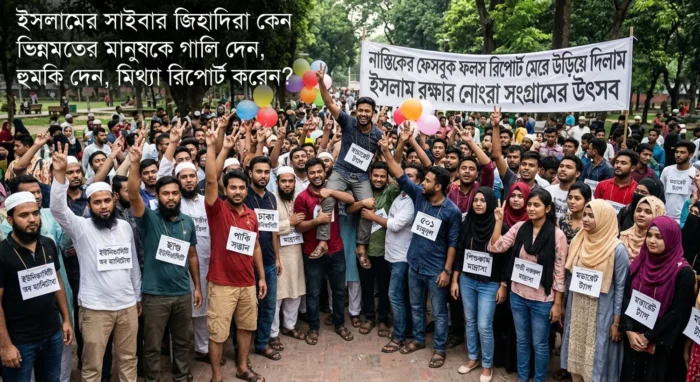
Why do Islamist cyber‑jihadis insult, threaten, and file false reports against people with different opinions?
Maulana Azhari once advised Islamists that sharing his Facebook posts is also an Islamic act;Read More
Comments are Closed