
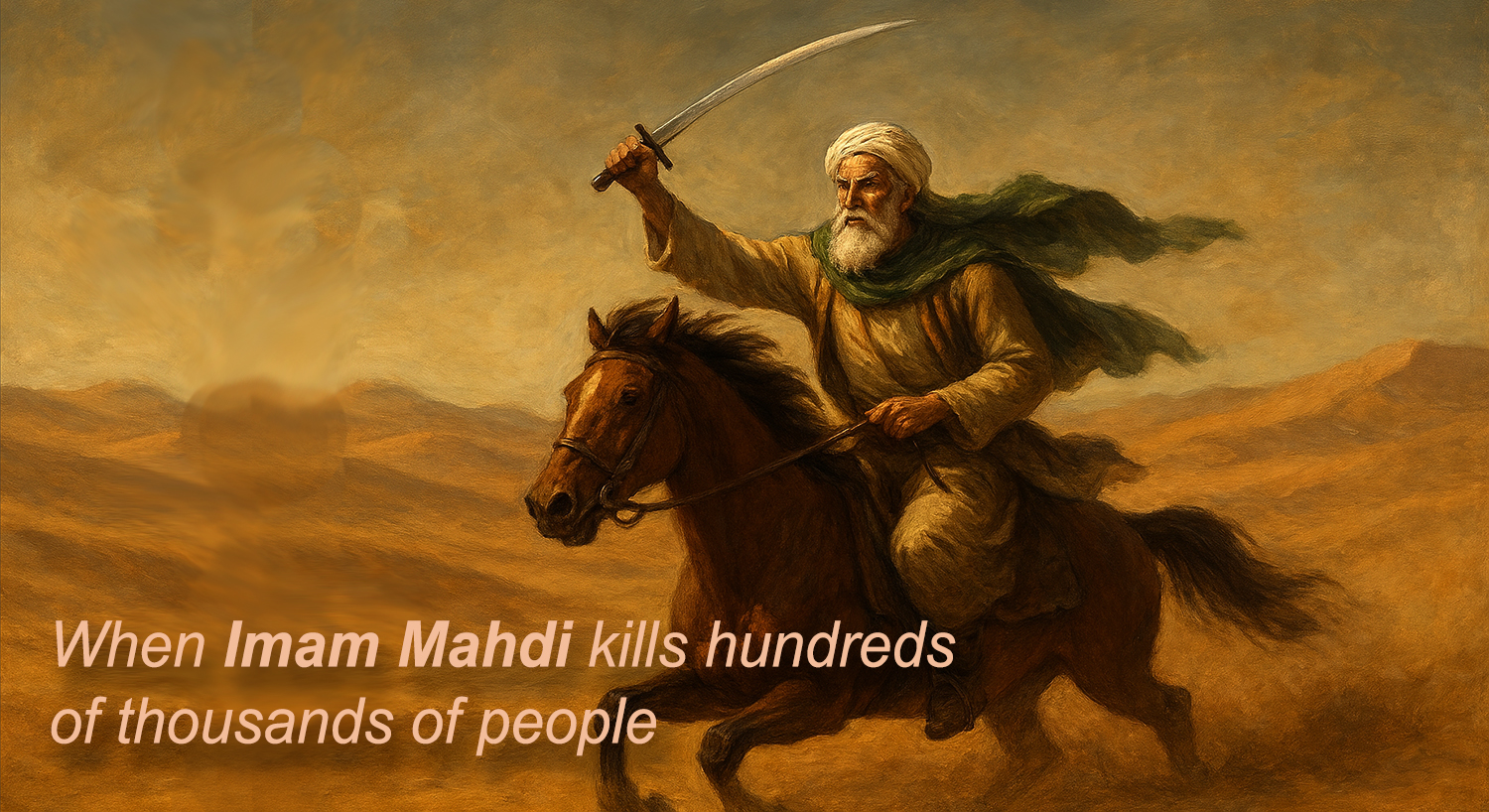
When the mythical Imam Mahdi becomes a killer
How a vanished 5‑year‑old Imam Mahdi from 1,200 years ago fuels mass killings in Iran
We know many things about Iran, but the most important truth that remains hidden from the eyes of ordinary people is this: the foundation of Iran’s state system stands on a theological myth. In the Shia Imami doctrine, the concept of the 12 Imams is well known. According to their belief, before the 11th Imam died, he hid his five-year-old son – Muhammad al-Mahdi – and that child “disappeared” at the age of five. This child, according to the Shia, is the 12th Imam, who has remained in occultation for 1,200 years and will one day return to establish justice.
Whatever one thinks of this as a religious belief, Iran’s real problem began when, after the 1979 revolution, Ayatollah Khomeini placed this religious concept at the center of the state structure. The Iranian constitution explicitly states that the state will be governed “by the representative of the Hidden Imam during his absence.” In other words, since the Imam is absent, the clerics will lead; the religious class will fill the leadership vacuum; and the highest representative of that class will be the Supreme Leader. In this way, a religious myth was transformed into the source of political power.
The result is the establishment of a long-lasting religious fascism over the people of Iran. The expectation of the return of a child who disappeared 1,200 years ago has been turned into state policy, and in the name of that expectation, unlimited power has been handed to the Supreme Leader. Whatever Khamenei says becomes the state’s law, policy, morality – everything. This strategy of turning religious emotion into a political weapon has mentally crippled a historically rich and intellectually advanced nation like Iran. Despite having vast natural resources, the country is economically devastated today.
Article 5 of Iran’s Constitution states:
During the period of occultation (absence) of ‘Hazrat Sahib-e-Zaman’ – that is, the Hidden Imam – the leadership and sovereign authority of the Islamic Republic of Iran shall be exercised by a Faqih (Guardian Jurist / Supreme Leader).
Here, “Lord of the Age,” “Sahib al-Zaman,” and “Hidden Imam” are all titles of the 12th Imam Mahdi.
In other words, the constitution directly declares:
- The Hidden Imam is currently in occultation
- In his absence, a Faqih will govern as his representative
- That Faqih is the Supreme Leader
The Preamble of the Constitution also states that the state has been established:
- As preparation for the return of Imam Mahdi,
- And that the current system represents him during his absence
(This part is frequently cited in scholarly sources, though not as directly quoted as Article 5.)
Articles 107–110 also describe matters related to this invisible Imam.
These articles outline the powers of the Supreme Leader — and their basis lies in the representation of the Hidden Imam described in Article 5. A myth, superstition, and religious blindness have thus produced the “legitimacy” for killing millions over the years.
The horror of this religious dictatorship becomes most evident in the judicial system. In the wake of recent protests, a man was arrested last Thursday, his trial concluded within five days, and then he was executed – this is the reality of Iran. The accused is not allowed to hire a lawyer, nor given the chance to defend himself. The charge? “Waging war against Allah.” Using such vague, emotionally charged religious terminology, the state can label anyone a traitor, apostate, or “mohareb.” In just a few days, more than 2,500 protesters have been killed, and hundreds more are being prepared for execution in the name of Islam. This process of granting religious legitimacy to state incompetence and terror is nothing short of a crime against humanity.
The reason the people of Iran today face such repression, devoid of freedom of speech and personal liberty, is this religious-political nexus – where religion is used as a tool to maintain power. Silencing the people, suppressing freedom of expression, imposing harsh restrictions on women, eliminating political opponents, executing protesters – everything is justified in the name of “protecting Islam.” In reality, it is nothing but the self-preservation of a power-hungry religious class that commits crimes against humanity day after day to maintain its authority.
The Iranian revolution once inspired people with dreams of freedom, but those dreams have been devoured by religious authoritarianism. Today, Iran is a state where life, liberty, and dignity all depend on the will of the Supreme Leader. A political structure built in the name of a child who disappeared 1,200 years ago has turned Iran into one of the most repressive states in the modern world.
When religion becomes the foundation of state power, it paralyzes human reason and judgment. Iran’s current condition is a brutal example of this – where religious myth, political authoritarianism, and state violence have merged into a terrifying machine of oppression. The victims of this machine are ordinary people – those who want freedom, justice, and human dignity. But Khamenei’s rule has taken those rights away from them.
The struggle of the Iranian people today is not merely political – it is a struggle for humanity. A struggle against religious fascism, against state terror, and against the darkness that has imprisoned an entire nation using a 1,200-year-old myth. Whether this struggle will ultimately determine Iran’s future – whether it will remain submerged in the darkness of dictatorship or find the light of liberation – remains to be seen.
Related Posts

Actresses Shabana, Moushumi, Popy – Religious Sentiment and the Politics of the Public Sphere
In the history of Bangladeshi cinema, names like Shabana, Moushumi and Popy mark important chapters.Read More
নায়িকা শাবানা, মৌসুমী, পপি – ধর্মানুভূতি এবং জনপরিসরের রাজনীতি
বাংলাদেশের চলচ্চিত্র ইতিহাসে শাবানা, মৌসুমী কিংবা পপির মতো নাম গুরুত্বপূর্ণ অধ্যায়। তারা আশি, নব্বই ওRead More
In Bangladesh, the very meaning of the “blasphemy” law is to find a new pretext for persecuting minorities
The attack on the house, shop, and temple of Deepto Roy in Tahirpur, Sunamganj isRead More
Comments are Closed