
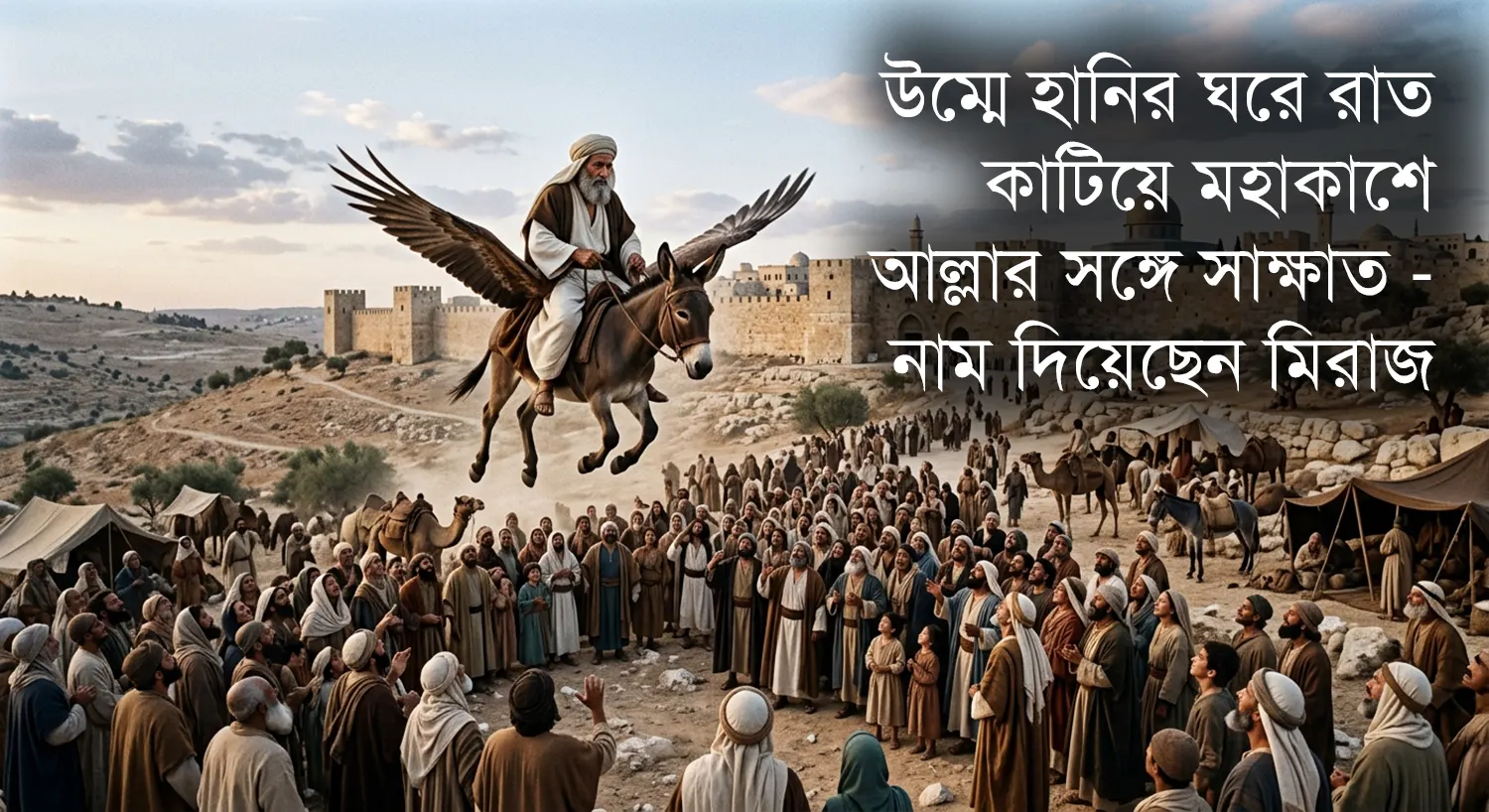
The story of Muhammad’s Mi'raj
Spending the night in Umm Hani’s house and then meeting Allah in the heavens – he named it Mi’raj
Mi’raj is a central event in Islamic belief. On the night of Mi’raj, the Prophet Muhammad could not be found. The companions became worried.
That night, to gather the strength for ascending to the heavens, the Prophet Muhammad also ate honey in the house of his childhood crush, Umm Hani—yet that honey was not just honey, it was primal, frenzied honey. Umm Hani was the Prophet’s cousin; Hani was Muhammad’s childhood crush. At one time the Prophet liked her. He proposed marriage to his uncle, but since Muhammad had no profession or social status, his uncle Abu Talib contemptuously rejected the proposal.
Umm Hani reports that on that night, that is, the night of Mi’raj, the Prophet was in her house! (Ibn Hisham, Volume One, pages 77–78). This is like a bombshell! Because Umm Hani was another man’s married wife. That night, Umm Hani’s husband was not in the house. When the companions could not find the Prophet, they searched and searched until they saw that he was in Umm Hani’s house! What was he doing there? How serious the matter was can be understood from Umm Hani’s frightened words. As soon as the Prophet left, she told her maid, “Go quickly and see what people say when they hear his (the Prophet’s) words.” (Ibn Hisham, Volume Two, page 77). Umm Hani testifies that that night the Prophet performed the Isha prayer at her house and then lay down to sleep. (Ibn Hisham, Volume Two, page 77). If you have a little intelligence, you can understand where the Prophet Muhammad actually was that night and what he was doing, behind the cover story of the Mi’raj tale.
You know, the Prophet Muhammad had the special ability to “download” Qur’anic verses on demand. When he was eager to marry his daughter-in-law Zaynab, and later when he wanted to sleep with her after the marriage, he downloaded one verse after another. On the day of that marriage, when a companion casually mentioned in conversation that after Muhammad’s death he would marry his child-bride Aisha, Muhammad became displeased and instantly “sent down” a verse prohibiting the marriage of his wives. Again, when Aisha and Safwan spent a night together in the desert and returned, Muhammad did not download any verses for a month; he had resentment and sorrow in his heart regarding Aisha. Anyway, Muhammad knew about the Zoroastrians, their various tales. Out of shame at his own lechery being exposed, he instantly narrated this story of Mi’raj to confuse the simple-minded companions.
Many Islamists claim that Muhammad was illiterate, that he could not have known the story of the Zoroastrian god Ardai Viraf’s journey into the heavens, thousands of miles away in Persia. It is true that from ancient times the Arabs have had little notable contribution in world history; they were receivers. Seventh-century Hejaz was not an isolated island. Mecca and Medina were junctions on trade routes where Jewish, Syriac Christian, Zoroastrian, Persian and Byzantine cultural influences regularly entered. Historians like Patricia Crone and Michael Cook have shown in their research that many of the early descriptions of Islam came from the shared oral traditions of the contemporary Middle East, which were not the exclusive property of any one religion.
John Wansbrough, using his literary-critical method, argued that many narratives in the Qur’an are deeply related to Jewish-Christian traditions (Midrash, Talmud, Apocrypha) and that they gradually took their present form through editorial processes. Tom Holland, in his popular histories, has shown how the religious environment of Late Antiquity—where apocalyptic imagination was at its peak—created the backdrop for the early narratives of Islam.
The similarities between Islamic prayer and the Zoroastrian ‘gah’ or ‘namaz’ are astonishing. Both religions have five daily prayers, and the times are determined according to the sun’s path. In both religions there are rules for attaining purity before prayer. The movements of prayer, wearing a cap, placing hands on the chest, the sermon, supplication—almost everything matches exactly. If you show Zoroastrian prayer to those who are unfamiliar with it, they will think it is Muslim prayer. You will find many videos on YouTube; you can take a look.
Ardai Viraf Namag was a Zoroastrian religious text from the Sasanian era, originally written in Middle Persian. It describes the dream-journey of the pious priest Ardai Viraf into the afterlife. The book is divided into five chapters—introduction, journey to heaven, paradise, hell, and conclusion. There are extremely striking similarities between the Islamic story of Mi’raj and the Zoroastrian account of Ardai Viraf’s journey to the hereafter, down to very subtle details. In both stories, a pious person travels through heaven and hell, seeing the rewards of the righteous and the punishments of sinners. Many say that the Prophet Muhammad already knew this story of Ardai Viraf. After spending the night in the house of his childhood crush and cousin Umm Hani in the absence of her husband, and being caught by the companions in the morning, he concocted this tale.
The beginning of this story, however, is not purely Zoroastrian. The motif of Mi’raj has similarities with many ancient Near Eastern stories of journeys through heaven and hell, but it is difficult to be certain who influenced whom. Plato’s Republic contains the “Myth of Er” (the soul’s journey after death), Virgil’s Aeneid has a descent into the underworld, and the myth of the winged horse Pegasus is often brought into comparison. Since the wings of Buraq are a later addition, it is difficult to prove a direct link with Pegasus. The Book of Enoch, the Ascension of Isaiah, the Apocalypse of Paul and Jewish Hekhalot literature—all of these contain themes of seven heavens, angelic guides and tours of heaven and hell, and geographically and culturally they were closer to Muhammad’s region. Many researchers, including Horovitz, have pointed more in this direction. In the Middle Ages, descriptions of Mi’raj were translated into Latin (Liber Scale Machometi). Asín Palacios showed a connection between Dante’s Divine Comedy and Islamic Mi’raj literature, though this view is debated. The motif of time standing still is also found in other traditions, such as the Jewish story of Honi Ha-Ma’agel or the Qur’anic tale of the Companions of the Cave.
Why Muhammad was in Umm Hani’s house that night is not clearly explained in Islamic sources; this is where you have to draw your own conclusions. In Ibn Ishaq’s Sirah, Umm Hani’s description is as follows:
- Muhammad performed the Isha prayer in her house, then slept, and before Fajr he woke them up.
- After Fajr he said that after praying Isha there, he went to Bayt al-Maqdis, prayed there, and now had returned to pray Fajr.
- When Umm Hani grabbed his cloak, he said that she should not tell people, because they would not believe it.
The reasons that are given, such as kinship ties or maintaining contact with the family after Abu Talib’s death, are mere conjecture.
Within the sources themselves there is disagreement about the location, date and reliability of the narrators.
- Location: In some narrations in Sahih Bukhari, Muhammad was near the Kaaba (in the Hatim or Hijr) in a state between sleep and wakefulness. Other narrations mention Shi’b Abi Talib or Umm Hani’s house.
- Date: Various times are mentioned, from one to five years before the Hijra.
- Chain of transmission (isnad): This narration of Ibn Ishaq comes through Muhammad ibn al-Sa’ib al-Kalbi. Hadith critics have called him weak or unreliable.
- Time of conversion to Islam: According to Sirah sources, Umm Hani accepted Islam at the time of the conquest of Mecca. Yet in the narration she is shown praying Fajr with Muhammad on the night of the event. Some see tension between these two pieces of information.
In the combined form of Bukhari, Muslim and later compilations, the sequence of events is roughly as follows:
- Jibril takes Muhammad from Mecca to Bayt al-Maqdis on a mount called Buraq (“Isra”).
- There, prayer is held with the prophets, and in some narrations Muhammad leads the prayer as imam.
- Then comes the ascent (“Mi’raj”): in the seven heavens he meets Adam, Yahya and Isa, Yusuf, Idris, Harun, Musa and Ibrahim.
- He sees Sidrat al-Muntaha and Bayt al-Ma’mur.
- Fifty daily prayers are initially prescribed. On Musa’s advice, Muhammad repeatedly petitions until they are reduced to five daily prayers.
- He visits Paradise and Hell. In one narration in Bukhari (from Ibn Abbas), Muhammad sees that most of the inhabitants of Hell are women, and the reason given is their ingratitude toward their husbands.
There are three notable differences between the popular story and the source texts:
- The winged horse: In the authentic hadith, Buraq is a white creature, smaller than a mule and larger than a donkey. The wings and human face are later additions from popular tradition and art.
- Meeting Allah: According to narrations from Aisha, she denied that Muhammad saw Allah directly (in her view, he saw Jibril). Ibn Abbas, however, said that Muhammad saw Allah “with his heart” or with his eyes. Many mainstream scholars speak of conversation and vision rather than a direct “meeting.”
- Time standing still: Descriptions like “the bed was still warm” are not found in authentic works. These appear in later popular tales.
Almost the entire full story comes from hadith and Sirah; the Qur’an contains two brief allusions.
- Surah Isra (17:1): Allah made “His servant” travel by night from Masjid al-Haram to Masjid al-Aqsa. There is no mention here of Buraq, the name Jerusalem, or details of the ascent.
- Surah Najm (53:1–18): There is mention of a vision near Sidrat al-Muntaha. Even here, the word “Mi’raj” or a sequential narrative is not present.
Researchers such as Josef Horovitz, Neal Robinson and Angelika Neuwirth highlight three particular points.
- What is “al-Aqsa”: In Muhammad’s time there was no mosque in Jerusalem. The present Al-Aqsa Mosque was built in the Umayyad period (late 7th and early 8th century). Some researchers think that in the verse, “the farthest place of worship” may have originally referred to a heavenly location, and the connection with Jerusalem was strengthened later. Mainstream Muslim scholars reject this view.
- Physical or spiritual: Even among early Muslims there was debate about this. According to narrations from Aisha and Mu’awiya, Muhammad’s body did not leave; his soul traveled. Similar views are found from Hasan al-Basri. Later, most mainstream scholars accepted the view of a physical journey.
- Layering of the narrative: The detailed parts differ between Ibn Ishaq, Bukhari and Muslim. Researchers see in this the possibility that the story expanded over time.
Indications from the sources
These are bibliographic references given from memory; publication years and page numbers should be verified.
- Ibn Ishaq/Ibn Hisham, As-Sirah an-Nabawiyyah
- The Isra and Mi’raj chapters in Sahih Bukhari and Sahih Muslim
- Josef Horovitz, Muhammeds Himmelfahrt
- Asín Palacios, La Escatología Musulmana en la Divina Comedia
- Ignaz Goldziher, Muhammedanische Studien (regarding Jerusalem and Umayyad politics)
- The “Mi’radj” and “Isra’” entries in the Encyclopaedia of Islam
Related Posts
উম্মে হানির ঘরে রাত কাটিয়ে মহাকাশে আল্লার সঙ্গে সাক্ষাত – নাম দিয়েছেন মিরাজ
মিরাজ ইসলামি বিশ্বাসের একটি কেন্দ্রীয় ঘটনা। মিরাজের রাতে নবী মুহাম্মদকে পাওয়া যাচ্ছিল না। সাহাবীরা চিন্তায়Read More

The 72 full‑breasted, personality‑less houris of Paradise vs. the personality‑rich cherished women of the world! What do you want?
It is said that in Paradise a believing servant will receive 72 exquisitely beautiful houris;Read More
জান্নাতের ৭২ উন্নতবক্ষা ব্যক্তিত্বহীন হুর বনাম দুনিয়ার ব্যক্তিত্ববান শখের নারী! কী চান?
বলা হয় জান্নাতে মুমিন বান্দা ৭২ জন অপূর্ব সুন্দরী হুর পাবেন, তারা হবে চিরযৌবনা, চিরকুমারী।Read More
Comments are Closed