
The Protocols - the Muslims
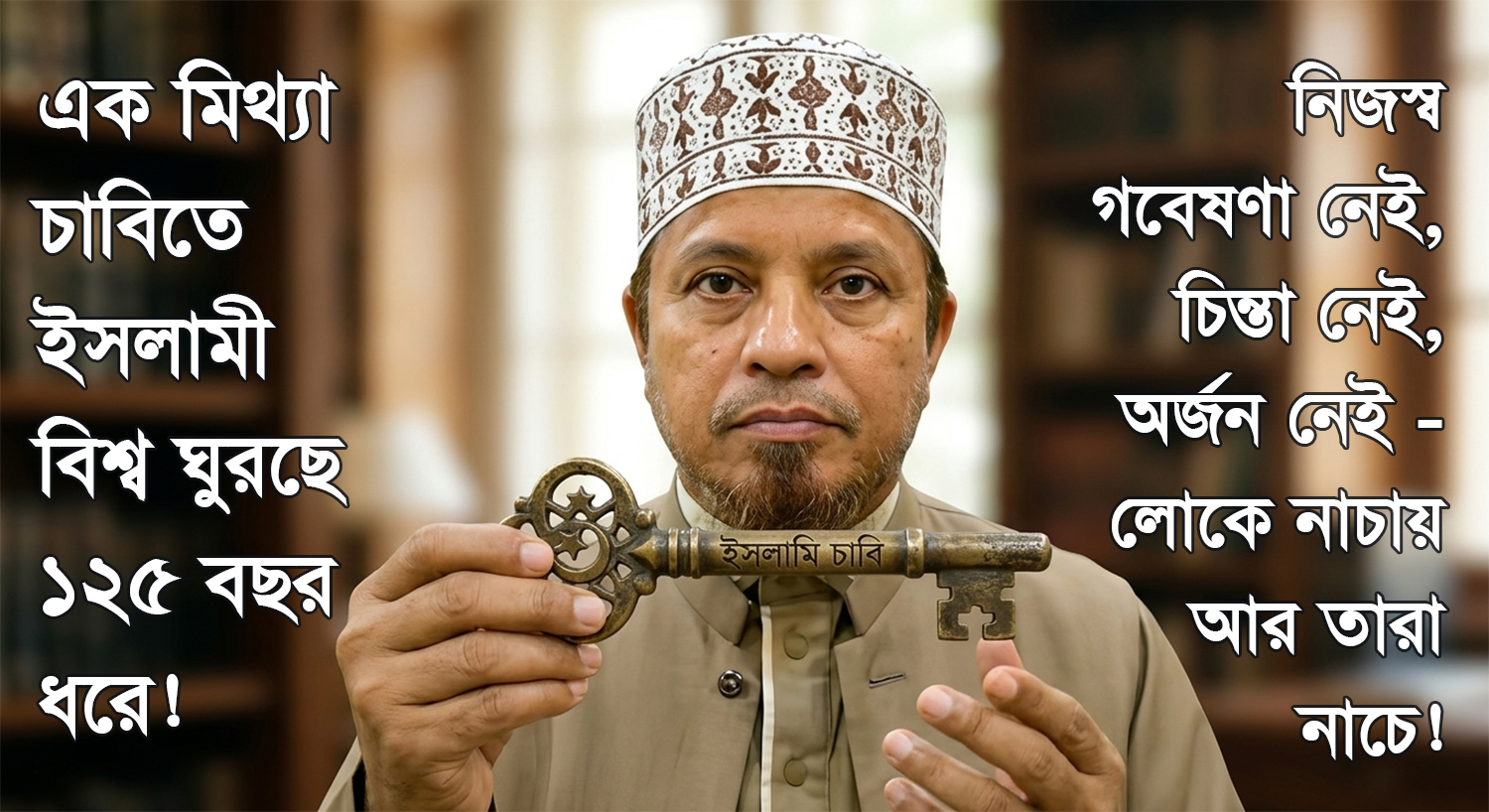
For 125 years, the Islamic world has been spinning on the basis of a single false key!
Once I was listening to a sermon by Professor Mufti Kazi Ibrahim Huzur where he spoke about the “Rothschild Brothers.” According to his sermon, this influential Jewish family of Europe controls all global politics and economics, and their main target is Muslims; he claimed they are responsible for all unrest in the world, that they worship Satan, and so on. Even though many people do not take Mufti Ibrahim seriously or consider his words humorous, his position in Bangladesh’s Islamic sphere is very high. He is a teacher of major scholars, muftis, and muhaddiths. Because of that, no scholar considers his words as a joke—they take them seriously. The sad part is that many Muslim scholars, politicians, and ordinary Muslims around the world have accepted this theory. Religious hostility toward Jews exists in the Qur’an and Hadith, and when this misinformation is added to it, many Muslims have learned to permanently hate Jews, and some even wish for their destruction.
Mufti Kazi Ibrahim is a highly influential religious authority, and listeners naturally believe his words without verification. But when we trace the source of this belief, we find an astonishing truth—it is not the product of any independent observation or research within the Muslim world, but rather an imported version of a political forgery created 125 years ago in Tsarist Russia. In other words, 125 years ago Russian intelligence created a proven fake document to protect the interests of their Tsar—and that document still controls the minds of millions of Muslims today. Russia handed over the key, and the Muslim world is still spinning in that vortex.
Let us see how a proven forged document called “The Protocols of the Elders of Zion” entered the Arab world from Russia, how it merged with Islamic political movements, and how it remains today a permanent source of anti‑Jewish sentiment in the Muslim world, including Bangladesh.
The birth of the Protocols: A proven state forgery
There is broad consensus among historians and researchers that the Protocols is a completely fabricated document. Scholars generally agree that the Russian Empire’s secret police, the Okhrana, created this text in the late 1890s or early 1900s.
The method of forgery is also clear. Historians agree that it was plagiarized from earlier French political satire and fiction—especially Maurice Joly’s 1864 work “Dialogue in Hell Between Machiavelli and Montesquieu.” Elements were also taken from an obscure 1868 German novel, “Biarritz,” which contained a fictional description of mysterious Jewish leaders meeting in a Prague cemetery.
According to research from Brandeis University, the Okhrana—meaning “protection” in Russian—operated under one of Europe’s most strongly antisemitic regimes and intended to use this forgery to discredit revolutionary forces opposing the Tsar’s reactionary policies.
According to the Jewish Virtual Library, there is also clear information about the individual behind the forgery: Pyotr Ivanovich Rachkovsky, head of the Okhrana’s Paris branch, personally planned bomb attacks and then foiled them, arranged assassinations of personal enemies, and published anonymous pamphlets which he then used as “evidence” of revolutionary activity.
The baselessness of this document is not only the conclusion of modern research—it has also been proven judicially. In the 1935 Bern trial, Christian judge Walter Meyer stated in his ruling that he hoped a time would come when no one would believe that in 1935 nearly a dozen sane and responsible people spent two weeks insulting the intelligence of the Bern court by debating the authenticity of the so‑called Protocols—when in fact the Protocols, though harmful, were nothing more than ridiculous nonsense.
In a 1961 U.S. Senate committee hearing, CIA Deputy Director Richard Helms clearly stated that the Russians had a long tradition of forgery—more than 60 years earlier, the Tsar’s intelligence service had created and distributed a fraud called “The Protocols of the Elders of Zion.”
In short: this is not speculation or a one‑sided claim—over a century of independent research, journalism, and court rulings have repeatedly proven this document to be a forgery. Yet this proven falsehood is still promoted in the Muslim world as a “hidden truth of history.”
From Russia to the Arab world: The migration of a forgery
There is a clear historical trail showing how this document transformed from an internal Russian political tool into part of the religious‑political discourse of the Muslim world.
According to the New World Encyclopedia, the first Arabic translations were made from French by Arab Christians—the first appeared in 1926 in a Jerusalem Roman Catholic community periodical. Another translation was published as a book in Cairo in 1927 or 1928. The first translation by an Arab Muslim was published in Cairo in 1951.
According to the Holocaust Encyclopedia, an Arabic translation was already available in Syria by 1925.
But the real explosion occurred after 1948. According to Wikipedia, after the establishment of Israel in 1948 and the spread of anti‑Israel sentiment across the Middle East, many Arab governments funded new editions of the Protocols and began teaching it in schools as historical fact.
In other words, it was not just fringe propaganda—it was inserted into the educational system at the state level. According to MEMRI research, over the past half‑century the Protocols has likely been published and distributed in the Arab world more than in any other region. There are now at least nine different Arabic translations—more than in any language except German—and it has spread to Pakistan, Malaysia, Indonesia, and other Muslim countries. In Syria, it is a bestseller.
According to My Jewish Learning, the situation today is even clearer: from Iraq to the Palestinian territories, from Egypt to Iran, from Turkey to Indonesia—there is not a single Muslim country where the Protocols has not been published or distributed in recent years. According to the World Jewish Congress, a 2002 Arabic edition published by Egypt’s major publishing house Akhbar al‑Yawm listed 37 countries to which it was exported—including Germany, the UK, France, and even the United States.
Notably: this belief is not limited to extremist Islamist groups. According to researcher Carmen Matussek of the World Jewish Congress, the popularity of the Protocols in the Arab world is not confined to Islamists—belief in a global Jewish conspiracy has become a feature of mainstream historical and political consciousness in much of the Middle East. In other words, this poisonous tree has taken root not only in madrasas or mosque pulpits, but also in general education, media, and politics.
Transformation into a religious narrative: How a political forgery became “religious truth”
In its early entry into the Arab world, the Protocols was primarily political propaganda—a tool of anti‑Zionist nationalist movements. But over time it merged with religious discourse, taking on a new form that made it more permanent and deeply rooted.
According to the work of researcher Matthias Küntzel, in the 1930s and 40s Egypt’s Muslim Brotherhood adopted conspiracy‑centered antisemitism from European fascist ideology and fused it with Islamic theological frameworks. The most notorious example of this process was Haj Amin al‑Husseini, the Mufti of Palestine, who traveled to Berlin in 1941, met Hitler, and actively assisted the Nazi war effort.
The mature form of this fusion appears in the 1988 Hamas Charter, where the conspiracy theories of the Protocols are directly linked with religious texts—portraying Jews as the driving force behind the French Revolution, both World Wars, and even the founding of the United Nations. My Jewish Learning confirms that Hamas, which now governs Gaza, incorporated parts of the Protocols into the actual articles of its charter.
Thus, what began as a political maneuver by a European secret police gradually—and dangerously—acquired the status of “religious truth” for many. This is where the depth of the problem lies: when a political forgery becomes intertwined with religious emotion, questioning it becomes far more difficult—because the questioner is then seen not merely as someone who “believes false information,” but as someone who “casts doubt on religion.”
Why has this falsehood lived so long?
Brandeis University historian Stephen Whitfield offers an important explanation for this longevity: what sustains the Protocols is not the language of the text—most extremists have never read it in full—but the idea it implies, namely the notion of the Jews’ astonishingly subtle influence in modern history. The document itself has no value, because it is fake—but it gives a specific shape to a vague fear, without which that fear could not survive.
In other words, people already harbor a kind of distrust, resentment, or unexplained political frustration—the Protocols gives that a “name” and “proof.” The Arab–Israeli conflict, colonialism, economic backwardness—these complex realities are given a simple, one‑word answer by the Protocols: “Jewish conspiracy.” In the words of My Jewish Learning, the Protocols provides a way to blame Zionism for all problems in Arab lands, excuses for Arab military defeats, and an explanation for their slow economic development.
This is the real dangerous power of this falsehood—it provides simple answers to complex questions, and those simple answers are memorized generation after generation, without question.
The Bangladeshi context: Localizing an imported myth
The claim about the Rothschild family in the sermon of an influential scholar, and its unquestioned acceptance, is simply a local version of a much larger global pattern. This pattern operates on several levels:
First, hierarchical authority. In religious education systems, knowledge often flows from top to bottom—the student usually accepts the teacher’s words without verification. When a high‑ranking mufti or teacher of hadith makes a claim, scholars below him may find it not only intellectually but socially risky to challenge it.
Second, compatibility with pre‑existing frameworks. Since a religious‑political narrative already exists (related to specific parts of history, such as the complex medieval Arab–Jewish relationship), a “modern proof” like the Protocols easily fits into that framework—it does not feel new, but rather like a “confirmation” of old beliefs.
Third, lack of verification. Many listeners lack the habit or opportunity to verify claims about the Protocols or the Rothschilds against mainstream historical research, journalism, or court rulings—especially when the sources of information are Arabic or Urdu‑language religious literature, which remain outside the reach of mainstream Western or English‑language scholarship.
A fake document, a real harm
The historical record regarding the Protocols of the Elders of Zion is completely clear—it is a proven forgery created by the Tsar’s secret police in Russia, later used by Nazi Germany, and which still survives today as one of the major sources of global antisemitism.
But despite the forgery being conclusively proven, its influence has not disappeared—because it is no longer just a text; it has become part of a belief‑structure intertwined with political frustration, colonial history, and in some cases religious narratives. Breaking it apart is therefore not simply a matter of saying “this is false”—it requires understanding the true historical origins and having the courage to question claims even when they come from someone sitting in a position of unquestioned authority.
Selected References:
- ADL, “A Hoax of Hate: The Protocols of the Learned Elders of Zion”
- US Holocaust Memorial Museum, Holocaust Encyclopedia
- MEMRI, “A European Plot on the Arab Stage: The Protocols of the Elders of Zion in the Arab Media”
- My Jewish Learning, “Protocols of the Elders of Zion”
- World Jewish Congress, analysis by Carmen Matussek
- Matthias Küntzel, Jihad and Jew-Hatred (2007)
- Brandeis University, interview with Stephen Whitfield
Related Posts

অপারেশান এন্টেবে – এক রাতের গল্প এবং নজরুল ইসলাম ও সুইটি আক্তারের ইসলামি হত্যার শিকার হওয়া!
একটি রাষ্ট্র বিদেশে তার নাগরিকদের জীবন বাঁচাতে কী করতে পারে? এর কোন টেক্সটবুক উদাহরণ আছে?Read More
A random page from Muhammad’s self‑made book Qur’an and its unscientific statements
Sometimes I flip through random pages of Muhammad’s self‑made book Qur’an, and today this pageRead More
মুহাম্মদের বানানো কোরআন বই এর একটা র্যান্ডম পৃষ্ঠা ও সেখানকার অবৈজ্ঞানিক বক্তব্য
আমি মাঝে মাঝে মুহাম্মদের বানানো কোরআন বই এর র্যান্ডম পৃষ্ঠা উল্টাই, আজ এই পৃষ্ঠা হাতেRead More
Comments are Closed