
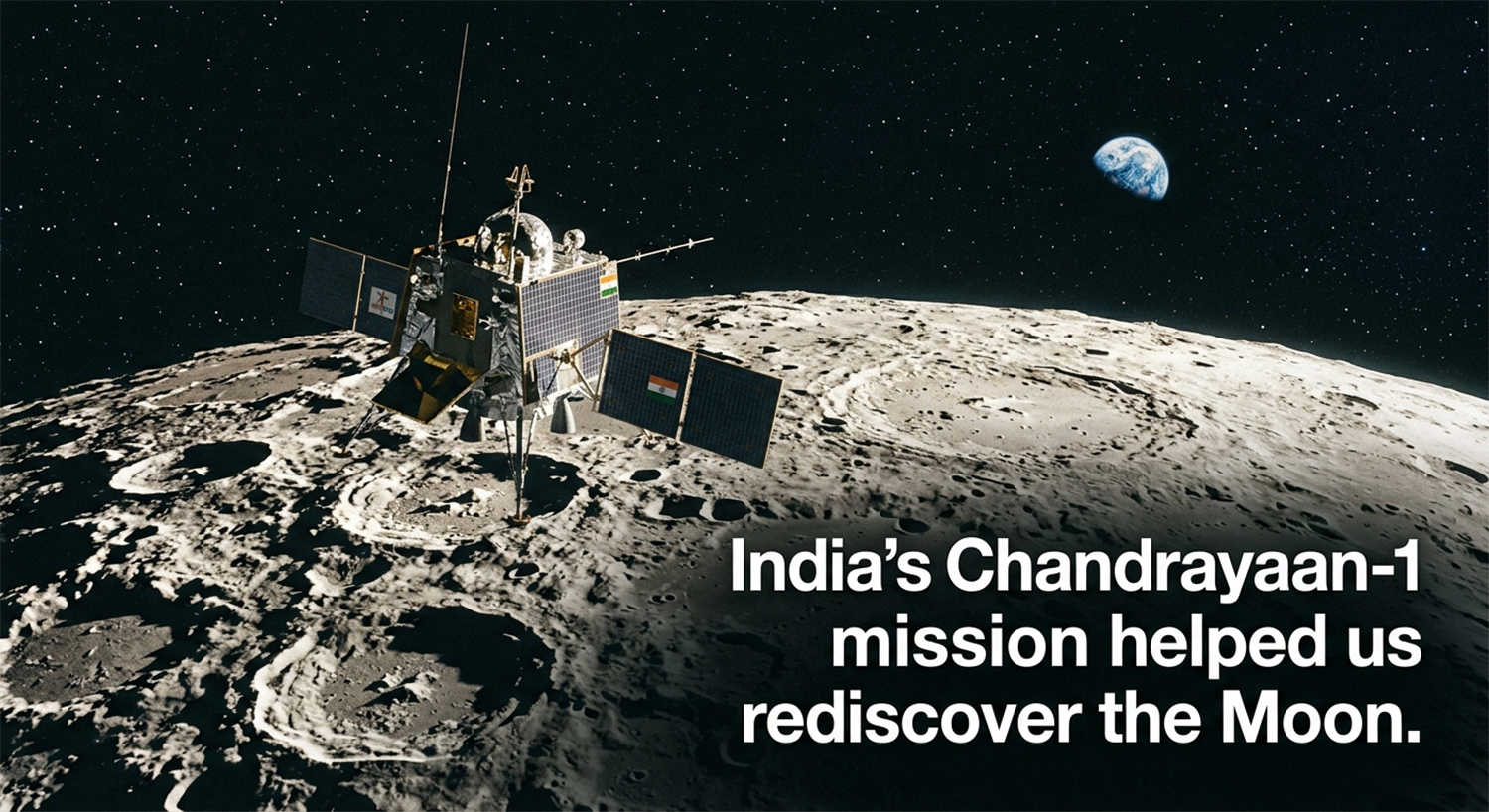
The Legacy of Chandrayaan‑1
From Chandrayaan‑1 to Artemis: Humanity’s New Journey of Dreams to the Moon
NASA, the United States space research agency, is sending humans back to the Moon with the Artemis-2 mission, 53 years after the Apollo 17 mission of 1972. Although this mission is American, the Indian people are also proud partners in this glory and progress. Many Indians may not even know how their country’s taxpayers’ money has contributed to opening new horizons in space, especially on the Moon. How an Indian mission has propelled humanity back toward the Moon after five decades — let’s find out.
Pay attention to the timeline of some important lunar missions
1969 —– Apollo 11
1972 —– Apollo 17
2008 —– Chandrayaan-1
2023 —– Chandrayaan-3
2026+ — Artemis-2
The context of returning to the Moon after a 53-year hiatus
When the Apollo 17 astronauts left the lunar surface for the last time in December 1972, no one imagined that Earth would have to wait more than five decades for the next human lunar mission. The Cold War ended, the Soviet Union collapsed, the Internet arrived, smartphones arrived — but humans never set foot on the Moon again. Political interest waned, budget constraints emerged, and the new dream of a Mars mission turned the Moon into something of an “old story.”
But in 2008, India sent a small, relatively low-budget spacecraft into lunar orbit — Chandrayaan-1. That mission not only added a new chapter to the history of Indian space science, but also presented a discovery to scientists around the world that fundamentally changed all prevailing notions about the Moon. That discovery was the definitive proof of the existence of water on the lunar surface.
In this article, we will analyze — why and how Chandrayaan-1 ignited new interest in the Moon among people, the scientific and political significance of that discovery, and how, as a result, humans are once again heading toward the Moon through the Artemis program after 53 years.
Chandrayaan-1: Introduction to a Historic Mission
Chandrayaan-1 was the Indian Space Research Organisation (ISRO)’s first lunar mission. On 22 October 2008, the spacecraft embarked on its journey into space aboard the PSLV-C11 rocket from Sriharikota, Andhra Pradesh. Built on a budget of just 386 crore rupees (approximately 80 million USD), Chandrayaan-1 was India’s most ambitious space project at the time.
- 1,380 kg weight at launch
- 100 km altitude from the Moon in orbit
- 11 scientific instruments — from India, Europe, and America
- The spacecraft remained active for 312 days (initial target was 2 years)
- Sent over 70,000 images of the Moon back to Earth
- Only 80 million USD total budget — extremely low compared to NASA
Along with Indian instruments, Chandrayaan-1 also carried several instruments from the European Space Agency (ESA) and NASA. This international collaboration turned the mission into a joint effort not just for India, but for the global scientific community. Among them, the most important was NASA’s Moon Mineralogy Mapper (M3) instrument, which would later change history.
The Epoch-Making Discovery: Proof of Water on the Moon
“The Moon is dry, dead, and uninhabitable — this long-held notion no longer holds after 2008. Chandrayaan-1 has cracked the foundation of that belief.”
The biggest and most historic discovery of Chandrayaan-1 was the proof of the presence of water molecules on the lunar surface. In a research paper published in the journal Science in September 2009, scientists analyzing data from NASA’s M3 instrument showed the presence of hydroxyl (OH) and water molecules (H₂O) on the Moon’s surface. Not only that, there is a strong possibility of vast amounts of water stored in the form of ice in the permanently shadowed craters at the Moon’s south pole.
Major Discoveries of Chandrayaan-1
💧 Water molecules on the lunar surface
Using the M3 instrument, hydroxyl and water molecules were detected in the lunar soil — this was a landmark moment in space science.
🌑Possibility of ice at the south pole
The Moon Impact Probe (MIP) reached the Shakleton Crater region at the south pole and sent back data indicating the presence of ice in permanently shadowed craters.
🪨Lunar geological map
A high-resolution three-dimensional map of the lunar surface was created, which is invaluable for planning future missions.
☢️Measurement of radiation on the lunar surface
The level of solar radiation on the Moon’s surface was determined, which will help in planning the safety of astronauts in future human missions.
🔬Distribution of minerals
Detailed maps of various minerals including aluminium, silicon, magnesium, iron, calcium, and titanium were created, which are important for future resource extraction.
Why is this discovery of water so important? Because if humans want to establish long-term bases on the Moon, water was the biggest obstacle. Carrying water from Earth is so expensive that it is practically impossible. But if water exists on the Moon itself, the equation changes completely. Not only drinking water — oxygen can be extracted from that water for breathing, and hydrogen can be used as rocket fuel. In other words, the Moon can become a “fuel station” for humanity’s journey deeper into the solar system.
Scientific and Political Impact: The Birth of a New Space Race
Chandrayaan-1 and its subsequent discoveries created big waves not only in the world of science but also on the political stage. Because the Moon is no longer just a romantic destination — it has become a strategic resource.
After the success of Chandrayaan-1, major space powers turned their attention to the Moon with renewed interest. China landed a rover on the Moon with Chang’e-3 in 2013. In 2019, Chang’e-4 landed on the far side of the Moon — a first in history. Japan, Europe, and the United Arab Emirates all began planning lunar missions. Suddenly, the world’s major powers realized that control over the ice at the Moon’s south pole could be the key to future space dominance.
| Feature | Chandrayaan-1 (2008) | Artemis (2026+) |
|---|---|---|
| Objective | Scientific survey from orbit | Human landing, long-term base |
| Budget | ~80 million USD | 93+ billion USD (estimated) |
| Participating countries | India + ESA + NASA | NASA + ESA + Japan + Canada + others |
| Destination | Orbit (100 km altitude) | Moon’s south pole |
| Main inspiration | Scientific prestige and technology demonstration | Water resources, base establishment, foundation for Mars |
| Main driving force | Chandrayaan-1’s discovery | Legacy of Chandrayaan-1 |
China’s rapid space progress particularly shook the United States. In 2017, NASA prepared the initial framework for the Artemis program, and in 2019 the Trump administration announced that America would send humans back to the Moon by 2024. Although the timeline has since slipped, the goal remains unchanged. If one traces the roots of this competition, Chandrayaan-1’s water discovery can be identified as an important turning point.
Chandrayaan-3 and India’s Historic Landing
Encouraged by the success of Chandrayaan-1, India sent Chandrayaan-2 (2019) and then Chandrayaan-3 (2023). On 23 August 2023, the Vikram lander of Chandrayaan-3 successfully landed in the south polar region of the Moon — the first time any country has achieved a successful landing in this region. This was the culmination of the path drawn by Chandrayaan-1.
The Pragyan rover of Chandrayaan-3 examined the soil of the south polar region and confirmed the presence of several elements including sulphur, aluminium, and iron — further strengthening the possibility of water ice. This landing reminded the world that the Moon’s south pole is the future battlefield, and Chandrayaan-1 had written the declaration of that war.
Artemis: Human Return to the Moon Inspired by Chandrayaan-1
The Artemis program is the successor to Apollo — but with a completely different purpose. Apollo was a mission to plant a flag and return. Artemis aims to create a sustained human presence on the Moon, build a Lunar Gateway orbiting station, and from there open the path to Mars one day.
Phases of the Artemis Program
Artemis I – 2022 ✓
Artemis II – 2026
Artemis III – 2027+
Lunar Gateway – 2028+
Permanent Base – 2030+
In Artemis III, a woman and a person of color will set foot on the Moon for the first time — this is not only a symbol of scientific progress but also of social progress. The landing site will be the Moon’s south polar region — exactly the place where Chandrayaan-1 showed the possibility of water, and where Chandrayaan-3 landed. This is not mere coincidence — it is a deliberate scientific choice.
Using SpaceX’s Starship, astronauts will reach the lunar surface. Canada, Japan, Europe, and even India are participating in the construction of the Lunar Gateway station. In this way, the seed of international cooperation that Chandrayaan-1 sowed has grown into a mighty tree in Artemis.
The Commercial Space Age: Chandrayaan-1’s Indirect Role
The success of Chandrayaan-1 proved that space exploration is no longer the exclusive domain of superpowers. A developing country can carry out world-class scientific work on a relatively low budget. This example has also inspired the private space industry.
SpaceX, Blue Origin, Astrobotic, Intuitive Machines — these private companies are now dreaming of transporting cargo to the Moon, extracting minerals, and even space tourism. Through NASA’s CLPS (Commercial Lunar Payload Services) program, private companies are being given the responsibility of sending payloads to the Moon. Behind this entire commercial revolution lies the resource wealth discovered by Chandrayaan-1 — water on the Moon, minerals, and helium-3.
Helium-3 is particularly noteworthy. It is almost absent on Earth, but present in abundance on the Moon. It could be an invaluable fuel for future fusion reactors. Its value is unimaginable by earthly standards. The Moon is therefore no longer just a matter of science — it is also a matter of business.
Philosophical and Psychological Inspiration for Humanity
Chandrayaan-1 did not just collect scientific data — it gave birth to a special feeling in the human psyche. In the Apollo era, the motivation for going to the Moon was Cold War competition. But Chandrayaan-1 and the missions that followed have shown that the Moon can become humanity’s new home.
“The Earth is the cradle of humanity. But no one stays in the cradle forever.” — Konstantin Tsiolkovsky. Chandrayaan-1 has ensured the first step out of that cradle.
Considering climate change, nuclear risks, and the possibility of asteroid impacts, today’s scientists say that humanity must become a “multi-planetary species” — that is, ensure human habitation not only on Earth but on multiple planets. In this long-term plan, the Moon is the first step. And much of the courage to take that step has come from the path shown by Chandrayaan-1.
Chandrayaan-1 has sparked a new enthusiasm for science and technology among hundreds of millions of Indians, especially the younger generation. ISRO has become a symbol of national inspiration. That inspiration has not remained limited to India alone — other developing countries are now also starting space programs.
The Immense Legacy of a Small Mission
Chandrayaan-1 was a small spacecraft. It lasted only 312 days, much less than its planned two years. But in those 312 days, what it achieved will be felt for decades. The discovery of water on the Moon is one of the greatest milestones in the history of science. That discovery has brought the Moon back to the center of human imagination, initiated a new space race, and laid the foundation for large-scale international missions like Artemis.
After 53 years, humans are once again going to the Moon — behind this are technological progress, political competition, commercial interests, and questions about the survival of humanity. But if one mission must be identified as the starting point of this new lunar journey, it is Chandrayaan-1.
One small Indian spacecraft has reopened the door of the Moon for all the people of the Earth. This is the true legacy of Chandrayaan-1.
Related Posts

Humans cannot even see 1% of the beauty and colors of Earth and the universe! Are humans really the best of creation?
The human eye can generally detect visible light or color in the wavelength range ofRead More
পৃথিবী ও মহাবিশ্বের সুন্দর জিনিসের ১% সৌন্দর্যের রঙও মানুষ দেখতে পায় না! মানুষ কি সৃষ্টির সেরা?
মানুষের চোখ সাধারণত ৩৮০ থেকে ৭৪০ ন্যানোমিটার (nm) তরঙ্গদৈর্ঘ্যের (wavelength) দৃশ্যমান আলো বা রঙের রেঞ্জRead More

Why does Allah show such preference for women with large breasts and large buttocks? Do men feel the same way? Does this give women any advantage?
If you leave Prophet Muhammad in Pattaya’s Walking Street and Beach Road after evening, inRead More
Comments are Closed