
The Islamic Science
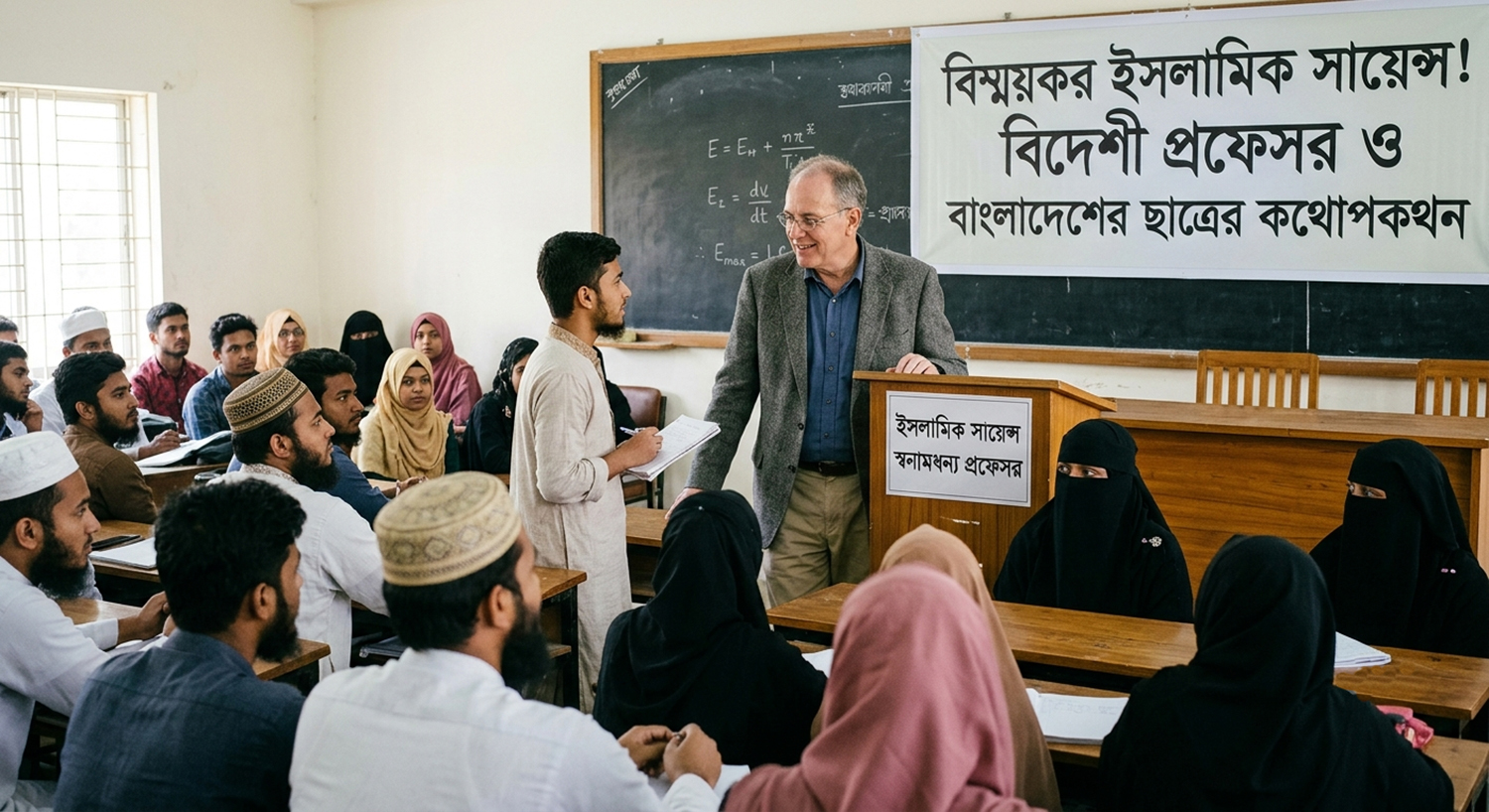
Conversation between a foreign professor and a Bangladeshi university student about Islamic science
A renowned professor from Europe once visited a science faculty class at a well-known university in Bangladesh to share some knowledge with the students. At first, he noticed that many of the male students had stubble beards, some wore caps, a large portion of the female students were covered in hijab, and a few had only their eyes visible. He began his Q&A session with one student.
Professor: How did such immense diversity of life and species around us come into existence?
Student: Everything came into the world by the will of Allah, and everything exists for the benefit of humans.
Professor: Interesting!
Student: You may know that in a great flood, Allah destroyed all living beings, and only those that boarded Noah’s ark survived.
Professor: You mean all the creatures we see today—millions of species—were on that ark? Penguins, blue whales, eels, tigers, lions—everything? How big was that ark?
Student: You can see that ark if you visit the mountains in Turkey. One pair of each species was taken aboard, and they reproduced to fill the world again.
Professor: I see, I might learn many new things today. There are currently around 8.7 million species on Earth. Keeping one pair of each on a single vessel is physically impossible. An even bigger issue is genetics. Starting from just one pair would result in inbreeding, preventing genetic diversity—those species wouldn’t survive.
Student: Those are all false claims. You must be influenced by evolution. Don’t you know many scientists in the West have rejected evolution? Everything is Allah’s will. Do you see monkeys turning into humans today? If monkeys evolved into humans, where did all these monkeys come from? Allah created Adam from clay and Eve from his rib. Their descendants are today’s 8 billion people.
Professor: There’s no end to knowledge. I have colleagues who are evolutionary biologists; I will share your insights with them. But as far as I know, this is a common misunderstanding. Evolution does not say humans evolved from monkeys; rather, humans and monkeys share a common ancestor millions of years ago, and evolved along different branches. This is supported by genetic evidence, fossil records, and DNA analysis.
Student: But sir, the Quran says Allah created Adam directly from clay.
Professor: Perhaps you’re right. But I thought science is based on evidence. We have genetic proof that humans and chimpanzees share 98.7% of their DNA. How do you explain that?
Student: Allah created them using the same materials, so naturally they are similar—it’s His power.
Professor: That’s one possible explanation, but in science, we see shared mutation history too—meaning both species diverged from a common origin. The similarity lies not only in function but also in shared genetic “errors.”
Student: You see that palm tree outside? That belongs to our dorm. Will it turn into a mango tree the next day?
Professor: No, it won’t. I see your argument is quite sharp; I keep getting defeated by it. Anyway, let’s talk about disaster management. Bangladesh faces cyclones and frequent fires in cities…
Student: Sir, it’s the season for ripe palm fruit—have you tried palm cake? It’s delicious. About disasters—yes, people’s faith has weakened, women wear immodest clothing, many factors are at play. But true believers are never harmed. You see, everything burns in fire—people die—but the Quran never burns!
Professor: Take care of your palm trees, they’ll yield more fruit. I suppose other dorms also have such trees? I’m learning from you—it seems this trip to Bangladesh will be the most educational of my life.
Student: With faith in Allah, people can come out unharmed even from fire. Prophet Ibrahim was thrown into fire by Nimrod. All creatures—frogs, cows, rabbits, crocodiles, penguins—came to save him, except a lizard, which blew air to intensify the fire.
Professor: Oh really? What happened then? That lizard did a terrible thing.
Student: Exactly. That’s why killing a lizard in one strike brings great reward; in two strikes, a bit less…
Professor: I see—the longer it takes, the lesser the reward. But I don’t want to kill an innocent creature. Did the fire intensify from the lizard’s blow? Did Ibrahim survive?
Student: Of course. What is a mere lizard compared to Allah? The fire became a garden of peace for him, and he came out smiling.
Professor: Perhaps Allah shouldn’t have created lizards at all.
Student: It’s a test. When people see lizards moving around, if they truly love Allah and His Messenger, they will kill them.
Professor: Did Prophet Muhammad instruct killing lizards?
[At this point, almost all students in the class stood up shouting]
Professor: What happened? Why such chaos?
Student: Sir, you are disrespecting the Prophet. Our religious sentiments are hurt. If the police find out, you will be arrested immediately.
Professor: I don’t understand—how did I disrespect the Prophet?
Student: Sir, you repeated the same mistake. After saying Muhammad, you must say “peace be upon him.”
Professor: I’m sorry, I didn’t know. I’ll say it from now on. What does it mean?
Student: I don’t know, but it must be said, otherwise one becomes a blasphemer, punishable by death.
Professor: Alright, let’s not continue on this topic.
[At that moment, the professor received a message]
Professor: A colleague just informed me that the Voyager spacecraft has set off toward Mars.
Student: Sir, you are stuck on Voyager. Do you know prophets didn’t care about such things? They had the power to travel the heavens at will.
Professor: Really?
Student: Muhammad (PBUH) traveled through the seven heavens on a winged horse and met Allah. Prophet Solomon could travel through the air on his throne, along with his entire court, carried by the wind.
Professor: My God! What are you saying? There is such a thing as gravity… never mind, I’ll just learn from you today.
Student: I’m telling the truth, sir—these are facts.
[A ringtone sounded: “When Yunus was swallowed by the fish…”]
Student: Please keep phones silent. As you heard, Prophet Yunus was swallowed by a whale and stayed alive inside it for 40 days.
Professor: How is that possible? Biologically, a human cannot survive inside a whale’s stomach—there’s no oxygen, there’s gastric acid, extreme conditions.
Student: Sir, you don’t understand Allah’s miracles.
[Another student tried to speak]
Student: Sir, Neil Armstrong heard the call to prayer on the moon and converted to Islam. He saw a huge crack across the moon. That’s because Muhammad once split the moon in two.
Professor: Neil Armstrong denied that himself. NASA also confirmed it. There’s no atmosphere on the moon, so sound cannot travel.
Student: Sir, what are you saying? If you want proof, I can show you sermons by clerics.
Professor: Armstrong himself denied it—what stronger proof do you need? But if those clerics say so, fine. I’ve heard many say some clerics in Bangladesh are exploiting religion.
Student: Those are atheist claims. Atheists are illegitimate, they have no parents…
Professor: I understand what you mean. I’m from a Western country—I haven’t seen such things, but I’ll verify when I return.
Student: Sir, intersex people are born due to relations with jinns.
Professor: Interesting! But I know intersex conditions arise due to chromosomal and hormonal variations—it’s fully biological.
Student: Are you saying Islam is wrong? Jinns have great powers—scientists used them to build bridges and generate electricity.
Professor: Is there any data? Do viruses consider religion?
Student: I don’t know, but clerics proved Covid targeted non-Muslims. Science is a conspiracy.
Professor: Many Muslims got Covid too.
Student: They weren’t true Muslims. Also, the sun sets in muddy water and prostrates under Allah’s throne.
Professor: Astronomy shows that Earth rotates—it only appears that the sun sets.
Student: See, the Quran is unchanged—science changes.
[A fly fell into the professor’s tea]
Student: No need to throw it away, just dip the fly—it has disease on one wing and cure on the other.
Professor: Microbiology shows flies carry dozens of pathogens like Salmonella, E. coli, and Vibrio cholerae.
Student: Maybe science hasn’t discovered the cure yet.
Professor: That’s a reasonable question. But hasn’t this been investigated over the past 1400 years? Has any evidence been found? Also, there is no biological structure in a fly that supports the idea of having separate chemicals in each wing. Anyway, do one thing—I haven’t taken a sip of this tea yet, you can drink it.
Student: Thank you, sir, I’ll drink it. Sir, mosquitoes and flies also act as soldiers of Allah. The mighty king Nimrod of ancient Babylon died when a mosquito entered through his ear and struck his brain. Allah sent a weak mosquito upon him to break his arrogance and pride.
Professor: I see you know quite a lot about history as well. How did you learn all this?
Student: Islam is the greatest religion. At the command of prophets, even the sun can stop. Allah once stopped the sun temporarily at the wish of a prophet.
Professor: It seems prophets had immense power—even control over the sun.
Student: Not just that. What can Allah not do? In winter, it becomes cold because Hell inhales; in summer, it gets intensely hot because Hell exhales. Everything is part of Allah’s perfect plan.
Professor: When it’s hot in Bangladesh, it’s winter in Australia, and Antarctica is cold all year round. How does Hell manage its breathing?
Student: To understand that, you must read the Quran and Hadith. Without reading the Quran, humans, due to their ingratitude, can be turned into monkeys or mice.
Professor: Are these all teachings of Islam? You said evolution is false—then how can humans turn into monkeys?
Student: As punishment, Allah can do anything. Even monkeys follow Sharia law.
Professor: I’ve learned more today than in my entire life.
Student: Sir, no matter how many degrees you have, if you lack knowledge of the Quran and Hadith, you are ignorant.
Professor: I see now—my whole life has been wasted.
[At that moment, the sound of a palm fruit falling was heard from a nearby palm tree]
Professor: A palm fruit has fallen from your tree—go collect it.
Student: Certainly, sir. I still have much more to say, but for now I’ll collect it. I plan to plant a palm orchard on campus so that each of us can own a palm tree.
Professor: Your palm tree will remain yours, don’t worry. With your knowledge of the world, universe, science, and history, you deserve not just a palm orchard, but a jackfruit orchard too. I hear jackfruit leaves are becoming popular as food.
Student: Not a bad idea, sir. Many people now run businesses supplying jackfruit leaves. For example, one supplies from France, another from New York.
Professor: Amazing! Jackfruit is the national fruit of Bangladesh, and yet you import it from abroad?
[At that moment, the classroom electricity went out. Darkness fell all around, and the professor thought to himself, “This is my chance to slip away—I’ve gained enough knowledge for today.”]
Related Posts

Islam’s Circular‑Logic Fallacy
Place: Cabin of a Dhaka–Sylhet-bound trainCharacters: Maulana Abdur Rahman (a responsible member of Tabligh Jamaat)Read More
ইসলামের সার্কুলার লজিক ফ্যালাসি
স্থান: ঢাকা থেকে সিলেটগামী ট্রেনের কেবিনচরিত্র: মাওলানা আব্দুর রহমান (তাবলিগ জামাতের একজন দায়িত্বশীল) ও অধ্যাপকRead More

Comments are Closed