

Please do not play with human dignity
Throwing excrement on a teacher – where does this originate?
You know that in Barisal, a madrasa teacher was humiliated by having filth poured on his head. Is this the first time? Not at all. Don’t you remember in Narayanganj when a teacher was forced to squat and rise by holding his ears? Did you see today’s news? A fourth-grade child accused of theft, along with his father, was tied with the same rope and tortured all day. Now, since everyone has a mobile camera, such incidents are filmed and uploaded to Facebook.
Every day across the country, hundreds of people are subjected to humiliation by organized groups – being forced to hold their ears, garlanded with shoes, having buttermilk poured on their heads, shaved bald, circumcised against their will, and countless other forms of disgrace. These incidents occur most often under the guise of “protest,” or by framing someone and then staging a sham arbitration.
Thanks to mobile phones, some of these events now appear on Facebook. More will come. For example, the video of filth being poured on the madrasa teacher’s head. Watch it once. See how utterly helpless a person becomes in that moment! Look closely at his face – you have never seen such darkness in your life. The madrasa teacher is an old man. Perhaps he will leave the area, or perhaps he has no means to go elsewhere. But this incident has broken him inside. His inner world will gradually collapse. His family will carry this memory for the rest of their lives.
In this way, countless people in the country carry wounds of humiliation in their hearts. A society, a nation, built upon lifeless souls. The wounds are varnished over, but inside they are hollow. No courage, no enthusiasm, no drive. No way forward. At every chance, memories of humiliation pull them back. Thus, people’s desires shrink, goals diminish, dreams die. Survival itself becomes the forced aim of life.
With a little effort, you can feel how gloomy, how dark, how stagnant your surroundings are. People do not laugh; they try to laugh. People do not dance in joy; they drag their bodies upward only to fall back down. If you pay close attention, you will see how few smiles, how few joys are genuine.
Do you know where this culture of humiliation and the collective joy in another’s disgrace begins? It begins in the family. It begins with parents. In towns and villages, different forms of humiliation exist – forcing a child to hold their ears, scolding in front of guests, collective family shaming, withholding food, locking them out at night, and more. Then in school – forcing a child to stand on a bench holding their ears, mocking a specific student with the whole class under the teacher’s lead, forcing them to balance chalk or brick pieces on their forehead while staring at the sun, and many other punishments. Later in college and university, ragging in the name of tradition, mental torture by so-called seniors. Then at the workplace, collective ridicule by colleagues. And of course, humiliation by influential groups in society. In the marrow of Bengali culture lies this tendency to humiliate others for any reason, and to celebrate that humiliation collectively.
When two people start humiliating someone, within minutes four, ten, or a hundred gather. People enjoy it immensely. It is not done for justice or revenge. They may not even know the reason – they do it because they enjoy it.
The worst aspect of mass humiliation in the name of protest is that it obstructs the struggle for justice. A few days ago, I saw on Facebook a photo of a rapist paraded through a village with a garland of shoes around his neck. The person who shared it was delighted, saluting those who did it. In the following days, I watched the media – there was no news of a case being filed for that rape. After the rapist was paraded, the anger of the villagers subsided somewhat. The group that organized the humiliation got their entertainment. The excited crowd went home laughing, saying, “He got what he deserved!” No one spoke of justice anymore, because the satisfaction of entertainment created the illusion that justice had been served. Perhaps even the victim’s parents felt a taste of revenge. As a result, the demand for justice was abandoned. Thus, a grave criminal escaped with a trivial punishment.
The demand for justice dying is dangerous. But even more dangerous is the community being entertained. What will the next entertainment be? Another event. Again, someone will be humiliated. It could be a rapist, a banana thief, a mosque shoe thief. Or it could be an innocent person. Perhaps even the rapist himself will join in the next humiliation, enjoying it. Until then, the raped child remains a source of entertainment – gossip about her, suggestive glances at her family, inviting the rapist to recount every second of his crime in detail, all serving as petty amusements.
The angry or curious crowd does not truly want justice. They want to participate in mass beatings and humiliations, to live a little while in excitement and satisfaction. They want to relive the joy of disgracing someone, to tell stories about it and pass the time.
This is sickness. A bad habit. A social disease that has become part of behavior. A supposed solution, a false closure. Those who indulge in such entertainment under the name of protest have their justification – the justification of lawlessness. By staging mass humiliation, they strengthen the culture of impunity. Yet establishing justice is not easy. It requires generations of relentless struggle. Only then may some benefit be achieved. But if one withdraws from the struggle for justice, the benefit will remain forever out of reach.
Such methods of humiliation are terrible weapons. First, they can be used against criminals in protest. Second, they can be used against innocent individuals out of personal enmity. In the first case, justice is not established. In the second, a grave crime is knowingly committed. But in both cases, there is one similarity – people enjoyed it. They had fun. And the same weapon was used.
What is a bad habit, what is unjust entertainment, carries the risk of being misused in many ways. What you do today in the name of protest, tomorrow may be done to frame you. Before entertainment-hungry crowds, you will have no choice but to endure humiliation helplessly.
Those who poured filth on the madrasa teacher’s head were influential. Those who forced the schoolteacher to hold his ears were powerful politicians. Those who cut the hair and beard of the Bauls were both influential and part of the majority. The crimes are committed by organized majoritarian groups.
Behind each of these incidents lies political power, influence, group strength, and the force of majority. This majority and influence take different forms at different times. Today you may belong to the majority as a Muslim or Hindu, but tomorrow as a resident of the northern neighborhood you may become a minority. Then the southern majority will revel in humiliating you.
The practice of majority power is not good. The practice of dominance is not good. Enjoying another’s humiliation is not good.
The helpless person, head bowed under the mountain of humiliation, staring blankly, is not a stone statue or a painted picture to be seen year after year in the same role. Rather, in each incident, it will be a different person. Sometimes an atheist, sometimes a teacher, sometimes a Baul, sometimes a cleric. Sometimes you, sometimes me. And behind it all, the real crimes and criminals slip away.
Let this barbarity be eradicated. And let it begin in the family. Let children be freed from this culture of humiliation. From their generation onward, this culture will diminish nationally.
Related Posts
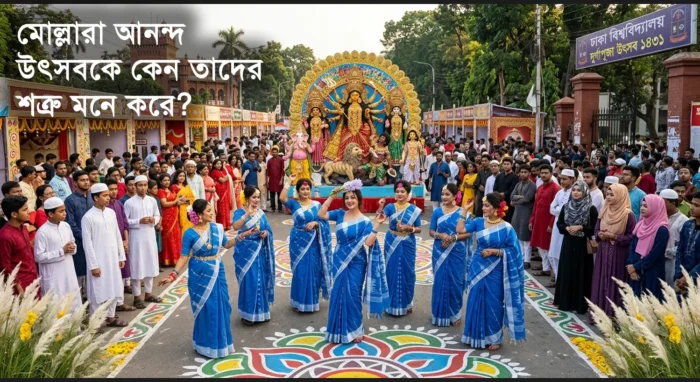
Why do Islamist clerics consider Bengali cultural festivals their enemy?
This year, unlike many previous years, the major Hindu religious festival Durga Puja in BangladeshRead More
ইসলামিস্ট মোল্লারা কেন বাঙালিদের আনন্দ উৎসবকে তাদের শত্রু মনে করে?
এবার বাংলাদেশে অন্যবারের তুলনায় বেশ শান্তিপূর্ণ, উৎসবমুখর পরিবেশে হিন্দু ধর্মের বড় ধর্মীয় উৎসব দূর্গাপূজা হয়েRead More
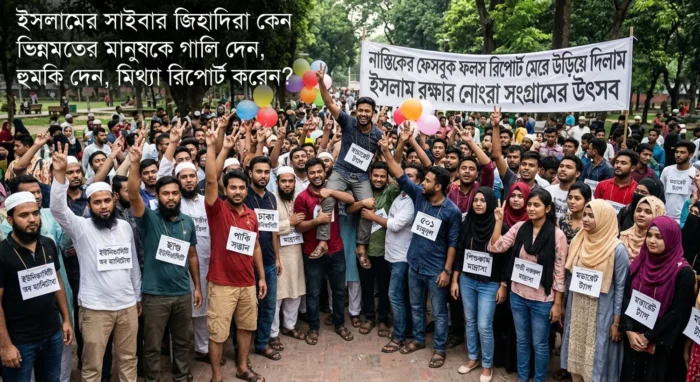
Why do Islamist cyber‑jihadis insult, threaten, and file false reports against people with different opinions?
Maulana Azhari once advised Islamists that sharing his Facebook posts is also an Islamic act;Read More
Comments are Closed