
Pedophilia and Islam
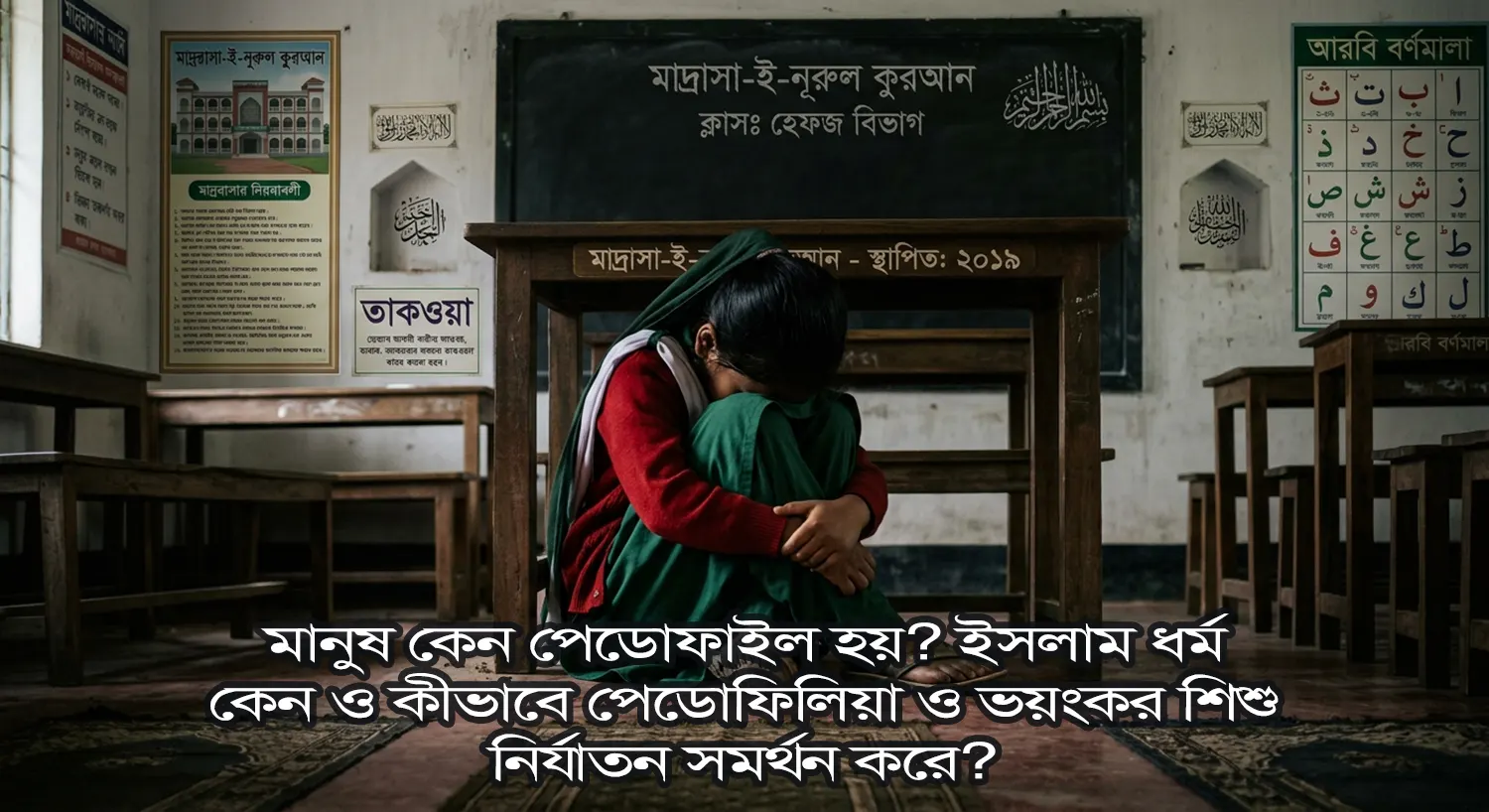
Why Do People Become Pedophiles? Why and How Does Islam Support Pedophilia and Severe Child Abuse?
The news that an 11-year-old child in a madrasa in Madan Upazila of Netrokona became pregnant after being raped had caused nationwide outrage over the past few months. The accused madrasa teacher, Aman Ullah Mahmudy Sagar, initially denied the allegations; attempts were made to blame the child’s guardian (her grandfather), and a section of religious figures and intellectuals stood in support of the teacher. But this month, a CID DNA report confirmed that he was indeed the father of the newborn. This incident is not isolated. In Bangladesh, every month brings numerous similar reports from one madrasa or another, sometimes from hifz schools, sometimes orphanages, and sometimes rooms attached to local mosques and madrasas. The question arises: why do these people do such things, why do they commit such horrific crimes? And why does it continue decade after decade without being stopped? Why are there examples and endorsements of pedophilia in the life of Islam’s Prophet Muhammad and in the Qur’an and Hadith? Let me clarify beforehand that pedophilia and child sexual abuse such as rape are not the same thing; that distinction will be explained in the next section.
To find an answer to this question, two separate issues need to be considered separately: on one side is pedophilia, a clinical condition; on the other is child sexual abuse, a social and institutional crime, which Islam has also recognized through examples and teachings. Because the two often occur together, it is easy to confuse them, but research shows they are not the same.
What Pedophilia Is, and What It Is Not
In psychiatry, pedophilia is a primary or exclusive sexual attraction to prepubescent children. It is recognized as a paraphilic disorder in both the World Health Organization’s ICD-11 and the American Psychiatric Association’s DSM-5. However, researchers emphasize that pedophilia (a sexual orientation or attraction) and child abuse (an act) are not the same thing. Many pedophilic individuals never touch a child, while many child abusers do not meet the clinical criteria for pedophilia. Instead, they are opportunistic, power-seeking, or controlling individuals who choose the most vulnerable victims.
Neuroscientific research (using fMRI and sMRI) has shown that people with pedophilia exhibit structural and functional differences in certain regions of the brain, particularly in the frontal, temporal, and limbic areas, which are associated with sexual arousal processing and impulse control. Some studies also suggest a role for prenatal hormone exposure or androgen exposure, and there are indications of genetic and epigenetic influences. However, researchers themselves caution that this field remains in its early stages, findings are mixed, and no single “pedophilia gene” or definitive cause has been identified. It appears to be multifactorial, involving a complex interaction of neurological development, hormones, childhood neurodevelopmental issues, and possibly environmental influences.
An important point is that pedophilia is not a “choice,” but it is never an excuse for abuse. A person may have no control over the nature of their attractions, but acting on them or refraining from doing so is entirely a matter of moral and legal responsibility. This is why medical science regards pedophilia as a treatable condition, where therapy and supervision can help prevent criminal behavior.
Where Science Ends, Sociology Begins
However, the child abuse that continues for years in institutions such as madrasas, churches, boarding schools, and orphanages cannot be explained solely through individual psychology. Researchers around the world have identified a common framework of institutional child abuse that appears remarkably similar regardless of religion, from Catholic Church scandals to Indian ashrams, Christian boarding schools, and Bangladeshi madrasas. This framework contains several common elements:
Unquestionable Authority
Religious teachers or “hujurs” are often viewed as representatives of religion itself. As a result, accusing them can feel equivalent to attacking the religion, creating fear that silences both children and parents.
Closed, Unsupervised Environments
In residential madrasas and hifz schools, children are separated from their families for long periods, have limited communication with the outside world, and often lack independent oversight mechanisms or effective channels for reporting abuse.
Punishment-Based Discipline Culture
Children are taught compliance through strict physical punishment. This same structure also leaves them unable to resist sexual abuse, because fear and obedience have already been deeply ingrained.
Institutional Self-Protection
When allegations emerge, preserving the institution’s reputation is often prioritized: the accused may be transferred elsewhere, victims blamed, or incidents covered up.
Social Taboos and Poverty
In Bangladesh, especially within the Qawmi madrasa system, institutions often operate outside the state educational framework and regulate themselves. Poor families, particularly those with orphans or disadvantaged children, send them to madrasas because of free lodging, food, and education. Accountability mechanisms are often absent. Sexual abuse is frequently considered a matter of family honor, so many incidents never become public.
The Netrokona case followed exactly this pattern: the accused denied responsibility, blamed the child’s guardian, supporters rallied behind him, and justice was established only through forensic evidence. This demonstrates that the problem is not merely an individual’s pathology; it is also a system that protects the accused while viewing victims with suspicion.
Debates Over Religious Texts and Interpretation
Discussions regarding child marriage have historically existed in the Qur’an, Hadith, classical exegesis, and fiqh literature (including Hanafi, Shafi‘i, and other schools). Writings such as Maududi’s Tafhim al-Qur’an and Khomeini’s Tahrir al-Wasilah contain fiqh discussions concerning child marriage, including passages stating that the marriage of young girls, regardless of age, and sexual relations between them and their husbands are rights recognized by Islamic law. Critics of Islam and reformist thinkers have raised questions about these teachings for decades. Since the Qur’an and Hadith are considered immutable, these elements cannot simply be removed from Islam.
The opposing side, including most contemporary Islamic scholars and reformist thinkers, argues that these fiqh discussions addressed the legality of marriage within specific historical and legal contexts and did not constitute approval of sexual abuse. They reject such interpretations as outdated or incorrect and point out that modern laws based on Sharia in many Muslim-majority countries set minimum marriage ages. Institutions such as Egypt’s Al-Azhar have taken positions against child marriage. This debate remains deeply divided both theologically and politically, with no final consensus on the “correct” interpretation.
However, the reality is that child sexual abuse is not a problem unique to one religion or culture. Global scandals involving abuse by Catholic priests, similar incidents in Hindu ashrams and guru-centered institutions, and allegations in Buddhist monasteries all demonstrate that the core structural problems are unquestionable authority, closed institutions, and lack of accountability. Religious legitimacy can make abuse even harder to identify and prevent because raising questions is often portrayed as an act of blasphemy.
Nevertheless, the scale and persistence of these incidents in religious educational institutions across many Muslim-majority countries, including Bangladesh, stand out. Reports of child rape, sexual abuse, and mistreatment continue to emerge from Qawmi madrasas and hifz schools. Neither society nor government appears able to effectively prevent them. Thousands of children’s lives are being devastated, and many are driven toward death by a religious education system that operates in the name of Islam, and thus in the name of Allah.
Examples of Pedophilia and Child Abuse in the Life of Prophet Muhammad
Despite having 9–11 wives and more than four female slaves, Prophet Muhammad allegedly sexually abused young girls. At nearly sixty years of age, with his child wife Aisha among his wives and several female slaves, he was allegedly especially attracted to other young girls. He is said to have expressed interest in marrying a crawling infant once she became older. Defenders of Islam often dismiss the source of this hadith as weak, but there are reportedly two other sahih hadiths that describe him engaging in behavior interpreted as sexual abuse toward two young girls. Defenders of Islam typically frame these reports as marriage proposals or marriages, but considering Muhammad’s sexual life, personal character, and the social environment of Arabia at the time, readers may draw their own conclusions.
At the age of 53, Prophet Muhammad married Aisha, the six-year-old daughter of his friend, and consummated the marriage when she was nine years old. There are also two sahih hadith reports involving two young girls named Jawniya and Umaima. Islamic defenders often rely on hadith titles to argue that these accounts concern marriage or divorce, but the texts themselves reportedly do not mention marriage or divorce, nor does the surrounding context necessarily suggest such interpretations.
The scenario presented is as follows: wealthy people in Arabia had resorts, gardens, leisure houses, or upper-story retreats in oasis areas, places whose primary function was private sexual activity. Prophet Muhammad is said to have once gone with companions to such a private retreat. There, a noble child or adolescent girl named Jawniya was brought before him, dressed and adorned. Evidence that Jawniya was still a child is claimed to lie in the presence of her wet nurse or female attendant. Wealthy Arab families often assigned such attendants to children and young girls. Jawniya supposedly did not know why she had been brought there and likely had not consented.
When Prophet Muhammad allegedly told Jawniya to remove her clothes and come to bed with him (or, in Islamic euphemistic language, to surrender herself to him), Jawniya reportedly replied that she was a princess and could not surrender herself to a common market man. In Arabia at that time, the term “market man” allegedly referred to a rogue, libertine, or immoral person. Other hadiths are cited as evidence for this usage. Muhammad then supposedly placed his hand on her body to calm her. Jawniya reportedly responded by asking him, for Allah’s sake, to release her. It is argued that she insulted him as much as she could, and disappointed, he eventually let her go.
After that disappointment, Muhammad is said to have returned to the same retreat, where another adolescent girl named Umaima was brought before him. She too allegedly rejected and humiliated the elderly prophet. Islamic defenders sometimes attempt to identify these two girls as the same person, but according to Sahih Bukhari 5255, 5256, and 5257, they are presented as distinct individuals with different names and circumstances. Other sources reportedly also treat them as separate individuals: one being Jawniya, daughter of al-Jawn, and the other Umaima, daughter of Nu‘man ibn Sharahil.
The companions allegedly knew that Muhammad would not be satisfied unless he engaged in sexual activity. After being rejected and humiliated twice, he was reportedly consumed with sexual frustration. At that point, one companion is said to have described the beauty of his own sister and offered to bring her to Muhammad. Muhammad accepted. The companion al-Ash‘ath then brought his sister Qatila to him. According to this narrative, Muhammad fulfilled his desire for sexual activity in that retreat in this way. Readers are invited to reflect on what this suggests about the companions and how they viewed women. This account is cited as appearing in Al-Bidaya wa al-Nihaya, Volume 5, pages 487 and 489, along with other sources.
This is the man whom Islamists claim to be the greatest individual of all time and the ideal model for every age. They further claim that his words and deeds represent the words and deeds of Allah. There is, according to this argument, no opportunity to dismiss these matters as merely products of the customs, habits, or flaws of that era. If one attempts to do so, then it must also be acknowledged that Muhammad, the Qur’an, the Hadith, and Allah are obsolete and unacceptable in the modern age.
Not only Muhammad, but figures such as Ali, Umar, and other influential companions and caliphs are also claimed to provide examples of attraction toward young girls and of sexual abuse carried out under the guise of marriage.
Islamic Sharia Provides Limited Scope for Judging Such Crimes
Munawar Hasan, a leader of Pakistan’s Jamaat-e-Islami, once stated in an interview that if a woman is raped and cannot produce four male eyewitnesses who directly observed the event, she should refrain from seeking justice. In countries governed by Sharia, there have been numerous cases where rape victims, unable to produce four male eyewitnesses, were instead punished for zina (fornication or adultery).
Islam contains no direct legal category for rape. At the time, rape was allegedly not regarded as a distinct crime. Instead, Islam prescribes severe punishments for consensual sexual relations categorized as zina. Rape is often judged within the framework of zina, but because zina requires four male eyewitnesses who directly observed the act, prosecution becomes extremely difficult. As a result, few victims seek justice, since proving the crime is nearly impossible and may even place the victim’s own life at risk.
Muslims are also encouraged to conceal the faults of fellow believers. As a result, when crimes such as rape occur in madrasas, other religious teachers often suppress the incidents rather than protest or resist them. This is why, although Islamists organize movements, demonstrations, meetings, and campaigns over many issues, they are rarely seen speaking out against the severe problem of child abuse.
Why Has It Still Not Stopped in the Modern Era?
In Bangladesh, the Qawmi madrasa system still operates largely outside state registration, curriculum oversight, and child protection regulations. Although child protection laws exist, implementation remains weak, independent complaint mechanisms are lacking, and local influential groups often protect the accused. From a psychological perspective, unequal power dynamics, with an adult teacher facing an isolated, dependent, frightened child, create ideal conditions for abuse. Social stigma silences victims, while religious politics frequently obstruct investigations.
Poverty and economic realities form a major foundation of this crisis. For many poor and marginalized families in Bangladesh, Qawmi madrasas provide the only affordable opportunity for education, food, and shelter. Consequently, parents often send children away at a young age to hifz schools or madrasas without realizing they may be placing them in environments lacking external oversight. Operating outside state registration and funding systems, these institutions manage themselves independently, often without background checks or accountability structures for teachers. Economic hardship further discourages poor families from filing complaints, as they fear losing their children’s only educational opportunity.
Social structures also sustain this silence. In rural and conservative communities, discussing sexual abuse is frequently regarded as bringing dishonor upon the family, so victims and their relatives often remain silent or settle matters informally. The power imbalance between teacher and student, where an adult religious authority confronts a dependent, frightened child separated from family, creates conditions favorable to abuse not only on a personal level but institutionally as well. Without an independent complaint system, children have no safe and trustworthy way to report abuse, and internal disciplinary structures often serve to protect the accused.
Religious politics and protection by influential figures constitute a third layer of obstacles. Qawmi madrasas are part of a powerful socio-religious network within the country’s political economy, with social influence and voting blocs considered important by political parties. As a result, allegations are often portrayed as conspiracies against religion or efforts to destroy madrasa education, diverting investigations. Local administrations and law enforcement agencies may also hesitate to act against influential clerics or institution heads. Child protection laws may exist on paper, but insufficient institutional commitment, lack of independent oversight bodies, and limited political courage have allowed this cycle to persist. Poverty, social stigma, and religious politics together create an environment that is dangerous for children and largely free from accountability.
Final Remarks
Pedophilia is a complex psychiatric condition that may involve neurological and developmental factors, but it can never serve as an explanation or excuse for abuse. The real solution to child abuse in madrasas lies in structural reforms: mandatory registration and oversight, independent complaint and investigation mechanisms, background checks for teacher recruitment, safe reporting channels for children, moving away from cultures of physical punishment, and, most importantly, ensuring that religious authority is not placed above criminal accountability. In the Netrokona case, justice was ultimately established through forensic science, demonstrating that systems can work if there is sufficient social and political will. The real question is therefore no longer “Why do people become pedophiles?” but rather “Why have we maintained a system in which abusers can so easily remain hidden?”
Related Posts
Why do Islamist cyber‑jihadis insult, threaten, and file false reports against people with different opinions?
Maulana Azhari once advised Islamists that sharing his Facebook posts is also an Islamic act;Read More
ইসলামের সাইবার জিহাদিরা কেন ভিন্নমতের মানুষকে গালি দেন, হুমকি দেন, মিথ্যা রিপোর্ট করেন?
মাওলানা আজহারি একবার ইসলামিস্টদের উপদেশ দিয়ে বলেছিলেন – তার ফেসবুক পোস্ট শেয়ার করাও ইসলামের কাজ;Read More
Palestine and Gaza merging with Israel, and all of Kashmir merging with India, would lead to greater humanitarian benefit
In modern politics, independence is often considered an almost inviolable value, where leaders aim toRead More
Comments are Closed