
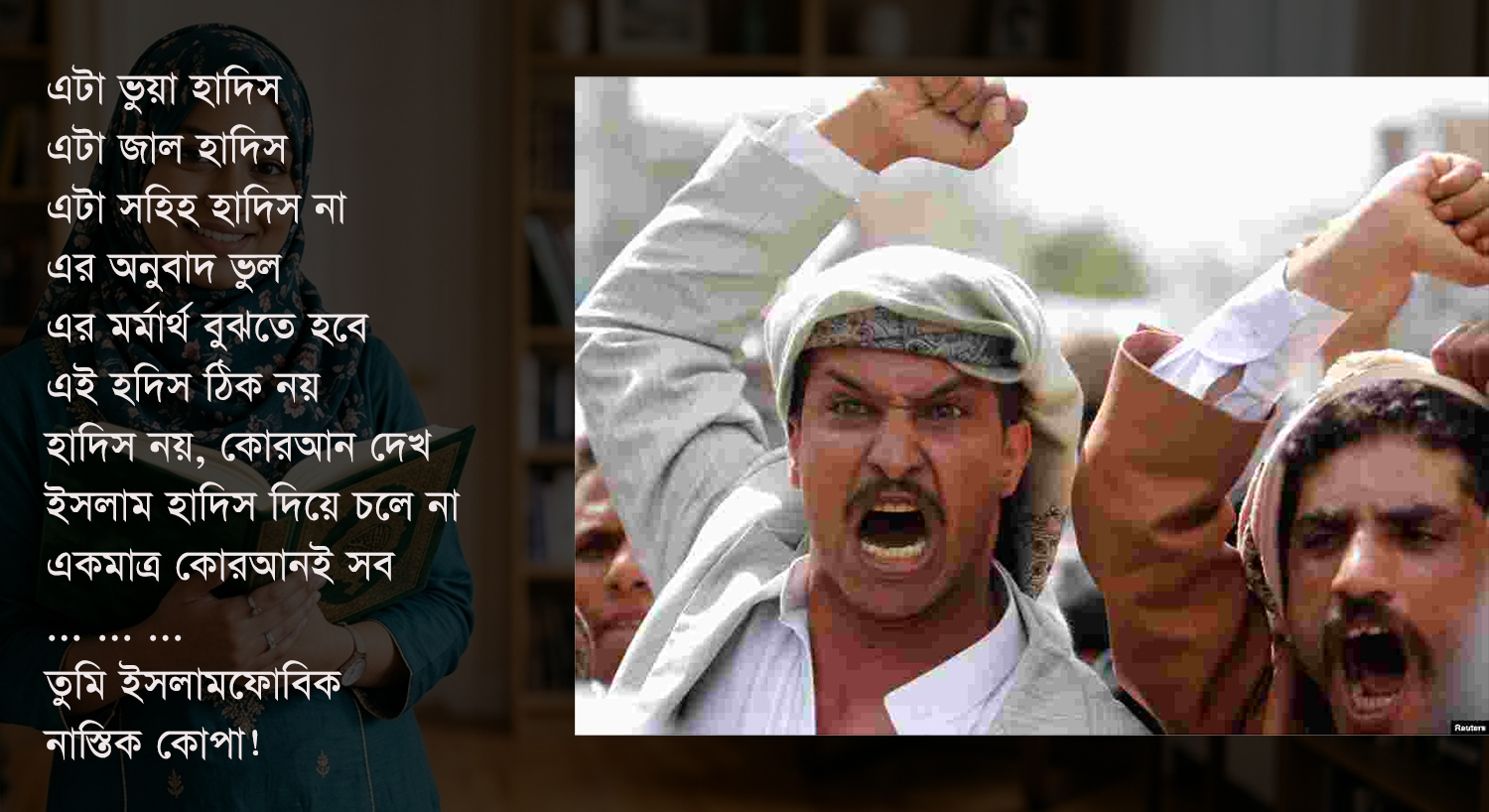
Only Quran, not Hadith?
Can Islam function without hadith? If someone rejects hadith, can they still remain a Muslim?
Those of us who highlight various dark chapters of Islam—where there are clear conflicts between Islam and issues such as human rights, science, governance, reform, philosophy, and humanity—often encounter a predictable response pattern from some Islamists. Initially, they claim we are citing fabricated hadiths. Then, when the hadith’s number, narration, and online references are provided, they say the translation is incorrect and that we are incapable of understanding its true meaning. After that, when multiple translations and sources from various hadith collections are presented, they argue that the hadith itself is not valid. Finally, at the last stage, they claim that only the Quran should be followed, not the hadith. In other words, they attempt to defend Islam even by discarding hadith or the sayings and actions of Prophet Muhammad—which Islam itself presents as a universal and timeless model to be followed.
In this article, we will systematically analyze:
(1) How the Quran establishes the authority of hadith and sunnah,
(2) The perspectives of the four madhhabs,
(3) A critique of the ‘Quranist’ position,
(4) The legal consequences of rejecting hadith, and
(5) The views of renowned scholars.
Basis of Hadith and Sunnah in the Quran
According to Islamic scholars, obedience to hadith or sunnah is not merely a traditional matter—its foundation lies directly in the Quran. Multiple clear verses of the Quran declare obedience to the Messenger of Allah (peace be upon him) as obligatory.
Obedience to the Messenger is a direct command from Allah
قُلْ أَطِيعُوا اللَّهَ وَأَطِيعُوا الرَّسُولَ
“Say: Obey Allah and obey the Messenger. But if you turn away, then the Messenger’s duty is only that which is entrusted to him, and your duty is what is entrusted to you.”
Surah An-Nur (24:54)
مَّن يُطِعِ الرَّسُولَ فَقَدْ أَطَاعَ اللَّهَ
“Whoever obeys the Messenger has indeed obeyed Allah. And whoever turns away—you have not been sent as a guardian over them.”
Surah An-Nisa (4:80)
وَمَا آتَاكُمُ الرَّسُولُ فَخُذُوهُ وَمَا نَهَاكُمْ عَنْهُ فَانتَهُوا
“Whatever the Messenger gives you, take it; and whatever he forbids you, refrain from it. And fear Allah—indeed, Allah is severe in punishment.”
Surah Al-Hashr (59:7)
Imam al-Shafi’i, in his work ‘Kitab al-Umm,’ cited this verse as one of the clearest Quranic evidences for following the sunnah. Because “what the Messenger gives” refers not only to the Quran, but to his entire teachings and example—preserved in hadith.
The Prophet’s speech is revelation—not personal opinion
وَمَا يَنطِقُ عَنِ الْهَوَىٰ إِنْ هُوَ إِلَّا وَحْيٌ يُوحَىٰ
“He does not speak from his own desire. It is nothing but revelation that is revealed.”
Surah An-Najm (53:3–4)
This verse shows that the Prophet’s statements are not merely his personal opinions, but part of divine revelation. Imam Ahmad ibn Hanbal stated: “Sunnah is the second revelation (الوحي الثاني).” Therefore, rejecting hadith indirectly amounts to rejecting this revelation.
Many Quranic commands cannot be practiced without hadith
The Quran establishes many obligations, but their detailed implementation is found in hadith. For example:
- The Quran commands to establish prayer (salat), but how to pray, the number of rak‘ahs, and the timings come from hadith.
- The Quran commands giving zakat, but the nisab, rates, and conditions come from hadith.
- The rituals of hajj—tawaf, sa‘i, Mina, Arafah—all are detailed in hadith.
- The finer rules of fasting—itikaf, tarawih—are derived from hadith.
Imam al-Awza‘i stated: “The Sunnah judges the Quran, not the Quran the Sunnah,” meaning the Sunnah explains the general rulings of the Quran.
The Reliability of Hadith Science According to Scholars
The unparalleled method of chain verification
The collection and verification of hadith underwent a highly rigorous process unmatched in the preservation of historical texts. Scholars examined both the chain of narrators (isnad) and the content (matn) in detail.
- Ilm al-Rijal: biographical evaluation of narrators
- Jarh wa Ta’dil: assessing credibility and weakness
- Ilal al-Hadith: identifying hidden defects
- Mutaba‘at and shawahid: cross-checking multiple chains
The credibility of Sahih Bukhari
Imam Bukhari examined over 600,000 narrations and selected only 7,275 for inclusion in Sahih Bukhari. Imam Ahmad ibn Hanbal said: “Bukhari represents the true scholar.” Even orientalists like Ignaz Goldziher acknowledged the strictness of hadith methodology.
Response to ‘Hadith was written late’
A common claim is that hadith was compiled 150–200 years after the Prophet’s death. This is only partially true:
- Hadith was preserved orally in a highly advanced memorization culture.
- Companions recorded hadith during the Prophet’s lifetime—e.g., Sahifa Hammam ibn Munabbih (7th century), preserved today.
- Caliph Umar ibn Abdul Aziz initiated formal compilation in the 1st century AH.
- Imam Malik’s Muwatta was written in the 2nd century AH.
By comparison, the Gospels of Christianity were written 40–70 years after Jesus, yet are accepted as authentic. Hadith methodology is comparatively more rigorous.
The Views of the Four Madhhabs
All four Sunni schools agree that authentic hadith is a fundamental source of Islam, and rejecting it amounts to departing from the faith.
Conclusion
From this discussion, it can be concluded:
- Accepting hadith is commanded by the Quran itself.
- Authentic hadith is preserved through rigorous historical methods.
- The consensus of Muslim scholarship affirms its authority.
- Without hadith, core practices of Islam cannot be implemented.
- The Quranist position is theoretically weak and practically ineffective.
From an Islamic perspective, authentic hadith is inseparable from Islam. Rejecting it while claiming to remain Muslim creates a contradiction, as the Quran itself commands obedience to the Messenger.
For someone who is raising reasonable questions about hadith, the advice is: learn and verify using the criteria of hadith science, seek explanations from reliable scholars—do not reject everything outright. A knowledge-based, critical inquiry is the path of reason.
While trying to defend Islam, will you end up denying hadith and thereby abandoning your own Muslim identity? We critique based on reason, conscience, science, and understanding. But you are believing Muslims—does it really suit you to deny such an integral part of your own religion? Rather, you should present arguments (I won’t call them evasions anymore) to explain why those hadith are relevant, no matter how inhumane, unscientific, or story-like they may appear!
Related Posts

Operation Entebbe – the story of one night, and the Islamic execution suffered by Nazrul Islam and Sweety Akter
What can a state do to save the lives of its citizens abroad? Are thereRead More
অপারেশান এন্টেবে – এক রাতের গল্প এবং নজরুল ইসলাম ও সুইটি আক্তারের ইসলামি হত্যার শিকার হওয়া!
একটি রাষ্ট্র বিদেশে তার নাগরিকদের জীবন বাঁচাতে কী করতে পারে? এর কোন টেক্সটবুক উদাহরণ আছে?Read More
A random page from Muhammad’s self‑made book Qur’an and its unscientific statements
Sometimes I flip through random pages of Muhammad’s self‑made book Qur’an, and today this pageRead More
Comments are Closed