
Old-Age Homes
Bangladeshi people generally have a very negative and often mistaken perception of old-age homes
There is no doubt that if everyone has the opportunity, financial means, and desire to live with their extended family, that is the best option, provided that their independence, privacy, and amenities are adequately ensured there. However, in today’s world, due to the extremely high cost of living and the resulting demands of working life, this is not always a practical reality.
People’s lives cannot be sustained by religion or emotions alone; life requires earning resources and working. Let me give a statistic that may help you estimate how busy working people in Bangladesh will become in the future. In Bangladesh, there are approximately 15 million people aged 60 and above who can be considered dependent. The old-age dependency ratio for those aged 65+ increased from 8.6 percent in 2022 to 9.4 percent in 2023. According to a 2024 estimate, it is approximately 9.92 percent. In other words, there are currently about 9-10 elderly people for every 100 working-age individuals. By 2050, the population aged 60+ will more than double, reaching approximately 36 million. According to UNFPA, they will then constitute 22 percent of the total population. According to the 2024 edition of the United Nations projections (medium variant), there will be approximately 17.9 people aged 65+ for every 100 working-age individuals by 2047. In 2046, the figure will be 17.3. If the government does not adopt appropriate policies and initiatives for the elderly from now on, a severe crisis will emerge in the future. The primary responsibility for the elderly lies with the government or the state because they contributed to financing the state and government during their younger years.
In the Western world, elderly people often prefer to live independently in their own homes or apartments, and this is the most common arrangement. Many also choose to live in retirement homes. There are many reasons for this: personal independence, preserving privacy while ensuring their own entertainment, having access to doctors, nurses, therapists, and social workers whenever needed, among many others. Such facilities often provide social and creative activities, including singing, reading books, handicrafts, reminiscence sessions, and sports. Even if their children want them to stay at home, many elderly people choose not to. If someone requires the assistance of a trained caregiver, what can their children realistically do amid their busy lives? Do elderly people not also wish to experience romance? In retirement homes, they have opportunities to engage in lively conversations with people of their own age. They can share memories of trips to Pattaya, Phuket, or Medellín. They can arrange a variety of entertainments for themselves, because personal freedom is highly valued by them. Many voluntarily choose not to become a burden on their children’s shoulders, considering that to be undignified.
In a retirement home, a person is never alone. Many of their peers live there as well. They receive nutritious meals, clean clothes, bedding, medical care, and medications on time without even having to ask. Not only that, weekends and special occasions often include group outings to cinemas, theaters, museums, or other attractions. And if their health declines even slightly, they may enjoy swimming in specially heated saltwater pools or spend a few days vacationing in areas with fresh, clean air. On weekends, their children and family members come to visit them, bringing their favorite foods and gifts. Another crucial issue is the cost of these retirement homes. Those of us who think of retirement homes as prisons, or who do not want to see elderly people living there, often do not realize that in developed countries an elderly person essentially pays for their retirement-home care throughout their entire working life. A portion of a citizen’s earnings is deducted by the government as part of the social safety system to cover expenses after retirement or during residency in a retirement home. Therefore, elderly people also look forward to enjoying the benefits and services they have spent their entire lives contributing toward.
For this reason, in a modern welfare state, there is no justification for portraying independent living for the elderly or retirement-home systems as inhumane or contrary to religion. I often see people claim that children do not care for their parents in those societies because Islam is absent there. This is a very mistaken and false assumption. Many children spend quality time with their parents. One day of quality time can be far more important than seven days of meaningless time, as is often the case in Bangladesh.
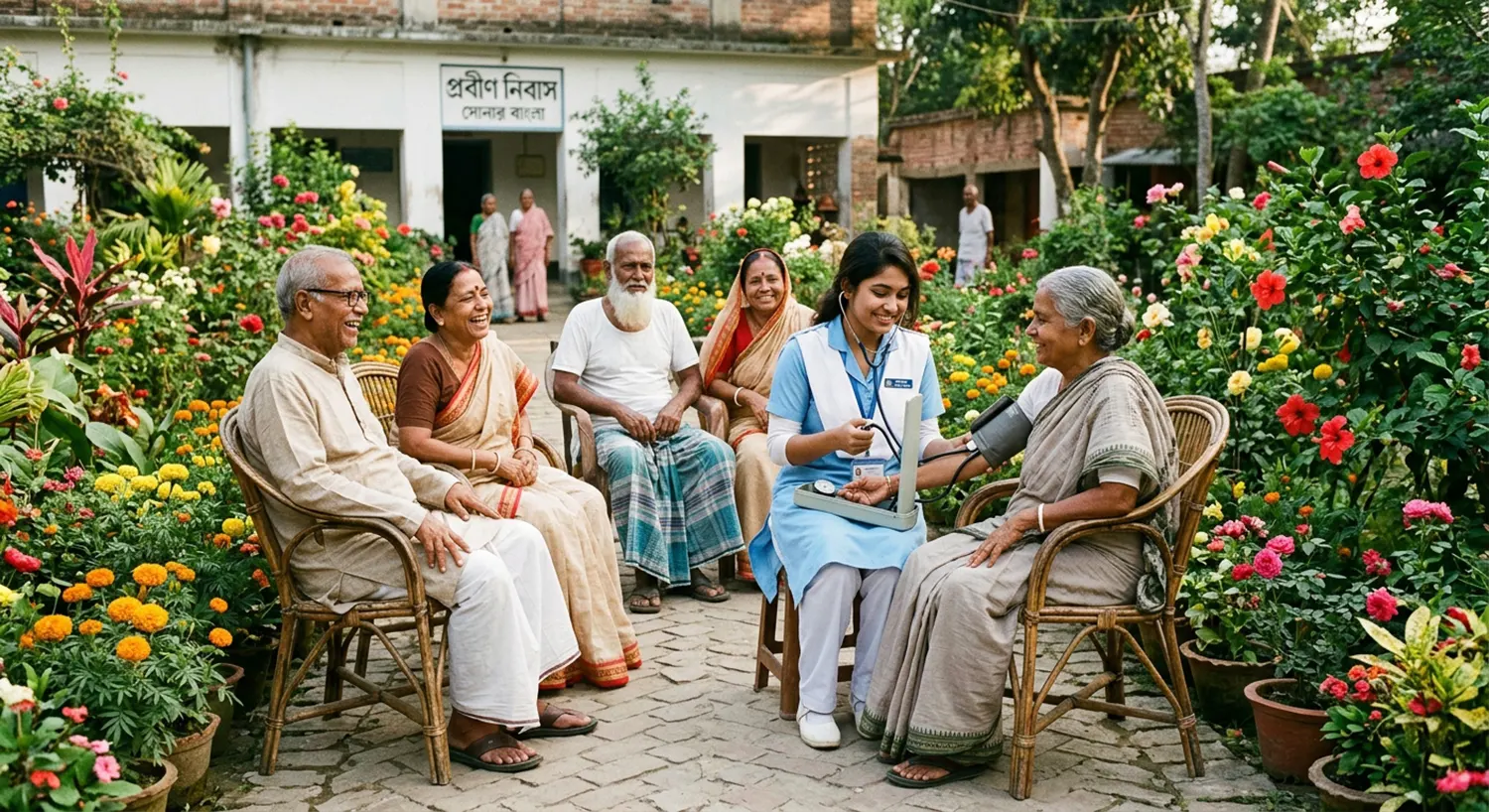
I know many of you will say that this is merely a dream in Bangladesh and that such retirement homes are still impossible here. I know that too. But what I wanted to explain is what a retirement home actually means and what a retirement home should ideally be like. When elderly parents are forced to leave their homes because of abuse and oppression by their children, or simply because of poverty and neglect, where their children or family members never visit them, never check on them, and do not even guarantee financial support for their upkeep, that situation is indeed tragic. I am not advocating for that kind of retirement-home system. I am talking about a retirement-home system that is properly regulated by the state or society, where our elderly parents, grandparents, and great-grandparents receive adequate support, healthcare, entertainment, and comprehensive social security. I dream of a retirement-home system in our country that resembles those in developed nations. While we, the younger generation, stay busy with our jobs and businesses, the elderly can remain happily occupied in retirement homes. Let retirement homes become places solely dedicated to the happiness and security of the elderly.
There are also many elderly parents who live in the same household as their children but receive money from them for helping care for their grandchildren. There is nothing wrong with that; they too need personal spending money.
There are also many Bangladeshi people who receive substantial monthly payments from the government for caring for their parents. Some even obtain such benefits fraudulently, using the money to support their entire household without having to work at all. I personally know a Bangladeshi family that receives so much government assistance for caring for their father that they have not needed outside employment for the past three years, while the rest of us struggle to make ends meet through work. In America, 55% of Bangladeshi immigrants receive such direct government cash benefits, whereas only 16% of Indians do. As a result, America no longer wants to accept Bangladeshi immigrants to the same extent and is making visas much harder to obtain. Therefore, there is no reason to assume that people living abroad keep their parents with them purely out of selfless responsibility and care. For this reason, the claim that Bangladeshi children care for their parents entirely without self-interest is an oversimplification.
Related Posts
Halloween and Thanksgiving Are No Longer Religious Festivals, Yet Islam Continues to Object to Them in Western Society
According to religious doctrine, Islam is fundamentally culturally isolated. For hardline Islamists, joyful and festiveRead More
হ্যালোউইন, থ্যাংকসগিভিং এখন কোন ধর্মীয় উৎসব নয় – কিন্তু ইসলাম পশ্চিমা সমাজে এখানেও বাঁধ সাধে
ধর্মীয় বিধান মতে ইসলাম মূলত কালচারালি আইসোলেটেড। কট্টর ইসলামিস্ট যারা, এদের জীবনে আনন্দঘন মুহূর্ত খুবRead More

Bangladesh’s Special Marriage Act Provides Legal Protection for Interfaith Couples and Non-Religious Individuals to Marry
When discussions of love or marriage arise in Bangladesh, one question keeps coming back: canRead More
Comments are Closed