
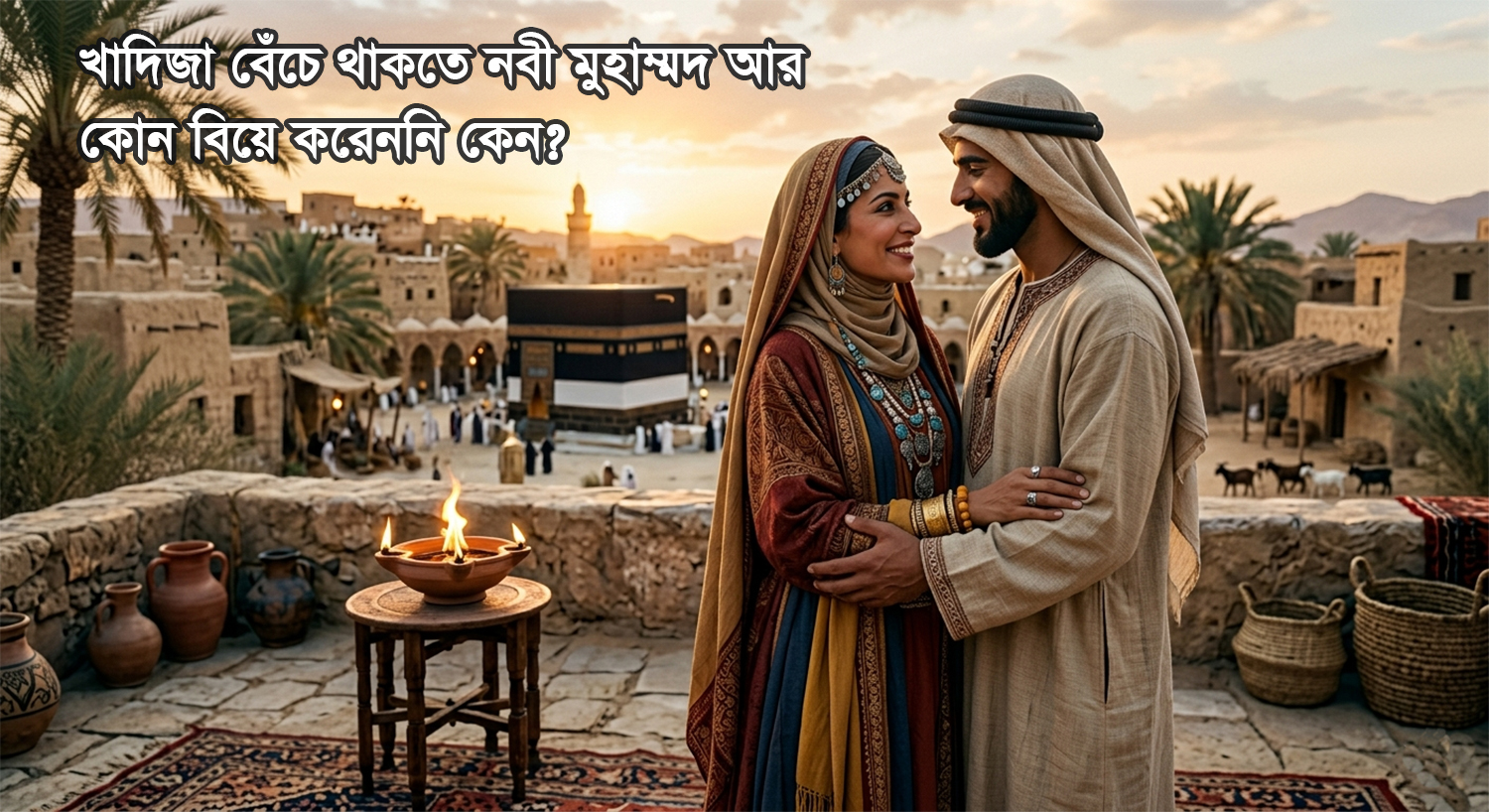
Muhammad and Khadija
Why did the Prophet Muhammad not marry anyone else while Khadija was alive?
The prophet Muhammad had 9–13 wives and 4+ sex slaves. There are also historical accounts that during so‑called jihad, after killing someone’s father, brother, husband, or relatives, beautiful women were made sex slaves the very same day and were sexually used. Even though he had the child wife Aisha, in a garden house in the desert he sexually abused two noble-born girl children, Jauniya and Umaima, after failing to persuade them to agree to intercourse. After being humiliated and rejected twice in a row, the companion Ash’ath brought his beautiful young sister Qatila to Muhammad, and Muhammad calmed himself by raping her. Beyond this, the pleasure‑loving prophet Muhammad also had intercourse with other ordinary women without marriage and without dowry. Evidence of this can be found in the Bengali translation of Ibn Kathir’s Tafsir, in the explanation of Surah Al‑Ahzab, verses 50/51, see pages 136 and 137. Muhammad’s child wife Aisha was quite annoyed by this bad habit of Muhammad; she even taunted Muhammad by saying that revelations came down according to Muhammad’s convenience! The verses he recited to the companions are the ones that are in the Qur’an; beyond that, no one knows how many private verses he “downloaded” for taking women to bed. It was said that simply having intercourse with him counted as marriage—how many hundreds of such “wives” did Muhammad have? Ibn Kathir’s Tafsir speaks of Muhammad’s uncontrollable sex life! Women would come to serve him, and under various pretexts he would have intercourse with them. In short, whenever he saw a woman, his “faith‑rod” would stand to attention. There is even a hadith that says when he saw a woman on the road and became sexually aroused, he would immediately run to one of his wives!
The personal life of Islam’s prophet Muhammad, especially his married life, has for hundreds of years been an important subject of discussion and debate among Muslim scholars, Orientalists, and secular historians. However, one indisputable fact is this: as long as Khadija bint Khuwaylid was alive (that is, from Muhammad’s age 25 to 50, about 25 years), he did not marry anyone else. Yet within a relatively short time after her death, he entered into multiple marriages. Traditional Islamic explanations view this change in light of religious, humanitarian, and political needs, but critics and analysts in the Orientalist tradition find socio‑economic and power‑centered reasons behind it.
Economic dependence and Khadija’s social influence
The economic reality of the Muhammad–Khadija relationship played an important role. At the time of marriage, Muhammad was approximately 25 years old and Khadija was 40—she was one of the most successful and influential businesswomen of the Quraysh tribe, whose trade caravans extended as far as Syria. Before marriage, Muhammad was employed to manage Khadija’s business. Critics argue that in this context, the balance of economic power in the couple’s relationship tilted toward Khadija. They believe that taking additional wives during Khadija’s lifetime could have created conflict with her family, wealth, and social network, which would have been risky for a young and comparatively less influential man.
The social customs of Mecca and the practice of monogamy
This concerns the social customs of pre‑Islamic Arab society. Although polygamy was practiced in pre‑Islamic Arabia, critics argue that in the case of upper‑class and influential women, a husband taking a second wife was considered a kind of social humiliation for the woman and her clan. In some cases, women from powerful or wealthy families would include a condition in the marriage contract that their husband could not take another wife. Khadija enjoyed great respect in Mecca and was given the title “at‑Tahira” (the Pure Woman). From this perspective, critics say that if Muhammad had married again during Khadija’s lifetime, it could have created social conflict with his powerful tribal connections, and that maintaining monogamy was an effective decision for Muhammad to protect his position in Mecca.
The early prophetic period and political crisis
This draws attention to the harsh realities after the beginning of prophethood. Muhammad received prophethood at the age of forty, when Khadija was about fifty‑five. In the early phase of preaching Islam, he faced intense opposition from the Quraysh; at one point, his entire clan, Banu Hashim, was subjected to a three‑year social and economic boycott in the valley of Abu Talib (Shi’b Abi Talib). According to critics, in this existential crisis there was no scope to think about new marriages or forming political alliances. Rather, during this difficult time, Khadija was at once his wife, his financial refuge, and his source of emotional strength—a relationship that was not in a situation to be put at risk.
Gaining state power in Medina and the change in circumstances
There is a clear contrast between the Meccan period and the Medinan period. In Mecca, up to Khadija’s death (when Muhammad was fifty), he was a persecuted preacher in a relatively weak position. But after the migration (Hijra) to Medina at the age of fifty‑five, the situation changed radically—he became the political, military, and religious leader of a new state. Critics claim that this newly acquired power and authority later created the opportunity for multiple marriages, which had not been possible in the comparatively weaker social position in Mecca.
Subsequent marriages and the theory of polygamy
This concerns the multiple marriages that took place in the decade following Khadija’s death. According to critics, traditional Islamic explanations describe these marriages mainly as acts of support for widows and orphans or as means of forming tribal‑political alliances. But critics believe that this explanation does not adequately apply to all the marriages. They particularly highlight the marriages to Aisha bint Abu Bakr and Zaynab bint Jahsh as examples. Their argument is that the removal of family and social constraints after Khadija’s death, combined with Muhammad’s absolute authority in Medina, is the real reason behind this change.
Final remarks
Many critics believe that the life of the prophet Muhammad was not smooth like that of many others in Mecca. Remaining unmarried until the age of 25, being rejected after proposing marriage—such psychological drives or personal quests for happiness, they argue, created a longing for opportunity that he later found in his post‑Khadija life in Medina. You also know that, in the absence of her husband, he spent the night at the house of his cousin Umm Hani, and when he was caught by the companions the next morning, he claimed that the Zoroastrian god Ardai Viraf’s story of ascension (Mi’raj) had occurred in his own life. In the case of Umm Hani (Fatima bint Abi Talib), when he had proposed marriage earlier in life, his uncle Abu Talib had rejected it with disgust.
The shift from monogamy during Khadija’s lifetime to multiple marriages after her death has been a long‑standing subject of debate among historians, theologians, and Orientalists. Critics and the Orientalist school explain this change in light of economic dependence, social customs, political crises, and shifts in power, whereas the traditional Islamic perspective views it as a combination of emotional attachment, religious duty, and socio‑political necessity. In analyzing the life of any historical figure, it is important to consider multiple perspectives and to keep in mind the limitations of primary sources, so as to avoid arriving at one‑sided conclusions.
Related Posts

অপারেশান এন্টেবে – এক রাতের গল্প এবং নজরুল ইসলাম ও সুইটি আক্তারের ইসলামি হত্যার শিকার হওয়া!
একটি রাষ্ট্র বিদেশে তার নাগরিকদের জীবন বাঁচাতে কী করতে পারে? এর কোন টেক্সটবুক উদাহরণ আছে?Read More
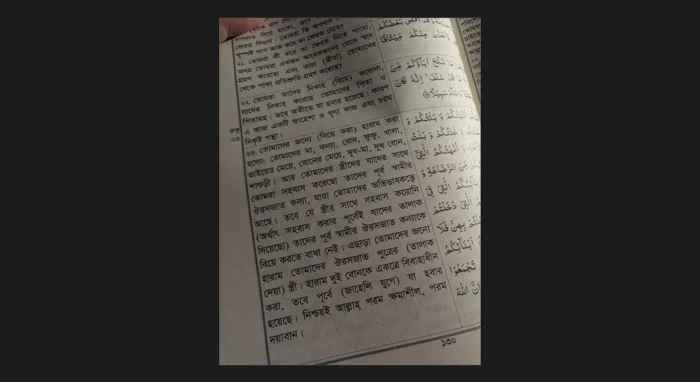
A random page from Muhammad’s self‑made book Qur’an and its unscientific statements
Sometimes I flip through random pages of Muhammad’s self‑made book Qur’an, and today this pageRead More
মুহাম্মদের বানানো কোরআন বই এর একটা র্যান্ডম পৃষ্ঠা ও সেখানকার অবৈজ্ঞানিক বক্তব্য
আমি মাঝে মাঝে মুহাম্মদের বানানো কোরআন বই এর র্যান্ডম পৃষ্ঠা উল্টাই, আজ এই পৃষ্ঠা হাতেRead More
Comments are Closed