
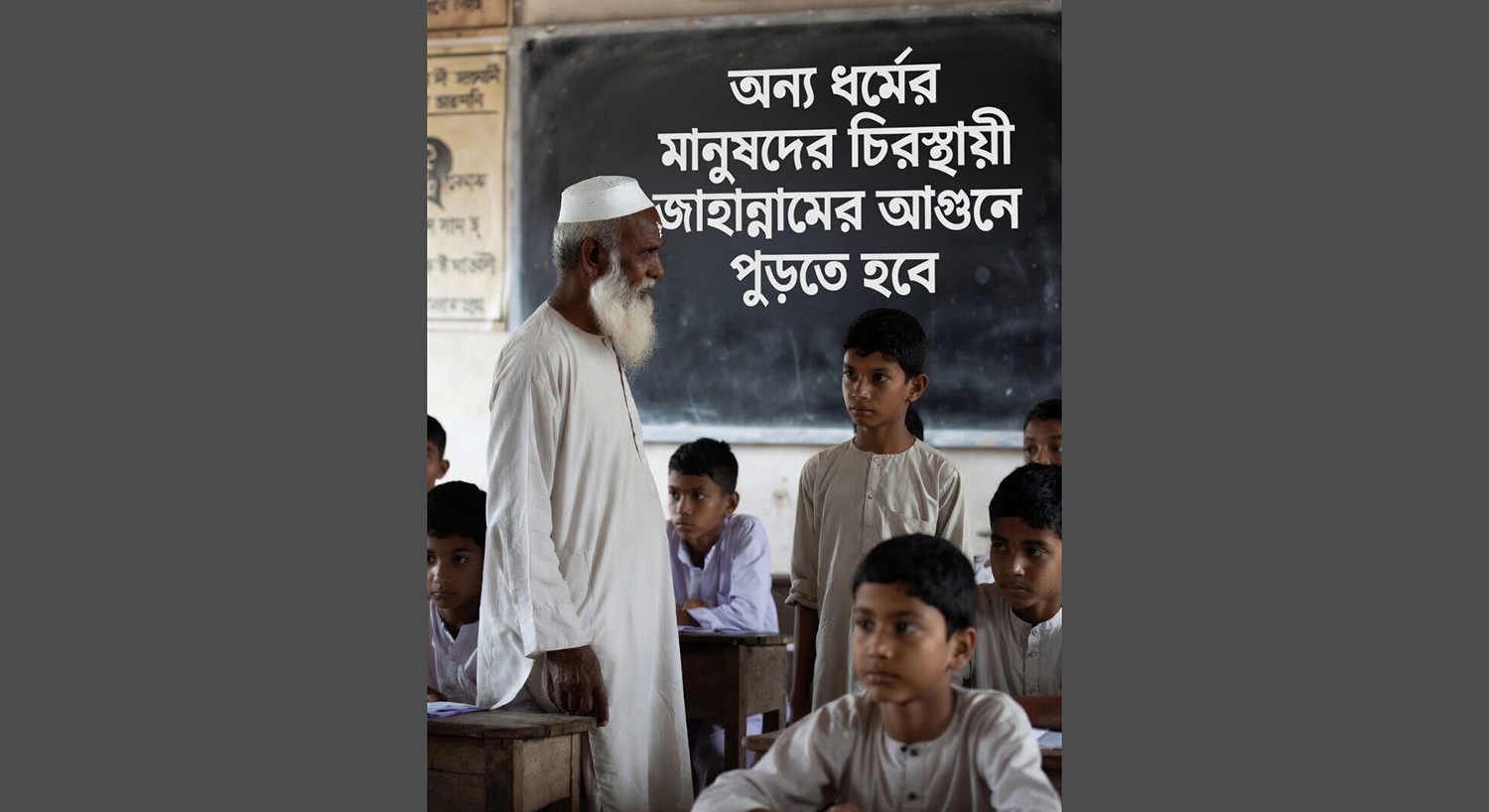
Morality and Jahannam
Does the concept of Hell align with genuine human morality?
Student: Sir, will the people of Hell have to cross the Pul Sirat?
Sir: Pul Sirat is a bridge between Paradise and Hell — thinner than a hair and sharper than a sword. People will have to walk across it.
Student: Sir, how will people walk on a bridge that is thinner than a hair? According to physics, it cannot support a human’s weight.
Sir: This is Allah’s power; it cannot be measured by physics.
Student: Alright, let’s assume it is possible by divine power. But sir, what is the purpose of crossing this bridge? If Allah already knows who will go to Paradise and who to Hell — then why this dramatic test?
Sir: It is a test.
Student: A test in this world and the hereafter? But why would an all-knowing Allah need to conduct a test? He already knows the result.
Sir: Allah knows best.
Student: Sir, I already knew that answer. Anyway, let’s talk about Hell. How many levels does Hell have?
Sir: It has seven levels.
Student: And Paradise?
Sir: One hundred levels.
Student: One hundred levels for reward, but only seven for punishment — does that mean Allah focuses more on reward than punishment?
Sir: His mercy outweighs His غضب (wrath).
Student: Then if His mercy is so great, why did He create Hell at all?
Sir: To punish sinners.
Student: Sir, how many times hotter is the fire of Hell?
Sir: Seventy times hotter than the fire of this world.
Student: Sir, the hottest fire on Earth is around 600 to 1400 degrees Celsius. Seventy times that would be up to 98,000 degrees Celsius. The surface of the Sun is only about 5,500 degrees. So Hell is many times hotter than the Sun?
Sir: It is possible by Allah’s power.
Student: If everything is possible by divine power, why give a number at all? Giving a number implies a measurable reality. And when that reality conflicts with physics, it cannot simply be dismissed by invoking “power.”
Sir: These are matters of the unseen, beyond human knowledge.
Student: Sir, where exactly is this vast Hell? In space? Beneath the earth?
Sir: Allah knows best.
Student: Sir, I read a hadith — that in summer Hell exhales, causing heat on Earth, and in winter it inhales, causing cold. Is this authentic?
Sir: Yes, it is found in Bukhari and Muslim.
Student: Then please explain — when it’s extremely hot in Bangladesh, it’s winter in Australia, and vice versa. At the same time, one part of Earth is hot while another is cold. Does Hell inhale and exhale simultaneously?
Sir: It…
Student: And not only that — the poles are cold year-round. Does Hell stay in “inhalation” there all the time? Near the equator, it’s hot all year — does it constantly “exhale” there? How can one Hell manage such variation?
Sir: It is meant metaphorically.
Student: But sir, the hadith directly states that heat comes from Hell’s breath. If it is metaphorical, how do we distinguish metaphor from literal meaning? Declaring things metaphorical when convenient seems arbitrary. Also, science already explains seasons — Earth’s axial tilt (23.5°) and orbit around the Sun cause them. There is no role for Hell’s breath here.
Sir: Science cannot explain everything.
Student: It can fully explain seasons, sir — there’s no debate. Anyway, what about the hadith saying Allah will place His foot in Hell?
Sir: Yes, there is a hadith — when Hell keeps asking for more, Allah will put His foot in it, and it will say “Enough, enough.”
Student: Sir, this suggests Allah has a physical foot. But it is also said He is formless. Can both be true?
Sir: It is metaphorical.
Student: Again metaphor! Hell’s breath is metaphor, Allah’s foot is metaphor — is anything literal?
Sir: The core aspects are literal.
Student: Who decides what is core? The interpreter? Then religion becomes subjective. Let’s talk about justice. Would a non-Muslim like Isaac Newton — who revolutionized science — go to Hell?
Sir: If one does not accept Islam, then Hell.
Student: And if a Muslim commits murder or rape?
Sir: If they repent, Allah forgives. A Muslim will eventually enter Paradise.
Student: So a rapist Muslim eventually goes to Paradise, while Newton burns forever — just because of belief?
Sir: Islam is the only true religion.
Student: Is that justice? No worldly court would consider this rational.
Sir: Allah’s justice is not like human justice.
Student: Clearly. Now, what will people eat in Hell?
Sir: The fruit of the Zaqqqum tree, which boils in the stomach like scalding water. They will drink pus and blood.
Student: If everything burns in Hell, how does the tree survive? And if bodies are burnt to ash, how do they eat?
Sir: Allah will regenerate their skin repeatedly so they can feel punishment.
Student: So people are revived repeatedly just to suffer again? Is that mercy, or cruelty?
Sir: It is what sinners deserve.
Student: What else will they drink?
Sir: Boiling water that tears their insides apart.
Student: Burning, then drinking boiling water, organs destroyed, then restored — does this reflect justice or vengeance?
Sir: Allah is just.
Student: Human rights reject cruel punishment. Eternal punishment for finite crimes — is that proportional?
Sir: Allah is not bound by human rights.
Student: Perhaps not — but a just being would act justly regardless. Also, is it true most inhabitants of Hell are women?
Sir: Yes, a hadith says that.
Student: Why?
Sir: They are ungrateful to their husbands and complain more.
Student: Is eternal punishment justified for such things? A criminal man may enter Paradise, while a woman may be punished forever?
Sir: It shouldn’t be oversimplified.
Student: The hadith says it clearly. Also, what about “clothed yet naked” women?
Sir: Yes, such women will be punished — those who expose their bodies.
Student: Who defines that? Standards change over time. Can eternal punishment be based on changing definitions?
Sir: Islamic guidelines are ثابت (fixed).
Student: But interpretations differ. Last question — someone in a remote tribe who never heard of Islam — will they go to Hell?
Sir: Allah knows best.
Student: Of course. Thank you, sir.
Does the concept of Hell align with genuine human morality?
A close examination of the concept of Hell in Islam reveals that these ideas largely reflect a culture of fear from a particular historical period. The descriptions — the Pul Sirat bridge, seven layers of Hell, seventy times hotter fire, the tree of Zaqqum, boiling drinks, and tearing insides — form a structure of fear rather than the design of an all-knowing being. Perhaps the most questionable claim is that seasonal changes are caused by Hell’s breathing. Science fully explains seasons through Earth’s axial tilt (23.5°) and orbit. More importantly, the explanation itself is inconsistent: when it is summer in one hemisphere, it is winter in the other. Polar regions stay cold, equatorial regions hot. How could a single Hell manage such contradictions?
From a justice perspective, the concept is even more problematic. A humanitarian scientist or doctor may be punished eternally for disbelief, while a criminal believer may be forgiven. This suggests identity matters more than actions. Regarding women, the explanation reflects patriarchal bias — ungratefulness or clothing issues leading to eternal punishment contradict modern standards of justice.
The most important question is: can morality exist without fear of Hell? Yes — and that is true morality. If people avoid wrongdoing only out of fear, they are not moral, just fearful. Millions live ethical lives without religious belief, guided by empathy, conscience, and social responsibility.
True morality comes from compassion, conscience, and understanding others’ suffering. Humans are social beings — to live with dignity and harmony, ethics is essential. Avoid wrongdoing because it harms others. Be humane because humanity defines us. Not the imagined fear of Hell, but conscience and reasoning should be the foundation of morality.
Part 1: Conversation about Heaven – available at this link
Related Posts
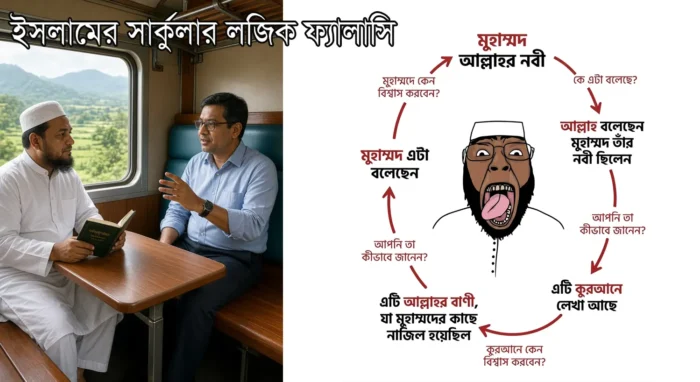
Islam’s Circular‑Logic Fallacy
Place: Cabin of a Dhaka–Sylhet-bound trainCharacters: Maulana Abdur Rahman (a responsible member of Tabligh Jamaat)Read More
ইসলামের সার্কুলার লজিক ফ্যালাসি
স্থান: ঢাকা থেকে সিলেটগামী ট্রেনের কেবিনচরিত্র: মাওলানা আব্দুর রহমান (তাবলিগ জামাতের একজন দায়িত্বশীল) ও অধ্যাপকRead More

Comments are Closed