
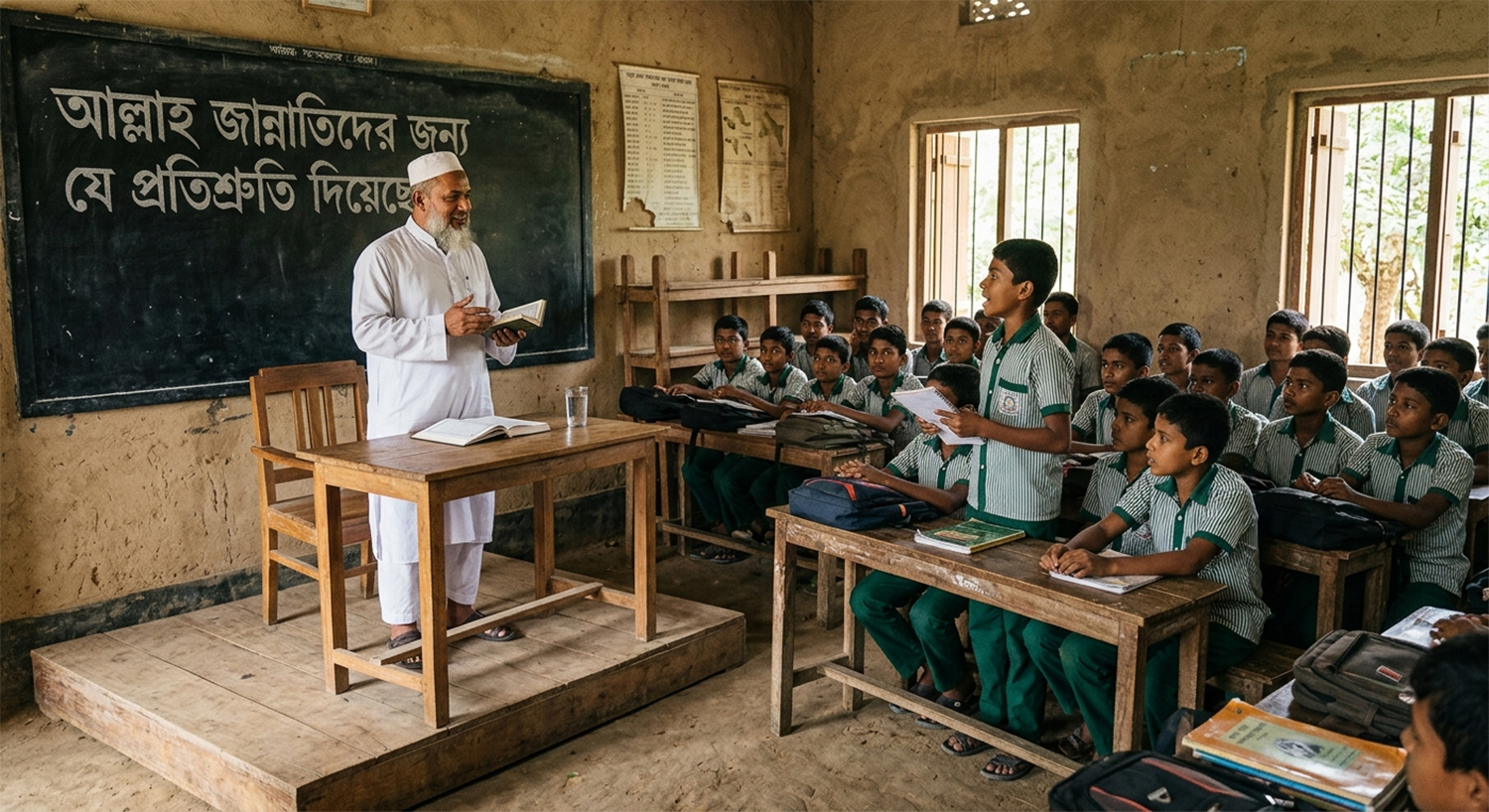
Islamic Jannah
Why Does the Islamic Concept of Paradise Feel Unappealing to the Modern Mind?
Student: Huzur, is it true that there will be 4 rivers in Paradise?
Huzur: You heard correctly. The rivers are — 1. A river of milk, 2. A river of water, 3. A river of delicious wine, 4. A river of purified honey
Student: Huzur, since in Paradise one can get whatever one desires, then what is the point of tempting people with these specific things?
Huzur: Allah knows best. Why are you asking me?
Student: Alright, Huzur, since there will be rivers of milk, wine, and honey in Paradise — then surely they must have sources and destinations? Can you explain where they come from and where they go?
Huzur: Allah knows that too.
Student: Huzur, Allah imagined a Paradise where cow’s milk flows through rivers — how do you explain that?
Huzur: Since the river of milk is mentioned in the Quran, there is nothing to explain. He knows best.
Student: Huzur, we get milk from animals — how will it flow in a river? What is the formula?
Huzur: By Allah’s command.
Student: I understand that, but what is the mechanism? And besides, how would a single person even consume a whole river of milk? What is the need for it? What would a person in Paradise do with so much milk?
Huzur: Why are you so bothered by it?
Student: Come on, Huzur — when a glass of milk is enough, what is the point of a whole river? Honestly, instead of motivating self-sacrifice, such promises make me want to laugh to death.
Huzur: Who is stopping you from dying? Go ahead, what’s the problem?
Student: Alright, forget that — honey exists in beehives. How will honey flow in rivers?
Huzur: Allah knows best.
Student: But bees gather honey for their larvae, not for humans. Humans take it by driving them away — how will it flow in rivers?
Huzur: Allah alone knows!
Student: When even 100 milligrams of honey is sufficient, isn’t the idea of being immersed in streams of honey somewhat absurd?
Huzur: Why would it be absurd? These are mentioned in the Quran.
Student: Huzur, how do you analyze the idea of rivers that flow only with wine?
Huzur: What analysis is there? Allah knows best.
Student: Shouldn’t there be some limit to this promise of rivers of wine?
Huzur: That’s not a bad point, something to think about.
Student: Exactly — giving a person rivers of wine as a reward, isn’t that an unhealthy primitive idea?
Huzur: These are Allah’s blessings, you won’t understand. Besides, the wine in Paradise does not intoxicate — people can drink as much as they want. What’s the problem?
Student: Huzur, if it doesn’t intoxicate, is it really wine or just juice?
Huzur: Allah knows best.
Student: Huzur, now let’s talk about golden houses. It is said that there will be houses of gold in Paradise. But what would I do with a house made of gold?
Huzur: You will live there comfortably.
Student: What comfort is there in a golden house? Gold is a hard metal, not comfortable like wood or brick. More importantly — if everyone in Paradise has a house made of gold, then gold has no value. When something has no exchange value, what is the difference between gold and dirt?
Huzur: There is no need for buying and selling in Paradise; Allah will provide everything.
Student: Then what is special about a golden house? On earth, gold is valuable because it is rare. If everyone has it, then it is no longer special. A pile of dust and a pile of gold become the same, right?
Huzur: Allah knows best.
Student: I knew that answer already.
Student: Huzur, it is said that there will be vast date palm gardens in Paradise. What would I do with such huge orchards? I only need ten or twenty dates a day. Will the rest just rot?
Huzur: Nothing will rot; everything in Paradise is everlasting.
Student: Fine, they won’t rot. But I can’t sell them either. If I offer them to neighbors, they’ll say, “Brother, I have my own garden.” Then what is the purpose of having a huge orchard? It’s just a waste of space.
Huzur: There is no shortage of space in Paradise.
Student: You avoided the question. The main issue is — what is the meaning of unnecessary excess? Is this the plan of a wise being, or the imagination of someone who equated “bigger” and “more” with “better”?
Huzur: You are destined for Hell.
Student: Huzur, now let’s talk about the Hoor. It is said that men will get hoor in Paradise. But aren’t these essentially like sex dolls — eternally young, eternally pure, made only for service? Without real personality, emotion, love, or the ability to resist — is there any genuine attraction left?
Huzur: The hoor are pure and perfect in every way.
Student: What does “perfect” mean? A woman who can never say no, who always consents, who has no independent will — is that a human or a machine? In real life, a man loves a woman for her personality and independence — without that, what is the meaning of a relationship?
Huzur: Everything will be different in Paradise.
Student: Does “different” mean there will be no human emotions? Then is it joy, or just a programmed experience? And Huzur, what do women get in Paradise? Do they get male hoor?
Huzur: Women will have their husbands.
Student: So men get 72 hoor plus their wives, while women get only their husbands — who are themselves busy with those hoor? How do you explain this inequality?
Huzur: Allah knows best.
Student: Of course.
Student: Huzur, fruits are mentioned in Paradise — mainly dates and figs. But I want to eat mangoes, lychees, berries, apples, oranges, jamun. These are not mentioned anywhere. Will I get them?
Huzur: You will get whatever you desire in Paradise.
Student: Then why mention only dates and figs separately? It would have been enough to say “you will get whatever you want.” Interestingly, mangoes and oranges were not known in 7th-century Arabia. Isn’t this evidence that the depiction of Paradise reflects a specific time and place?
Huzur: The Quran is universal.
Student: If it is universal, why are the favorite fruits of people from Bangladesh or Europe not mentioned? Was universality limited to the Arabian Peninsula?
Huzur: You are an atheist; it is useless to argue with you.
Student: Without debate, how can truth emerge?
Student: Huzur, overall tell me — does this portrayal of Paradise really seem appealing?
Huzur: Of course, it is the ultimate reward.
Student: Think about the desert people of 1500 years ago. They suffered from lack of water, so rivers were appealing. Wine was a luxury, honey was rare, milk was valuable nutrition, gold symbolized wealth, dates were staple food, and women were objectified. These very things appear in the description of Paradise. Is that a coincidence?
Huzur: That is Allah’s knowledge.
Student: Or is it the limited imagination of a 7th-century Arab, shaped by the needs of his surroundings?
Huzur: You cannot understand divine power through logic.
Student: What is divine power?
Huzur: It is Allah’s special ability.
Student: What is the formula for that ability?
Huzur: You are an atheist; you do not have the capacity to understand.
Student: Then who does have that capacity?
Huzur: Those who believe blindly without conditions.
Student: Hahaha — finally you said it clearly. One must believe blindly — no questioning allowed. Thank you, that was exactly what I needed.
Why Does the Islamic Concept of Paradise Feel Unappealing to the Modern Mind?
If we carefully analyze the description of Paradise in the Quran, it becomes clear that this portrayal is rooted in the lifestyle, needs, and deprivations of the people of the 7th-century Arabian Peninsula. At that time, desert inhabitants suffered from severe water scarcity, so the promise of rivers in Paradise was highly appealing. Milk, honey, and wine were luxury items beyond the reach of ordinary people. Gold symbolized wealth and power. Dates were the primary food source. In this context, the depiction of Paradise served as a powerful psychological incentive for the poor and deprived.
However, from the perspective of a modern individual, this description often appears incomplete and, in some cases, even absurd. Today, a visit to any supermarket reveals dozens of varieties of fruits, yet the Quranic description mentions mainly dates and figs — with no reference to mangoes, lychees, apples, or oranges. This strongly suggests a geographically limited imagination. If an all-knowing being were describing Paradise, would such diversity be overlooked?
The promise of golden houses is appealing on Earth because gold is rare and valuable. But if everyone in Paradise possesses golden houses, then gold loses its uniqueness. Value depends on scarcity — a basic economic principle seemingly ignored. Similarly, vast orchards and rivers of wine represent excess in quantity but lack any practical necessity.
The concept of hoor is also problematic when viewed through a modern or feminist lens. A being designed solely for pleasure, without individuality or autonomy, reflects a patriarchal mindset that objectifies women. Furthermore, the apparent lack of equivalent rewards for women highlights a clear imbalance.
Most importantly, the concept of Paradise lacks elements that reflect modern human aspirations — such as knowledge, creativity, exploration, and discovery. There is no mention of libraries, research, music, or space exploration. Not even a hint of technology or communication exists, because such concepts were beyond the imagination of 7th-century Arabia.
Overall, the Islamic depiction of Paradise appears to be a construct shaped by a specific time, geography, and social context. While it may have effectively inspired desert communities of the past, for many modern, educated, and reflective individuals, it can seem limited, unequal, and lacking in imaginative depth.
Part 2: Conversation about Hell – available at this link
Related Posts
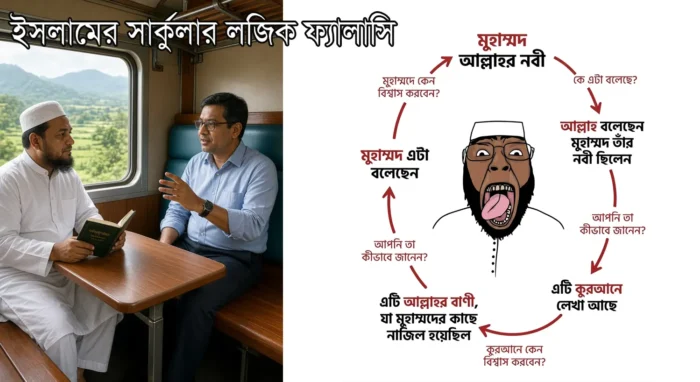
Islam’s Circular‑Logic Fallacy
Place: Cabin of a Dhaka–Sylhet-bound trainCharacters: Maulana Abdur Rahman (a responsible member of Tabligh Jamaat)Read More
ইসলামের সার্কুলার লজিক ফ্যালাসি
স্থান: ঢাকা থেকে সিলেটগামী ট্রেনের কেবিনচরিত্র: মাওলানা আব্দুর রহমান (তাবলিগ জামাতের একজন দায়িত্বশীল) ও অধ্যাপকRead More
Comments are Closed