
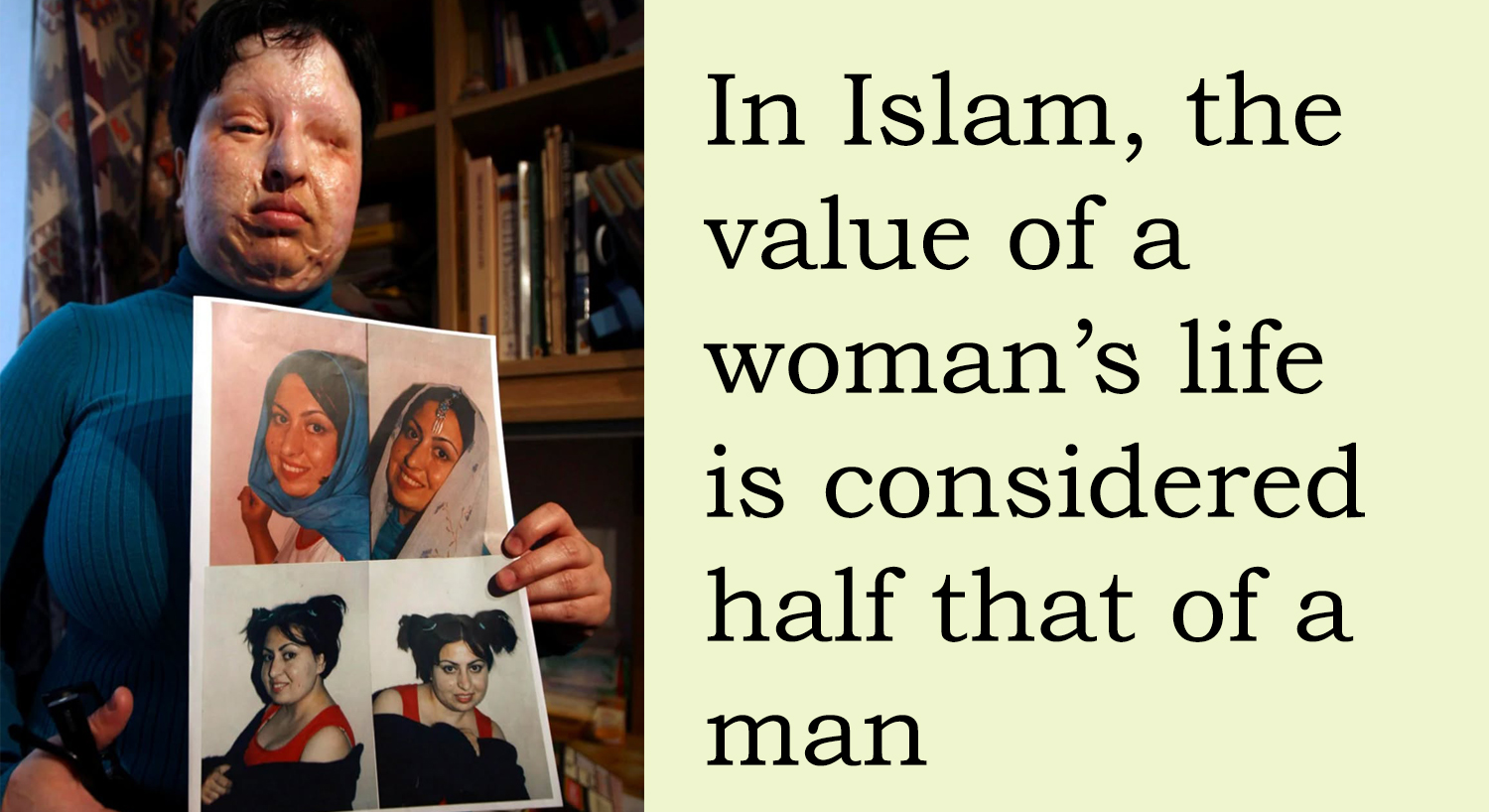
In Islam, women are considered half
In Islamic law, women are considered half of men — the story of Ameneh’s triumphant struggle and the defeat of religion
An evening in October 2004. A young electronics engineer was returning home from work on the streets of Tehran. Her name was Ameneh Bahrami. Suddenly, acid was thrown onto her face. In an instant, both of her eyes were permanently destroyed, and her face was disfigured forever. This single attack turned her next seven years of struggle into a legal epic — one that was not just a personal fight for a woman, but became a global debate about the constitutional value of women within the framework of Islamic law. This legal battle showed that — valuing women as half of men in Islamic law is profoundly inhumane, degrading to women, and unacceptable in the modern world. This woman proved that human compassion can be greater than any religion!
The Night of the Attack and Its Background
Ameneh Bahrami was a highly educated, independent young woman. In a conservative society like Iran, studying electronics engineering and establishing herself professionally as a woman was itself a story of struggle. Her classmate, Majid Movahedi, had proposed marriage to her. Ameneh rejected the proposal.
The simple truth that a woman has the right to say “no” — Majid could not accept it. To take revenge for the rejection, one day, as she was returning from work, he threw acid at her face. An acid attack is not just physical violence. It is a weapon that permanently alters a person’s identity — the face, a symbol of one’s individuality and freedom. That very night, Ameneh lost her eyesight. Despite multiple surgeries, she never regained her vision.
But Ameneh did not break down. She turned to the law.
Qisas — An Eye for an Eye
Iran’s Islamic legal system includes a provision called “Qisas.” It is based on verses 178–179 of Surah Al-Baqarah in the Qur’an — “life for life, eye for eye, nose for nose.” This means that if someone destroys another person’s eye, the victim has the right to demand the same injury be inflicted on the offender.
[In some regions of Pakistan, there have also been reports of customs where if a woman from one tribe is raped, a man from that tribe rapes a woman from the perpetrator’s family in retaliation.]
In Ameneh Bahrami’s case, this law applied. She demanded that Majid be blinded in the same way. After seven years of legal battle, in 2011, the Iranian court issued that verdict. Acid would be dropped into Majid Movahedi’s eyes to blind him.
But that was not the end. This case revealed facts that exposed to the world the deeply embedded gender inequality within Islamic law. Human rights activists around the world were shocked by this discrimination, by what they described as deep hostility toward women. Could a woman’s life be worth half that of a man? Could a 1400-year-old discriminatory law still be applicable today? Can a religion view women this way? Activists raised their voices loudly over the Ameneh case.
In the Eyes of the Law — A Woman as Half a Person!
When Ameneh demanded that Majid be blinded in both eyes (since she lost both of hers), Iranian Islamic law presented a strange and troubling calculation.
Diyah or Blood Money: A Woman = Half of a Man
According to Islamic jurisprudence (fiqh), diyah is the compensation paid for injury or death. In determining this compensation, Islamic law introduces a fundamental inequality:
The full diyah of a woman is half that of a man.
That is, if a woman is killed, the compensation paid is only half of that for killing a man. Similarly, the value of a woman’s eye is considered half of a man’s eye.
https://nbcnews.com/id/wbna29509977
This doctrine exists in the four major Sunni schools — Hanafi, Maliki, Shafi‘i, and Hanbali — and is also present in Shia law. Many scholars have justified it by arguing that men bear the “economic responsibility” of the family, so their lives carry greater “financial value.”
But this argument cannot hide an inhumane truth — in the eyes of the law, a woman is worth less than a man.
What Happened in Ameneh’s Case?
Ameneh lost both eyes. She wanted Majid to lose both of his — a demand that seems entirely just in human terms, although human rights activists consider such punishments inhumane and contrary to human rights.
Iranian Islamic law said:
- The value of Ameneh’s two eyes = one eye of a man
- Destroying both of Majid’s eyes = paying his full diyah
- Since Majid’s two eyes were considered more valuable than Ameneh’s two, Ameneh would have to pay him compensation for the “excess damage.”
In other words, the victim would have to pay in order to receive justice.
This provision drew severe criticism from international human rights organizations. Amnesty International, Human Rights Watch, and various UN bodies described it as a clear violation of human rights.
The Status of Women in Islamic Law — A Review
Ameneh’s case is not an isolated incident. It reflects broader institutional inequalities against women in Islamic legal systems. Some examples:
1. Inequality in Testimony
In classical Islamic law, in many cases, the testimony of two women is considered equal to that of one man. This comes from Surah Al-Baqarah (2:282) regarding financial transactions. In some Islamic legal systems, this has been applied beyond financial matters, including criminal cases.
2. Inequality in Inheritance
According to Surah An-Nisa (4:11), a son receives twice the share of a daughter. That means a woman inherits half as much as her brother.
3. Inequality in Marriage and Divorce
In classical Islamic law, a man can initiate divorce, sometimes simply by pronouncing “talaq” three times. A woman, however, often must go through the courts, provide justification, or obtain a khula divorce by returning her dowry. In Bangladesh, for example, the marriage contract includes a clause (box 18) where the husband may grant or deny the wife the right to divorce. If not granted, she cannot divorce through the registrar and must go to court, while a man can divorce at will.
4. Inequality in Diyah
As seen in Ameneh’s case, the value of a woman’s life and bodily harm is considered half that of a man in several legal systems, including those of Iran, Saudi Arabia, and Pakistan.
5. Inequality in Guardianship
In many Islamic countries, women need permission from a male guardian for travel, marriage, and even obtaining a passport. In places like Saudi Arabia, this “mahram” system has long restricted women’s independence.
Supporters often defend these inequalities as “divine law.” But in reality, they reflect the patriarchal structures of medieval societies and attempt to preserve them indefinitely.
Support and Criticism — Two Sides of the Debate
It should be noted that there are differing views within Islam on these matters.
Conservative view: Many scholars argue that the lower diyah for women reflects men’s financial responsibilities (maintenance, dowry, etc.), meaning their economic loss is greater.
Reformist view: Many Muslim scholars and feminist thinkers — such as Fatema Mernissi — argue that these rulings are contextual and subject to change. The core Qur’anic principle is justice (adl), and any law that produces injustice should be reconsidered.
Human rights perspective: The UN Convention on the Elimination of All Forms of Discrimination Against Women (CEDAW) clearly states that men and women are equal before the law. Any legal system that assigns women lesser value conflicts with international human rights standards.
The Moment of Forgiveness — Beyond the Law
The defining moment of this epic came on July 31, 2011.
In a hospital room, Majid Movahedi lay on a bed. Doctors were ready. The court’s sentence was about to be carried out. Acid would be dropped into his eyes.
At that moment, Ameneh Bahrami announced that she forgave him.
She didn’t just forgive — she said:
“I do not want anyone else to go through the pain I have endured.”
Read that sentence. Pause for a moment.
A woman who fought for seven years. Who lost her sight, her appearance, her dignity. Who even faced discrimination from the law — which treated her as “half a person.” In the end, she chose forgiveness.
This forgiveness was not weakness. It was the reflection of extraordinary moral strength — proving she was greater than her oppressor, even greater than the laws that claimed divine authority.
Her decision created a global impact. BBC, The Guardian, The New York Times — all covered her story. Even today, it is cited in discussions.
Ameneh’s Legacy — What Changed, What Didn’t
Ameneh’s story teaches us many things.
What changed: Awareness about acid attacks increased globally. Many countries imposed stricter regulations on acid sales. Her story gave a voice to acid attack survivors.
What didn’t: In countries like Iran, women’s diyah is still half of men’s. Thousands of women worldwide still suffer acid attacks. Laws that devalue women continue to exist under the claim of divine authority. The debate over women’s legal status continues.
Humanity Beyond Law
Ameneh Bahrami’s story presents two truths.
First truth: Any law that values a woman at half a man is unjust. Whether justified by religion or the state — it is unacceptable from a human dignity perspective. Justice is indivisible. There is no such thing as “half justice.”
Second truth: A person’s moral height can transcend the limits of law and religion. By forgiving, Ameneh proved she was far greater than the law that measured her as “half a person.”
Her forgiveness was not weakness — it was victory.
Yet this victory raises a question — why must a woman struggle so hard for justice? Why must she forgive a system that deemed her worth half of a man?
Ameneh Bahrami’s story is not over. It remains an unfinished question — for the conscience of society. Human-made law or divine law — which serves humanity better? Which should civilization embrace, and which should it leave behind?
Related Posts

Operation Entebbe – the story of one night, and the Islamic execution suffered by Nazrul Islam and Sweety Akter
What can a state do to save the lives of its citizens abroad? Are thereRead More
অপারেশান এন্টেবে – এক রাতের গল্প এবং নজরুল ইসলাম ও সুইটি আক্তারের ইসলামি হত্যার শিকার হওয়া!
একটি রাষ্ট্র বিদেশে তার নাগরিকদের জীবন বাঁচাতে কী করতে পারে? এর কোন টেক্সটবুক উদাহরণ আছে?Read More
A random page from Muhammad’s self‑made book Qur’an and its unscientific statements
Sometimes I flip through random pages of Muhammad’s self‑made book Qur’an, and today this pageRead More
Comments are Closed