
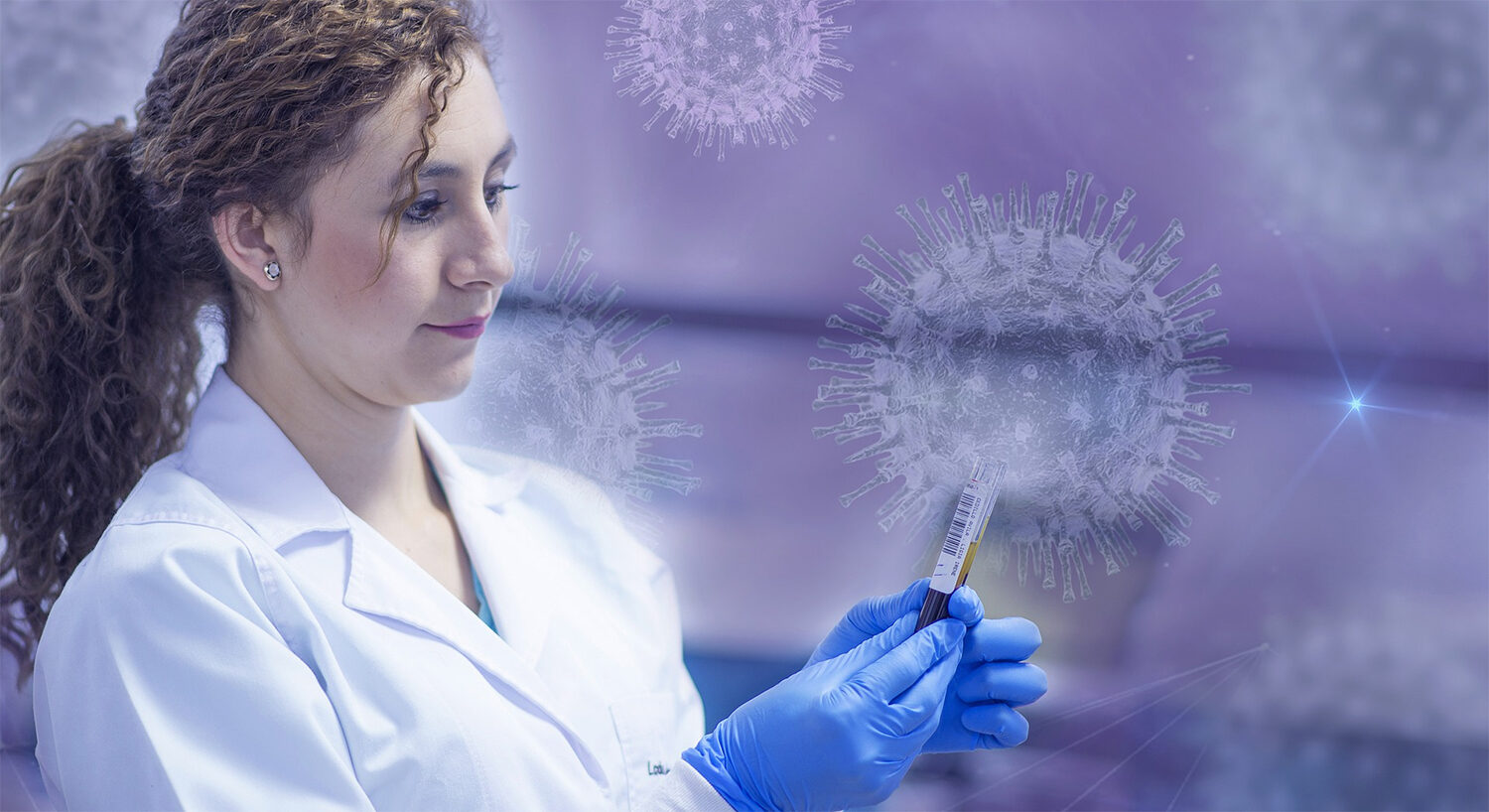
Civilization and Viruses
Did you know that viruses have played a major role in human development and civilization?
I have written before that this world fundamentally belongs to viruses and bacteria. We are parasites in their world. In this world, these so-called parasitic microorganisms have made enormous contributions to the survival of humans and other living beings — contributions we often fail to acknowledge. Consider this: the human being who today wields such extraordinary intelligence, who advances science at a breathtaking pace, who claims to be the pinnacle of creation — would you accept that the greatest contributor to all of this was a species of virus? Scientists actually believe so. You may know about the common ancestor shared by humans and chimpanzees millions of years ago in the course of animal evolution. But what happened that caused chimpanzees to remain wild chimpanzees while humans became the masters of the Earth? It was here that a species of virus played its role. This was not a planned event by any means — it was purely an accident. This universe, this Earth, all these living beings, this climate — none of it happened by design. Everything is merely the result of a series of accidents. Today they have settled into an apparent system for a temporary period, and we think everything is unfolding according to plan.
According to scientists, the very intelligence that humans use today to wage war against viruses is itself fundamentally a contribution of one species of virus.
Can a virus be a friend to humanity? In a world devastated by the COVID-19 pandemic, the answer to this question would not be positive at all. The world’s great superpowers are trembling under the ferocious onslaught of this virus, stripped of their strength. Many have even suggested that the rampage of this ultramicroscopic monster could wipe out all of human civilization.
Even so, what scientists say stands in stark contrast to such a negative public perception of viruses. There are approximately 5,000 species of viruses on Earth. Of these, only about 200 are truly dangerous. A group of daring scientists, dressed in protective gear, travels from one end of the Earth to the other — through dense forests and remote caves — in search of viruses harmful to humans, seeking to protect the world from potential pandemics. They collect viruses from bats, known reservoirs of viral diversity, and study them. But that is a separate discussion. Let us stay on the main topic here. Viruses as friends — really?
Viruses — which microbiologists are reluctant to classify among the living — are they friends or enemies of humanity? Though viruses appear to be enemies in the wake of the COVID-19 outbreak, some viruses are our closest allies. Scientists believe that such viruses have contributed enormously to the thousands of years of human evolutionary history. Here are the stories of a few such viruses.
1. The Arc Gene:
Whether in joy or in sorrow, how does our brain store memories? When we learn something, how do we retain it?
In seeking answers to these questions, neuroscientists around the world labored for many years. Ultimately, to find the answer, they had to turn back to these genetic parasites — viruses. Long before humanity stood upright and began walking on two feet, the ancestors of humans were infected by a particular virus. At that time, a few molecular units (genes) from the virus’s genetic material made their way into the chain of human genetic material. And because of this, the human brain came to possess this astonishing quality. In short, it can be said that the very foundation of human intelligence today was laid by this virus. At least, that is what scientists believe. If their hypothesis is correct, then all of today’s civilization, science, and progress became possible as a result of that ancient viral infection.
2. Ancient Retroviruses:
Why don’t humans lay eggs? In these times of COVID-19, offering thanks to a virus might seem like audacity in adversity. And yet — thank you, viruses, and particularly the ancient retroviruses (Endogenous Retroviruses; ERVs). These viruses spared humanity the enormously laborious process of laying eggs and hatching offspring. As strange or outlandish as it may sound, scientists have published research-backed data, evidence, and arguments in support of this theory in reputable journals. What these scientists are saying, put simply, is this: this virus played a special role in the highly complex evolution of the placenta by inducing mutations in the genetic material of early human ancestors. And because of this, mammals give birth to live young rather than laying eggs — and among those mammals is the human being.
A 2016 scientific review published in the prominent journal Cell noted that, due to viral infections, between 40 and 80 percent of the human genome is derived from these viruses.
3. Bacteriophages:
These viruses infect and destroy harmful bacteria. They are found nearly everywhere — in soil, in water, and even within the human body (mostly in our gut and mucus). These viruses are used to help control bacterial infections in the human body. Antibiotics spare neither good nor bad bacteria. Bacteriophages, on the other hand, seek out and destroy only the harmful bacteria. Their benefits have already been demonstrated, and the use of such viruses — particularly in cancer treatment and in eliminating antibiotic-resistant bacteria — has given rise to a new wave of optimism in medicine.
4. Indiana Vesiculovirus or Vesicular Stomatitis Virus (VSV):
Due to the blocking action of a protein called interferon, this virus is unable to harm healthy human cells. However, in cancer cells where interferon fails to respond, this virus selectively destroys those cancer cells. Researchers have therefore become enthusiastic about using such viruses in cancer treatment. Recent studies have shown that it is possible to reduce tumor size using this virus, and positive results have been observed in treating melanoma, lung cancer, colon cancer, and brain tumors using VSV. Furthermore, this virus has been modified and deployed to destroy T-cells infected with HIV. This modified virus has been given a fitting name — it is called the “Trojan Horse.”
Recombinant VSV has shown remarkable results in Ebola vaccine trials. The vaccine developed to prevent Ebola infection has been found to be between 76 and 100 percent effective. Researchers are firmly confident that this virus holds the potential for many more applications in the service of humanity.
5. Adenoviruses:
Adenoviruses are a group of fairly common viruses. They are highly contagious, typically cause only mild symptoms, and usually resolve within a few days. Researchers have reported that a particular strain of this virus, HAdV-52, binds to a specific type of sugar present in cancer cells. Experts therefore believe that HAdV-52 could prove quite effective in treating cancer.
6. Viruses in Vaccine Development:
The role of vaccines in building immunity against disease in humans and animals is no longer a secret to anyone. Viruses are used in the preparation of these vaccines. The best example is the cowpox virus. For centuries, smallpox was a name synonymous with terror across the world. In the twentieth century alone, nearly 300 million people lost their lives to smallpox. That terrifying disease is today a grim chapter in history. And yet, the cure for this most dangerous of infectious diseases was hidden within another virus — the cowpox virus.
Beyond medicine, pathways for the widespread use of viruses in agriculture have also opened up. Scientists are tirelessly researching to unravel the hidden mysteries of viruses, and such research is revealing astounding information.
According to scientists, these brainless viruses have long since taken over the human brain. The intellectual battle that humans wage against viruses today is, paradoxically, itself a contribution of viruses. So the question of whether viruses are friends or enemies should not be difficult to answer — because these ultramicroscopic, acellular viruses are the very ones that gave us the intelligence to ask the question in the first place.
References:
1. Neuroscience & Biobehavioral Reviews, April 2019, 99:275–281.
2. Edward B. Chuong, PLOS Biology, October 2018, e3000028; or Abir Mitra, BBC World Service, 31 January 2020.
3. Journal of General Virology, December 2012, 93 (Pt 12): 2529–2545.
[ With gratitude to: Mainul Hasan, Microbiologist and expert working within the French judiciary. https://tinyurl.com/ybhdl28o ]
Related Posts

Why does Allah show such preference for women with large breasts and large buttocks? Do men feel the same way? Does this give women any advantage?
If you leave Prophet Muhammad in Pattaya’s Walking Street and Beach Road after evening, inRead More
নারীর বড় বক্ষ ও নিতম্বের প্রতি আল্লাহর এতো পক্ষপাত কেন? পুরুষেরও কি তাই? এটা কি নারীকে সুবিধা দেয়?
আপনারা যদি পাতায়ার ওয়াকিং স্ট্রীটে ও বীচ রোডে সন্ধ্যার পর আলো আঁধারিতে নবী মুহাম্মদকে ছেড়েRead More

Do women like the color pink? What is the psychology behind it?
Last winter my friend Lamia went to buy a birthday present for her niece. TheRead More
Comments are Closed