
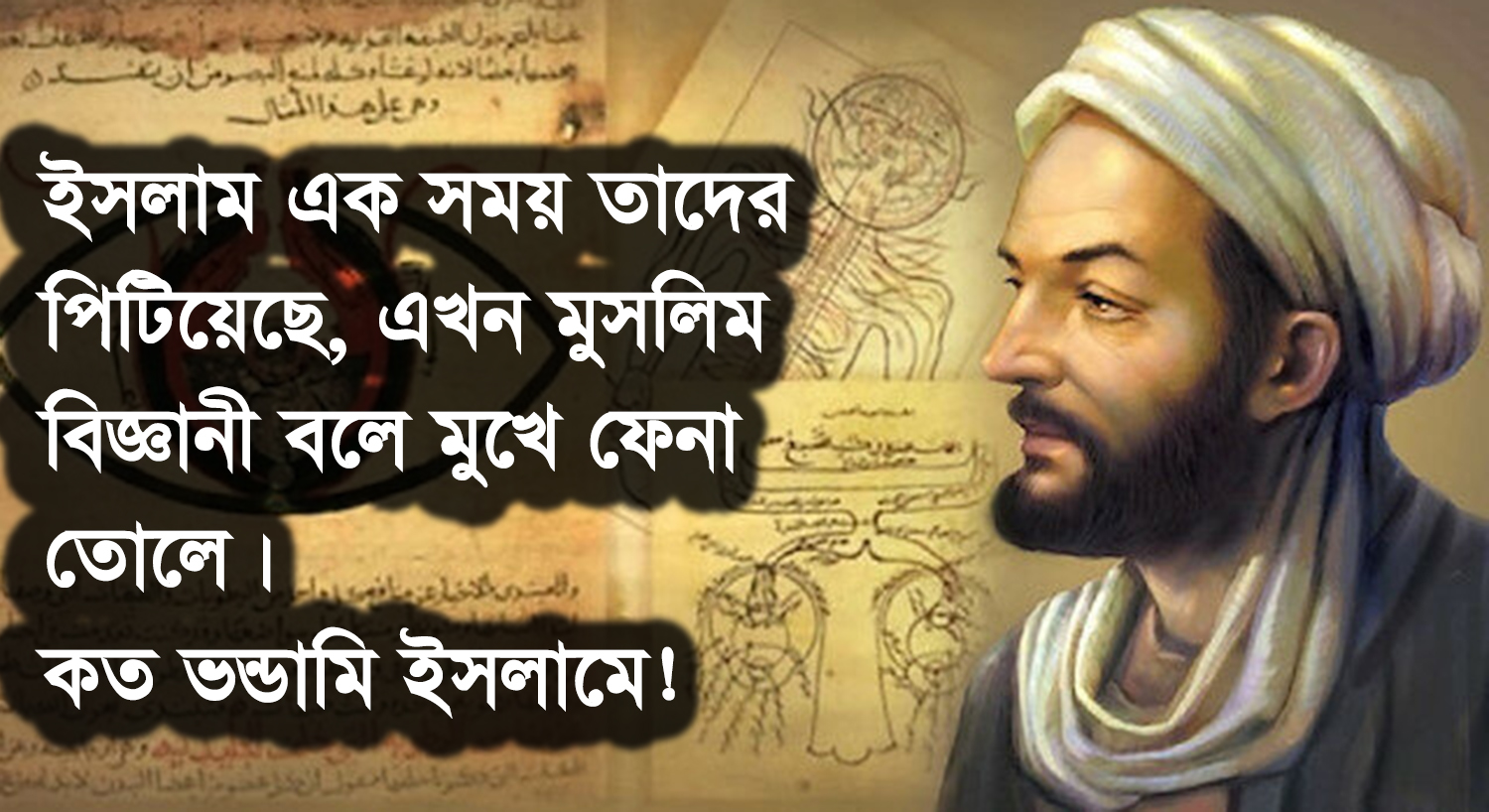
Are They Islamic Scientists?
Islam once humiliated scientists; now it takes pride in them. Islamic hypocrisy!
Science does not recognize religion, nationality, or geographical boundaries. There are no verses from religious scriptures written on laboratory tools or telescopes—only the pursuit of truth. We do not label Newton, Galileo, Einstein, or Hawking as Christian/Jewish/atheist scientists. Yet, under the label “Islamic Golden Age,” scientists from that era are often branded as “Muslim scientists,” with religious ownership being claimed.
Today, many believers, religious speakers, or writers proudly mention names like Ibn Sina, Al-Razi, or Ibn Rushd as “Muslim scientists.” But history shows that these individuals were often viewed with hostility by the orthodox Islamic religious authorities of their time because of their scientific and philosophical ideas. Influential theologians like Imam Al-Ghazali labeled many of their philosophies and scientific thoughts as “kufr” (contrary to Islam). Not only that—they were insulted, humiliated, beaten, declared mad and confined, exiled, imprisoned, and even killed. Al-Ghazali’s Tahafut al-Falasifa (The Incoherence of the Philosophers) is a major example of this conflict. The same Islam that once placed obstacles in their path now claims them as “Muslim scientists”! What hypocrisy!
Persecuted in Life, Celebrated After Death: A Historical Hypocrisy
Ibn Sina (Avicenna, 980–1037): Author of the famous medical encyclopedia Al-Qanun fi al-Tibb. To understand human anatomy correctly, he reportedly had to dig up graves at night to examine corpses, because autopsy was considered sinful in the religious society of his time. Accused of heresy, he also spent time imprisoned in Isfahan.
Ibn Rushd (Averroes, 1126–1198): The great philosopher who revived Aristotelian thought was exiled under orders of the orthodox Caliph Al-Mansur. His philosophical and scientific writings were publicly burned by royal decree.
Al-Kindi (801–873): Known as the “Philosopher of the Arabs,” he suffered severe persecution under Caliph Al-Mutawakkil for engaging with Greek philosophy and science. He was flogged publicly, his vast library confiscated, and he died in humiliation in old age.
Al-Farabi: A scholar of logic and social sciences, he was declared a “heretic” and “atheist” by orthodox clerics. Al-Ghazali labeled him an enemy of Islam, forcing him to spend much of his life moving from city to city to escape persecution.
Omar Khayyam (1048–1131): Mathematician, astronomer (calendar reform, cubic equations), and poet. His poetry often questioned religious hypocrisy and fate, leading many to view him as a skeptic rather than a conventional believer.
Al-Razi (Rhazes, 865–925): A pioneer in medicine who distinguished smallpox from measles. He was criticized for his rationalist views. Stories about his blindness exist—some claim he was struck by his patron, while others argue it was due to illness. He openly criticized religious authority and blind faith.
Ibn al-Haytham (Alhazen, 965–1040): Founder of modern optics and a pioneer of the scientific method. He fell out of favor with Caliph Al-Hakim and spent about 10 years under house arrest, pretending to be insane.
Ibn al-Rawandi: A strong critic of religious doctrines and prophethood, he was attacked for alleged atheism.
Abu Bakr al-Asamm and other Mu’tazilite thinkers: Later suppressed for their rationalist beliefs.
Suhrawardi (the “Martyr”): Executed in Aleppo for his philosophical ideas, though political motives were also involved.
In these cases, persecution was often linked with political power under Islamic rule, but religious orthodoxy (especially the rise of Ash‘arism) played a major role.
The aim of science was the advancement of humanity, not a religious agenda
Al-Khwarizmi (father of algebra), Al-Razi, Ibn al-Haytham—they sought to uncover the laws of nature. Al-Razi criticized blind belief. Their work was not intended to “prove” religious texts.
Global Context: Religious Authority vs Science
This conflict is not unique to Islamic societies. Orthodox forces in other religions have also hindered scientific progress.
Hypatia: The renowned mathematician and astronomer of Alexandria was brutally murdered by an extremist Christian mob.
Giordano Bruno: Burned alive by the Roman Catholic Church in 1600 for promoting the idea of an infinite universe and rejecting geocentrism.
Galileo Galilei: Punished by the Church for supporting heliocentrism; forced to recant under threat of death and spent the rest of his life under house arrest.
Socrates: Condemned to death for questioning traditional beliefs and encouraging critical thinking among youth.
Even Charles Darwin, who was initially intended by his family for clergy, could not ignore nature’s truth. His On the Origin of Species revolutionized biology, yet religious institutions continue to oppose evolutionary theory to this day.
Institutional religion has often feared new truths.
Modern Example: Dr. Abdus Salam
The hostility toward scientists is not confined to the medieval past; it persists even today. A major example is Dr. Abdus Salam, Pakistan’s only Nobel laureate in physics.
He received the Nobel Prize in 1979 for his contributions to physics. His “crime” was that he belonged to the Ahmadiyya community.
He was not embraced by his country or orthodox society. He faced humiliation, was effectively forced into exile, and even after his death, the word “Muslim” was legally removed from his gravestone. Yet his electroweak theory remains a cornerstone of modern physics worldwide.
Science Belongs to Everyone, Scientists Are Global Citizens
The contributions of scientists do not belong to any one religion. In many cases, institutional religion has responded with fatwas, persecution, and neglect. Today, those who criticize science still rely on Ibn Sina’s medicine, Fleming’s penicillin, and modern technology.
The path of science is never easy. Those who pursue truth have only one identity—human. Their work serves all humanity. Imposing religious labels on them is nothing more than opportunistic distortion of history.
Suggested References
 Tahafut al-falasifa (The Incoherence of the Philosophers) – Imam Al-Ghazali. The Rise of Early Modern Science: Islam, China, and the West – Toby E. Huff. The Life of Ibn Sina: A Critical Edition and Annotated Translation – William E. Gohlman. Islamic Science and the Making of the European Renaissance – George Saliba. Al-Bayan al-Mughrib – Ibn Idhari. Averroes: His Life, Works and Influence – Majid Fakhry. Kitab al-Fihrist – Ibn al-Nadim. Tarikh al-Hukama (History of Philosophers) – Ibn al-Qifti. Risala fi Fihrist Kutub Muhammad ibn Zakariya al-Razi – Al-Biruni. Kitab A’lam al-Nubuwwah (The Signs of Prophecy) – Abu Hatim al-Razi. Uyun al-Anba fi Tabaqat al-Atibba – Ibn Abi Usaibia. Ecclesiastical History – Socrates Scholasticus. Vatican Secret Archives: Trials of the Roman Inquisition. Giordano Bruno and Renaissance Science – Hilary Gatti. The Galileo Affair: A Documentary History – Maurice A. Finocchiaro. Apology & Crito – Plato. The Post-Darwinian Controversies – James R. Moore. Cosmic Anger: Abdus Salam – The First Muslim Nobel Scientist – Gordon Fraser. Salam, The First ****** Nobel Laureate (Netflix Documentary). A History of the Warfare of Science with Theology in Christendom – Andrew Dickson White. The Venture of Islam (Volume 2): The Expansion of Islam in the Middle Periods – Marshall G.S. Hodgson. Defenders of Reason in Islam: Mu’tazilism from Medieval School to Modern Symbol – Richard C. Martin & Mark R. Woodward.
Related Posts

Why does Allah show such preference for women with large breasts and large buttocks? Do men feel the same way? Does this give women any advantage?
If you leave Prophet Muhammad in Pattaya’s Walking Street and Beach Road after evening, inRead More
নারীর বড় বক্ষ ও নিতম্বের প্রতি আল্লাহর এতো পক্ষপাত কেন? পুরুষেরও কি তাই? এটা কি নারীকে সুবিধা দেয়?
আপনারা যদি পাতায়ার ওয়াকিং স্ট্রীটে ও বীচ রোডে সন্ধ্যার পর আলো আঁধারিতে নবী মুহাম্মদকে ছেড়েRead More

Do women like the color pink? What is the psychology behind it?
Last winter my friend Lamia went to buy a birthday present for her niece. TheRead More
Comments are Closed