
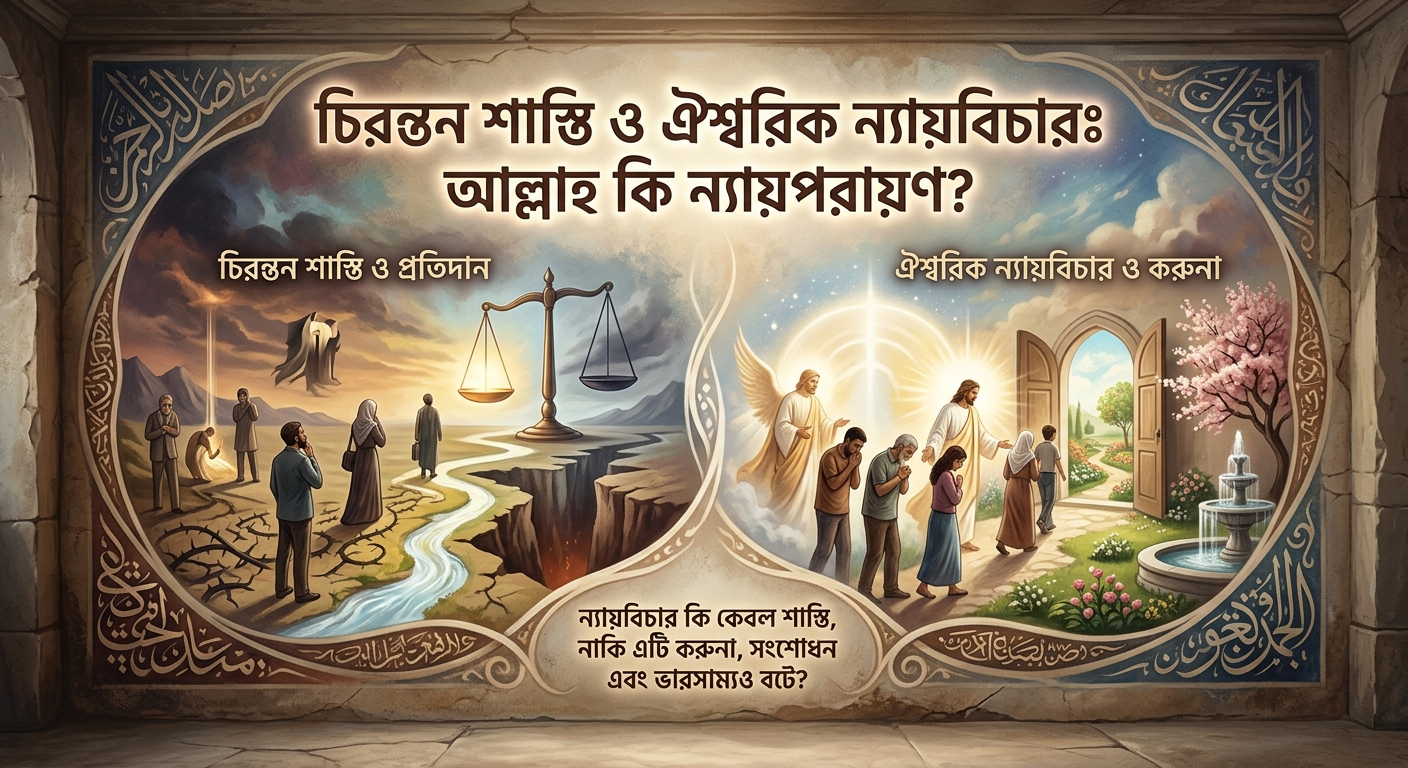
Allah and Justice
Eternal Punishment and Divine Justice: Is Allah Just?
A central claim of the religion of Islam is that Allah is perfectly just — in Arabic, this is called Al-Adl. But at the same time, the Qur’an declares that unbelievers will burn in Hell forever. Hidden within these two claims is a deep philosophical contradiction that cannot be easily ignored. The idea of eternal punishment does not align with the concepts of justice and infinite mercy. The question is simple — is it just to give infinite punishment for a finite crime?
The argument can be presented as follows:
According to universally accepted principles of justice, punishment must always be proportionate to the crime. This is not merely a religious idea — it is a fundamental basis of human morality. If someone steals an apple, giving them life imprisonment is clearly unjust — you don’t need a scripture to understand that.
Human beings are finite entities. Their lives are finite, their actions are finite, and therefore their crimes are inevitably finite. Even the most brutal criminal in history, such as Hitler, who was responsible for the deaths of millions — he too harmed a finite number of people. That suffering also occurred within a finite span of time. Therefore, if infinite punishment is to be just, then the crime must also be infinite — which no human being is capable of committing.
The Qur’an says in Surah An-Nisa 4:40: “Indeed, Allah does not wrong even the weight of an atom.” In Surah Al-Anbiya 47 it says: “On the Day of Judgment We shall set up the scales of justice.” These verses present Allah’s justice as something precise and measurable. But then the question arises — how does infinite punishment for a finite crime remain “balanced” on that scale?
Common responses from Islamic scholars and their weaknesses
Islamic theologians present several arguments in response to this question. These need to be examined.
First argument: Unbelief itself is an infinite crime
A common response is that unbelief or kufr is not an ordinary sin. Rejecting an infinite, eternal God is an infinite-level crime, and therefore infinite punishment is justified.
But this argument has a fundamental flaw. The seriousness of an action is usually determined by its impact, not by the identity of the one against whom it is committed. If someone lies to a very powerful king, the act of lying itself does not change — the king’s greatness does not magically turn the lie into an “infinite” crime. If a powerful ruler says, “Even the slightest disrespect toward me deserves infinite punishment,” we would call that tyranny — not justice.
Second argument: People continue to sin eternally in Hell
Some argue that the inhabitants of Hell continue to deny Allah even there, so the punishment continues.
This argument falls into a circular problem. If people continue to sin in Hell because they have no opportunity for reform or because they have become psychologically broken — then who is responsible for that situation? Would a just being intentionally create an environment where people are compelled to commit more sins, and then punish them further for those additional sins?
Third argument: Allah’s justice is beyond human understanding
This is the most common and the most problematic argument. It is said that Allah’s justice cannot be understood through human reasoning.
But if this argument is accepted, the entire religious framework collapses. Islam simultaneously claims that Allah is Adil (just) and that humans can understand this attribute — this is what is supposed to draw people toward Allah. If the meaning of “justice” has no connection to human understanding, then calling Allah “just” becomes meaningless — it becomes a word with no comprehensible content.
Moral responsibility and the question of free will
The problem of eternal punishment becomes even deeper when we consider the question of free will.
The Qur’an says Allah is all-knowing — He knows who will believe and who will not. Surah Al-An’am 6:107 says: “If Allah had willed, they would not have committed shirk.” If Allah already knows that a person will be an unbeliever, and still creates them, then who bears the moral responsibility for that person’s eternal punishment?
This is a classic problem in theology — “the contradiction between predestination and moral responsibility.” In Islamic theology, the Mu‘tazila and Ash‘ari schools debated this for centuries — but no satisfactory solution has ever been found.
Comparative perspective
This problem is not unique to Islam, but in Islam it becomes particularly intense.
Christianity also contains the idea of eternal Hell, and many Christian theologians have faced this question. The doctrine of Universalism (which says that eventually everyone will be saved) has been adopted by some Christian thinkers as a solution to this moral problem. Hinduism and Buddhism do not have the concept of an “eternal” Hell — the idea of rebirth through karma offers a different kind of moral balance.
In Islam, however, the question becomes especially sharp because Islam simultaneously claims Allah’s perfect justice and the eternal punishment of unbelievers — holding these two claims together logically is extremely difficult.
From the standpoint of philosophical reasoning, there is a real and unresolved contradiction between Islam’s concept of eternal punishment and its claim of Allah’s perfect justice. Islamic scholars have offered several responses — but each response raises new questions. Any sincere Muslim who wishes to practice their religion with moral depth should not avoid this question. “This is Allah’s matter, we cannot understand it” — this answer is not sufficient for a morally conscious person. Although Islam does not provide its followers much room to ask such questions.
If justice is truly a fundamental attribute of Allah, then that justice should align with human moral intuition — at least in principle. And by that measure, the concept of eternal Hell has not yet passed the test.
Related Posts

Operation Entebbe – the story of one night, and the Islamic execution suffered by Nazrul Islam and Sweety Akter
What can a state do to save the lives of its citizens abroad? Are thereRead More
অপারেশান এন্টেবে – এক রাতের গল্প এবং নজরুল ইসলাম ও সুইটি আক্তারের ইসলামি হত্যার শিকার হওয়া!
একটি রাষ্ট্র বিদেশে তার নাগরিকদের জীবন বাঁচাতে কী করতে পারে? এর কোন টেক্সটবুক উদাহরণ আছে?Read More
A random page from Muhammad’s self‑made book Qur’an and its unscientific statements
Sometimes I flip through random pages of Muhammad’s self‑made book Qur’an, and today this pageRead More
Comments are Closed