
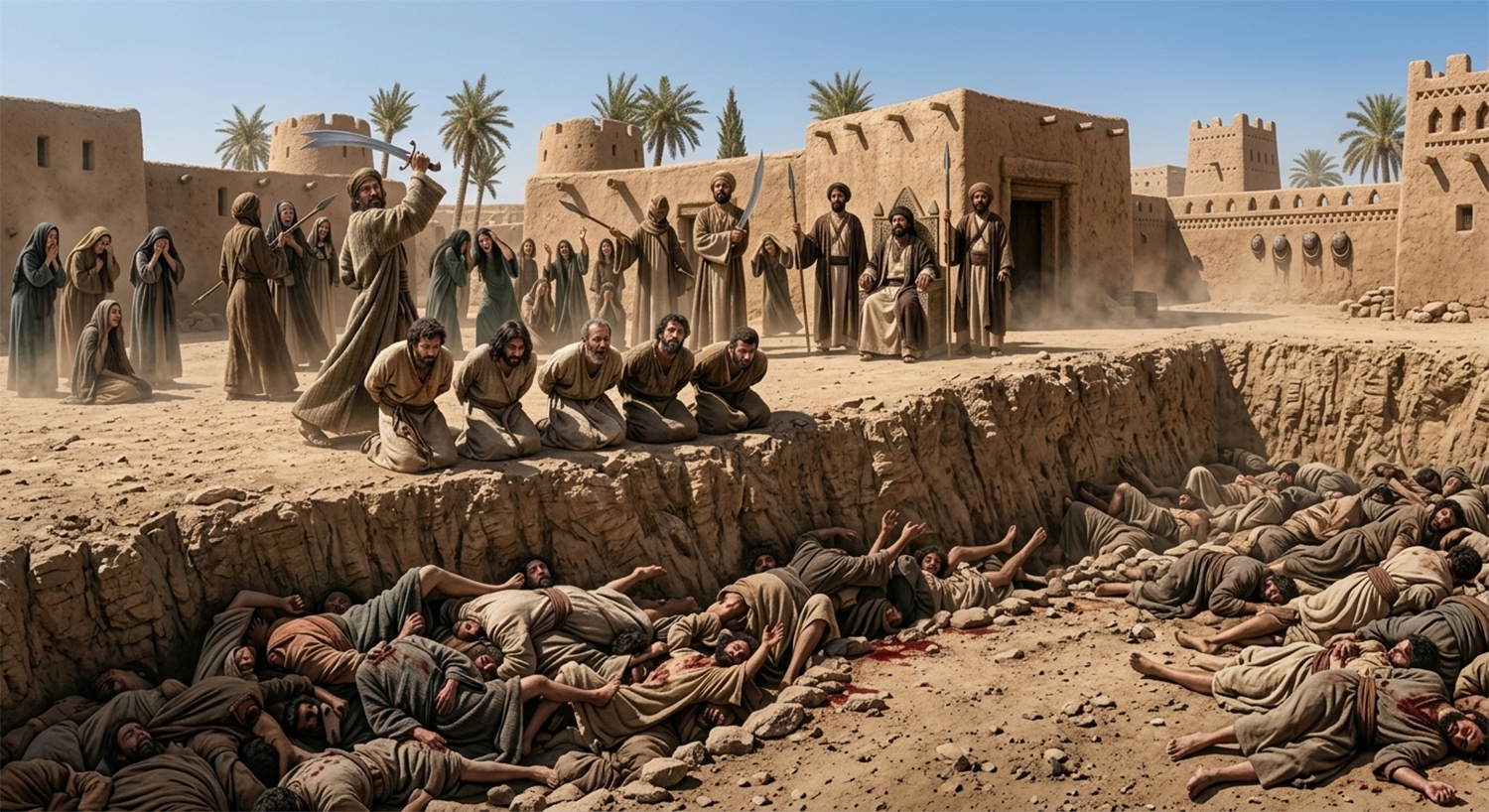
A Massacre Commanded by Allah
How Allah allegedly carried out an inhumane and brutal massacre!
The Post–Battle of the Trench Situation and a Supernatural Command
After the Battle of the Trench had ended, when according to normal expectations peace and a return to ordinary life should have followed, a dramatic turn of events occurred. According to the accounts of the sira, the Muslim forces had just returned from the battlefield and laid down their arms. However, instead of establishing humanitarian peace, an immediate military campaign was launched against an entire tribe, justified by a divine or supernatural command (the alleged arrival of the angel Gabriel).
From a humanitarian perspective, besieging an already exhausted population—after a prolonged siege—without any prior warning or opportunity for diplomatic negotiation led to severe psychological and physical suffering. According to Ibn Ishaq, this siege lasted about 25 days, and the prolonged encirclement created extreme humanitarian distress and fear among the ordinary members of Banu Qurayza.
The Psychological Crisis of the Besieged and the Lack of Real Choice Before Surrender
The severe psychological and existential crisis faced by the Banu Qurayza under prolonged siege becomes clear from the three options described by Ibn Ishaq. Each option presented to them carried elements of human tragedy:
First option: Abandon their beliefs and religion and accept Islam (contrary to religious freedom).
Second option: Kill their own wives and children with their own hands to prevent dishonor or enslavement by the opposing side, and then fight to the death (a reflection of extreme desperation and brutality).
Third option: Surrender unconditionally.
Ultimately, they sought advice from Abu Lubaba of the allied Aws tribe. When Abu Lubaba indicated through gesture that surrender would lead to “death” or beheading, the helplessness of the ordinary people of Banu Qurayza became even more evident. Despite this warning, with no alternatives or provisions left, they were compelled to surrender.
Mass Beheading and Human Catastrophe (Critical Evaluation of Mass Execution)
According to historical accounts, what happened to the men of Banu Qurayza after surrender is often considered one of the most brutal episodes in history.
Mass execution: Large trenches or pits were dug in the central marketplace of Medina. The captured and defenseless men were brought in groups, made to stand by the trenches, and then beheaded. According to Ibn Ishaq and Musa ibn Uqba, the number of those killed ranged from 600 to 700, with some reports suggesting as many as 800 to 900.
Humanitarian assessment: By modern standards of war crimes or human rights, executing hundreds of surrendered prisoners en masse—based merely on allegations of political or military treaty violations (where not all members of the tribe actively participated in fighting)—would be considered neither humane nor justifiable.
Women, Children, and Human Trafficking as War Booty
The darkest and most inhumane aspect of this घटना emerges in the distribution of women, children, and property after the conflict.
Enslavement and distribution of property: After the war, the surviving women and children were treated as “war booty” (Ghanimah). Following the execution of the men, their movable and immovable property, along with their families, were distributed among the Muslim fighters, with cavalry receiving three times the share of infantry.
Human trafficking and purchase of weapons: Even after distributing some women within Medina, Muhammad reportedly sent a group of women and children to the Najd region to be sold as slaves. The proceeds from these sales were used to purchase horses and weapons for the Muslim army. This suggests that the most vulnerable survivors—women and children—were used as commodities for economic and military purposes.
Rayhana and personal share: According to the practices of the time (and attributed divine sanction), Muhammad was entitled to one-fifth (khums) of the war booty and the right to choose a woman. He selected Rayhana bint Zayd, a Jewish woman whose husband and male family members had been executed shortly before. For a woman, this would have represented severe psychological trauma and profound human humiliation.
Age Criteria and Moral Questions
The sira mentions that a boy named Atiyyah al-Qurazi was spared only because he had not yet reached puberty (based on physical or biological signs). This age-based distinction raises ethical concerns. A youth may have faced execution simply for having reached maturity by a matter of months or years, despite having no personal responsibility for the alleged crime or decisions of war. In other words, punishment appears to have been collective rather than based on individual accountability.
From a humanitarian perspective, the incident of Banu Qurayza represents not merely a military victory but what can be viewed as the ethnic and cultural erasure of an entire community. Whether from a modern or even a broadly humane historical standpoint, executing hundreds of surrendered prisoners, enslaving women and children, and seizing property as punishment for a breach of political agreement constitutes an example of extreme cruelty and violation of human rights. These accounts in the sira and maghazi literature are not simply glorified religious narratives, but can also be interpreted as records of a profound human tragedy whose legacy continues to be debated.
References:
Ibn Ishaq (edited by Ibn Hisham), Sirat Rasul Allah, p. 453
Ibn Ishaq, Sirat Rasul Allah, pp. 462–463
Musa ibn Uqba, Kitab al-Maghazi, pp. 108–111
M. J. Kister, “The Massacre of Banu Qurayza: A Re-Examination,” pp. 66–74
Related Posts
Operation Entebbe – the story of one night, and the Islamic execution suffered by Nazrul Islam and Sweety Akter
What can a state do to save the lives of its citizens abroad? Are thereRead More
অপারেশান এন্টেবে – এক রাতের গল্প এবং নজরুল ইসলাম ও সুইটি আক্তারের ইসলামি হত্যার শিকার হওয়া!
একটি রাষ্ট্র বিদেশে তার নাগরিকদের জীবন বাঁচাতে কী করতে পারে? এর কোন টেক্সটবুক উদাহরণ আছে?Read More
A random page from Muhammad’s self‑made book Qur’an and its unscientific statements
Sometimes I flip through random pages of Muhammad’s self‑made book Qur’an, and today this pageRead More
Comments are Closed