
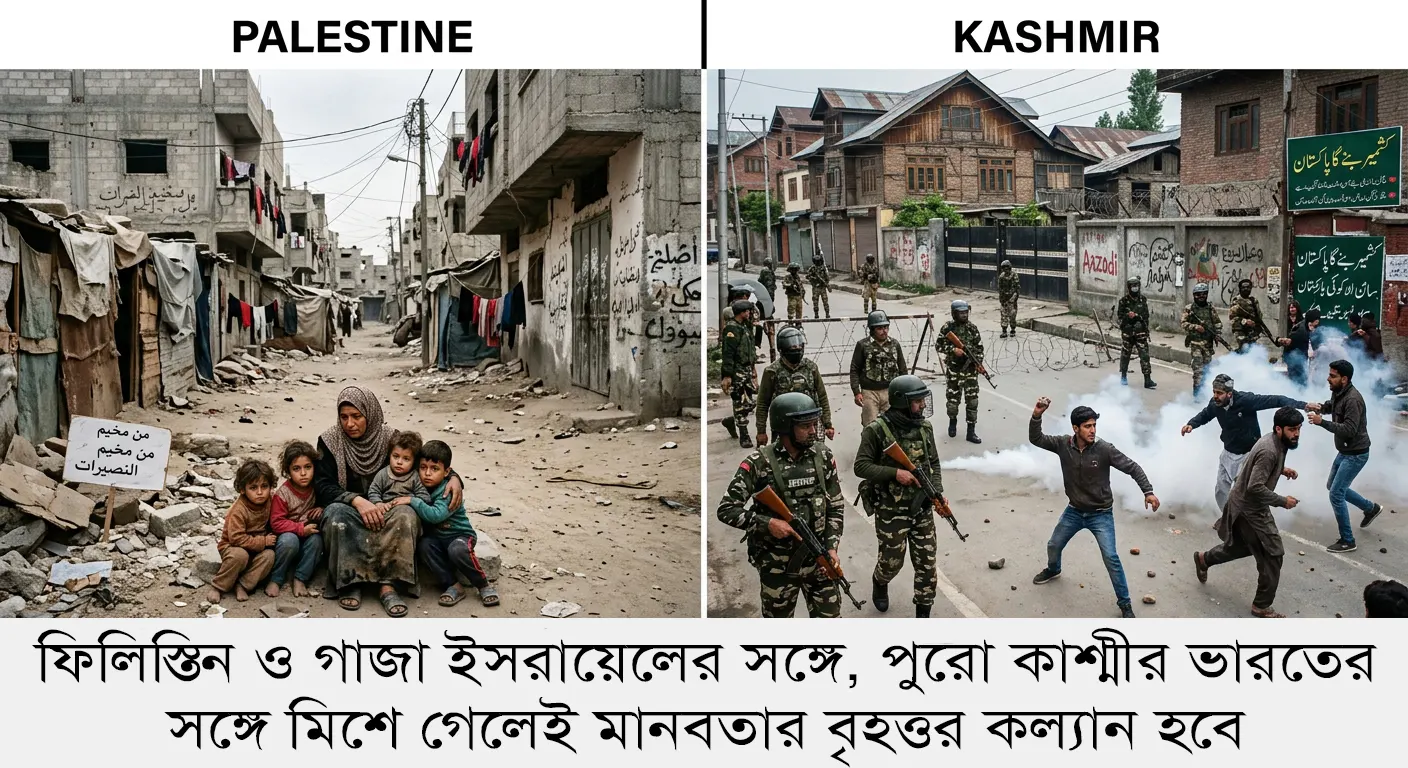
Palestine & Kashmir
Palestine and Gaza merging with Israel, and all of Kashmir merging with India, would lead to greater humanitarian benefit
In modern politics, independence is often considered an almost inviolable value, where leaders aim to take national leadership or form a government to control the state. But in the daily life of an ordinary person, the questions are different: what quality of school their child will attend, what quality of hospital they will get if they fall ill, whether they can sleep safely at night, what kind of job their child will get in the future, whether they will have access to healthy food, tasteful clothing, and a decent home. Setting aside religious sentiments, historical grievances, and historical judgments, a logical argument can be made for Palestine’s West Bank–Gaza and greater Kashmir based solely on these questions. The argument is that the material well-being of the vast majority of people in these regions would improve faster if they became part of a strong, well-organized state—provided that state accepts them as equal citizens. This essay attempts to present the strongest version of that argument. There may be counterarguments. But since I think about human welfare beyond religion or political interests, my argument says that Palestine and Gaza merging with Israel, and all of Kashmir merging with India, would lead to greater humanitarian benefit—if they agree to accept equal citizenship.
1. Economy: Measuring the Gap
Beyond religious and political emotional manipulation, real numbers paint a sharp picture. Israel’s per capita GDP is around 50,000 USD, comparable to or higher than many European countries. According to the World Bank, the West Bank’s per capita income is about one-fourteenth or one-fifteenth of that—around 3,000–4,000 USD. Before the 2023 war, Gaza’s income was less than half of that, unemployment was around 45 percent, and even higher among youth. A large portion depended on humanitarian aid. After the war, Gaza’s economy and infrastructure have collapsed to such an extent that international organizations estimate it will take decades and tens of billions of dollars to rebuild. The war was initiated by Hamas, an Islamist militant group constitutionally committed to eliminating Jews. In their state, people practically cannot eat year-round without foreign aid, yet they remain busy killing Israeli civilians and bringing more suffering to their own people through war.
There is an important observation about this gap. Before the war, about 150,000 Palestinians worked in Israel and settlements with permits, earning significantly higher wages than what was possible in the West Bank. In other words, people’s behavior itself shows that being connected to a strong economy is valuable to them. Access to large markets, capital, technology, and institutions is difficult to build in a small, landlocked or blockaded territory.
Gaza’s area is only about 365 square kilometers, with a population of around 2.1 million. In such a densely populated area, there is neither space nor market to develop ports, airports, industrial zones, and farmland together. Economists call this a “scale problem.” Small states like Singapore or Estonia can succeed, but behind their success were open trade routes, stable institutions, and peace with neighbors—none of which exist here.
2. Education, Technology & the Knowledge Economy
In the 21st century, wealth is primarily human capital. Israel spends about 5–6 percent of its GDP on research and development—one of the highest in the world. The country is a global leader in tech startups, cybersecurity, agricultural technology, and water management. Israel’s agricultural technology and drip irrigation model for growing crops in desert regions are used across Africa and Asia. Israel is also among the world leaders in medical research. Some life-saving innovation you depend on may have come from Israel, without you even knowing.
What could this mean for Palestinian youth? Universities in the West Bank, such as Birzeit, produce well-educated graduates, but many remain unemployed or leave the country due to the narrow local job market. Youth unemployment and educated unemployment could be eased through connection to a larger technology economy. The example of Israel’s Arab citizens—who are Muslim—is relevant: they make up about 20 percent of the population and have significant presence in politics, business, medicine, and pharmacy. Despite some discrimination, their living standards and income are far better than those of residents of the West Bank or Gaza. They are the same ethnic group, but simply being citizens of Israel gives them and their children a much better life than those in the West Bank and Gaza. So what is the benefit of the illusory independence promoted by religious and political leaders?
3. Quality of Life & Health
Life expectancy is a broad indicator of a society’s healthcare, nutrition, and safety. In Israel, it is around 82–83 years, close to the world’s top countries. In Palestinian territories, it is around 73–75 years, and has fallen further after the recent Gaza war. Infant mortality, access to clean water and uninterrupted electricity, and specialized medical care—all show large gaps. Gaza residents often had to wait for permission from Israel or Egypt for cancer treatment or complex surgeries. When medical capacity and medical need fall under separate authorities, human suffering naturally increases. Hamas considers killing Israelis a religious duty, yet relies on Israel to save their own citizens through medical treatment. Such is the misuse of religious ideology by Islamist militants.
4. Social & Personal Security
In conflict economies, the weakest people pay the highest price. Investors do not come to risky areas, children’s schools close repeatedly, and mental health damage persists across generations. Since 2007, Hamas rule, Israeli blockade, and repeated wars have created a generation in Gaza that has grown up without stability. Meanwhile, the Palestinian Authority is in crisis: no effective national election since 2006, widespread allegations of corruption and incompetence, and public trust in leadership is extremely low. Being citizens of a state with rule of law, a functioning judiciary, and police structure would likely increase personal security, property rights, and contract enforcement.
5. Kashmir: The Economic Logic of a Landlocked Region
The argument for Kashmir is even more geographical. This landlocked, mountain-surrounded region’s economy depends on tourism, apple and fruit cultivation, handicrafts, and hydropower. Each of these requires large markets and uninterrupted transport links. Before 1947, Srinagar’s natural trade routes were westward to Rawalpindi–Lahore and southward to Jammu–Punjab. Partition and border conflict severed those links. An independent Kashmir would be a landlocked, militarily weak state between two nuclear-armed neighbors—its existence dependent on their goodwill.
Comparative indicators are also notable. India is one of the world’s top five economies, with per capita GDP roughly double that of Pakistan. Pakistan has faced IMF-dependent debt crises and double-digit inflation in recent years. However, to be fair, literacy rates in Pakistan-administered Azad Kashmir are reportedly good, and Indian Jammu & Kashmir is close to national averages in many indicators. Gilgit–Baltistan’s constitutional status remains unresolved, and its people have no representation in Pakistan’s parliament. Thus, the strongest part of the argument is against independence—not in favor of one side. If Kashmir were independent or remained with Pakistan, the economic and social liberation of Kashmiris would fall far behind. The part currently with India could benefit if they avoided conflict and participated in India’s economic and social progress as ordinary citizens.
6. The Risk of “Another Afghanistan”
The fear of instability in an independent Kashmir is not imaginary. After 1990, the rise of militant groups in the valley, the expulsion of Kashmiri Pandits—turning hundreds of thousands into refugees—and cross-border militant involvement show that a new, weak state could easily fall into the hands of armed groups. Afghanistan after 2021 under Taliban rule is an extreme example: girls’ secondary and higher education banned, severe restrictions on women’s employment, and economic collapse. Weak institutions combined with armed groups first destroy freedom of speech, personal liberty, and education. Hamas rule and the aftermath of the 2023 attack in Palestine also show that organized violence harms ordinary citizens the most. Leaders rarely face the consequences—they recover their daily expenses anyway.
7. Not Religion—Language & Culture Are the Glue of a State
Bangladesh’s birth in 1971 proved that religious identity alone cannot hold a state together. Language, culture, economic fairness, and political representation are the foundations of unity. This principle supports the argument in two ways. First, the idea of binding Palestine or Kashmir to another Muslim-majority state based on “Muslim identity” is weak. Second, instead of religious emotion, mutual economic interdependence and a structure of citizen rights are more sustainable. India’s multilingual, multireligious federal structure and Israel’s concept of civic equality both theoretically prioritize citizenship over religion.
Conclusion
In summary, the argument is this: compared to a small, blockaded or landlocked, weakly institutionalized entity driven by religious emotion, becoming equal citizens of a strong economy can increase the average person’s income, health, education, and security. Differences in per capita income, life expectancy, and research spending indicate this possibility. If you care about people and humanity, the realistic path is this—Palestine’s West Bank and Gaza merging with Israel, and all of Kashmir merging with India, would lead to greater humanitarian benefit. Politics and religion first, or humanity first? Humanity, of course. Even to save one human life, politics and religion should be set aside.
Related Posts
ফিলিস্তিন ও গাজা ইসরায়েলের সঙ্গে, পুরো কাশ্মীর ভারতের সঙ্গে মিশে গেলেই মানবতার বৃহত্তর কল্যান হবে
আধুনিক রাজনীতিতে স্বাধীনতাকে প্রায় অলঙ্ঘ্য মূল্য ধরা হয়, সেখানে নেতাদের লক্ষ থাকে দেশের নেতৃত্ব বাRead More
The Jewish claim to the land of Israel is actually connected to their historical roots
Have you heard the popular song from the 1970s ‘By the Rivers of Babylon …’?Read More
ইহুদিদের ইসরায়েলের ভূমির দাবী আসলে তাদের ঐতিহাসিক নাড়ির সঙ্গে সম্পৃক্ত
আপনারা ১৯৭০ এর দশকের জনপ্রিয় গান ‘বাই দ্যা রিভারস অফ ব্যাবিলন …’ শুনেছেন? মানবিক মানুষRead More
Comments are Closed