
Fallacies in Islam
Islam’s Circular‑Logic Fallacy
Place: Cabin of a Dhaka–Sylhet-bound train
Characters: Maulana Abdur Rahman (a responsible member of Tabligh Jamaat) and Professor Rezwan (a secular intellectual)
Maulana: Professor sahib, you set out on a trip with so many books! We just go out with a pair of clothes and a bedding. (Laughs) Actually, all the knowledge of the world is in the Qur’an alone.
Rezwan: (Laughs) Hearing you say that makes me curious, Maulana sahib. Is everything really there?
Maulana: Yes, everything. Islam is the only complete way of life chosen by Allah. You have studied so much, yet you are far from the light of religion. It pains me deeply. Have you thought about what will happen after death? The punishment of the grave, the field of resurrection, crossing the bridge of Sirat, and then Paradise or Hell.
Rezwan: I have thought about it, that’s why I have questions. In the descriptions of Paradise, it is said there are rivers, fruits, houris, golden plates. In the descriptions of Hell, there is fire, boiling water, when the skin burns away a new skin is given so it can be burned again. A finite human being makes mistakes or disbelieves in a seventy–eighty-year life, and his punishment is eternal fire. Does that match the idea of justice?
Maulana: Allah does not wrong anyone. He is the true Just One.
Rezwan: Then think a little. Even for a thousand years of crime, the maximum punishment should still be finite. Infinite punishment does not fit with our concept of justice. Besides, if you read the descriptions of Paradise and Hell, you will see they are pictures from the imaginary world of seventh-century Arab desert people. For desert people, shade, flowing rivers and orchards are indeed heaven. And forcing belief by frightening people is not reasoning, it is an Appeal to Fear fallacy (Appeal to Fear). Saying “If you don’t believe, you will burn in fire” does not prove it true, it only frightens.
Maulana: Brother, this is not fear, it is a warning. Prophets came with both glad tidings and warnings.
Rezwan: For glad tidings and warnings to be true, first their source has to be proven. Now let’s talk about the stories. Riding Buraq, in one night, from Mecca to Jerusalem, then a journey through the seven heavens. The moon splitting in two. Sulayman (A) understood the speech of ants. In Nuh’s (A) ark, pairs of all the animals of the earth. Modern biology, geology, physics say these things did not happen or cannot happen. If the moon had split, why did no other civilization on earth record it? Where is the evidence of a worldwide flood in geological strata?
Maulana: These are miracles. Miracle means an exception to the laws of nature. If Allah wills, everything is possible.
Rezwan: That itself is a fallacy, Maulana sahib. The phrase “If Allah wills, everything is possible” is such that it can never be proven wrong in any situation. A claim that can never be proven wrong is invalid in science. This is called Unfalsifiability (Unfalsifiability). And what is the evidence that any miraculous event actually occurred? Only descriptions written later. Here an Appeal to Authority works.
Maulana: The Qur’an has already said that no one will be able to produce a surah like it. This is the greatest miracle of the Qur’an.
Rezwan: Look carefully at this challenge. By saying “No one will be able to produce anything like it”, it itself sets the standard of literary quality, and the judges are all followers of the Qur’an. If someone says, “I can,” you say, “You couldn’t.” This is a Moving the Goalposts fallacy (Moving the Goalposts). Besides, literary beauty is not proof of a text’s divine origin. Homer’s epics, Shakespeare, Rabindranath—all are unique. That does not make any of them God-sent.
Maulana: You will not be able to show any mistake in the Qur’an. The Qur’an itself says there is no contradiction in it.
Rezwan: You said something interesting. This is another Self-referential Claim (Self-referential Claim). The book itself says it is error-free, and that statement is taken as proof of its infallibility. Now look at some examples. In the Qur’an it is said that Dhu al-Qarnayn saw the sun setting in a muddy spring. Mountains are described as pegs or stakes. Human semen supposedly comes from between the backbone and the ribs. When explaining these, your scholars say they are “metaphors”. Yet when they find any verse that seems to match a modern scientific discovery, they take it literally and say, “Look, it was already in the Qur’an 1400 years ago!” When it is convenient, it’s literal; when it’s inconvenient, it’s metaphor. This is called a Cherry Picking fallacy (Cherry Picking) and a Special Pleading fallacy (Special Pleading).
Maulana: (After a brief silence) … You said many things. But you are not understanding that faith is such a light that Allah gives to whom He wills.
Rezwan: Maulana sahib, let me make one request. Please give me a simple answer to the most important question. Why is Islam true?
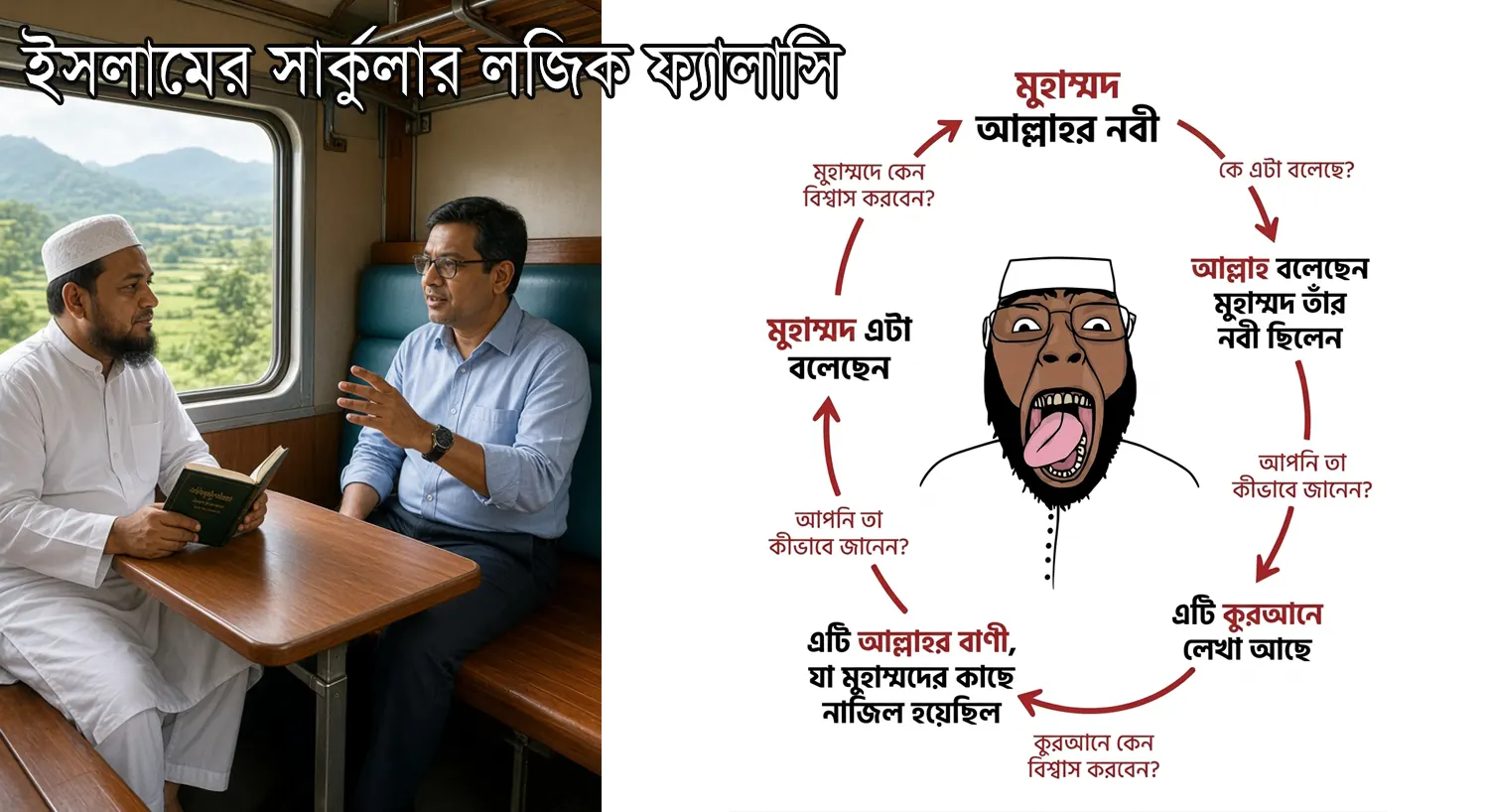
Maulana: Because Muhammad (SAW) is the prophet of Allah.
Rezwan: Who said that he is the prophet of Allah?
Maulana: Allah said it.
Rezwan: How do you know that?
Maulana: It is written in the Qur’an.
Rezwan: Why should we believe the Qur’an?
Maulana: Because it is the word of Allah, which was revealed to Muhammad (SAW).
Rezwan: How do you know that?
Maulana: Because Muhammad (SAW) himself said so.
Rezwan: Why should we believe Muhammad?
Maulana: Because… he is the prophet of Allah.
Rezwan: (Smiling softly) And right there we have gone full circle and returned to the first statement. See? This is a case of circular reasoning (Circular Reasoning), in Latin Petitio Principii. The very statement you are trying to prove is what you are assuming as the basis of proof. The proof begins with the Prophet and ends with the Prophet. There is no independent external testimony here. This is not just Islam—any religious scripture falls into the same trap when it tries to prove itself by itself.
Maulana: (Looking out the window for a while) Professor sahib, I don’t want to win an argument with you. I know I haven’t studied like you. But I know my faith has given me peace. And what has your knowledge given you?
Rezwan: (In a gentle voice) That’s a good question. I am not denying your peace. I have no objection to the belief by which a person finds peace. My objection is only to the claim that it is the only truth and proven by reason. I live with questions, and you live with belief. We are both human.
Maulana: Then do one thing. You are a searching person. See with your own eyes. Come out with us for one “chillah”—forty days. You will stay in mosques, serve people, observe our lives. After that, your questions will remain wherever they are. Perhaps you may even find answers.
Rezwan: (Thinking for a moment, smiling) Forty days is longer than my research leave! But as a seeker, I will remember your invitation, Maulana sahib. Only one condition: I must have the freedom to ask questions.
Maulana: (Laughs) Ask away, sir. Allah guides only those who ask questions. Come, there is still a long time before we reach Sylhet. Will you have some tea?
Related Posts

ইসলামের সার্কুলার লজিক ফ্যালাসি
স্থান: ঢাকা থেকে সিলেটগামী ট্রেনের কেবিনচরিত্র: মাওলানা আব্দুর রহমান (তাবলিগ জামাতের একজন দায়িত্বশীল) ও অধ্যাপকRead More

Comments are Closed