
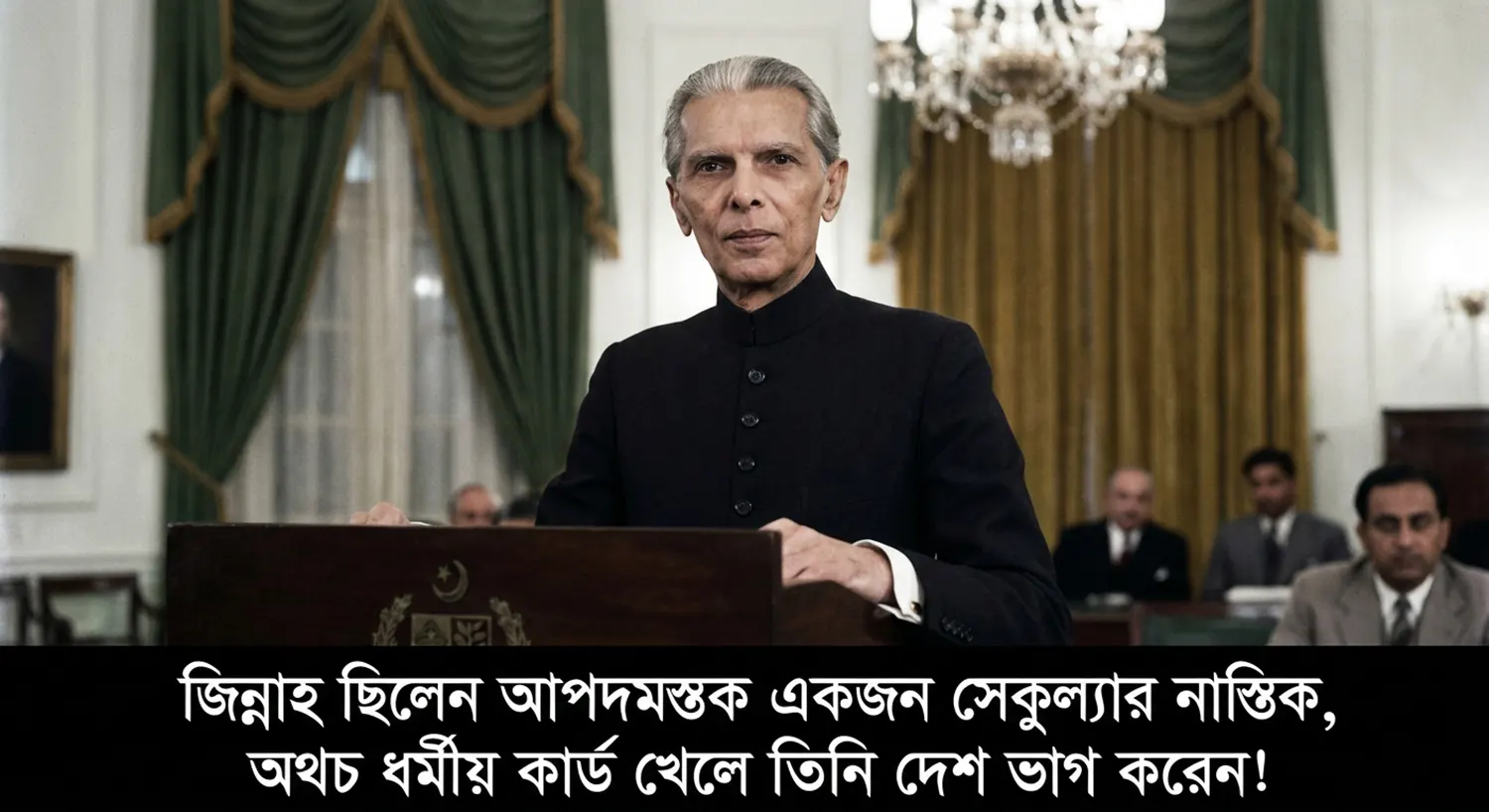
KA Muhammad Ali Jinnah
Jinnah was a thoroughly secular atheist, yet by playing the religious card he divided the country!
The first killing in India over writing and accusations of hurting religious sentiments took place in Kolkata in 1924. Even though the capital shifted from Kolkata to Delhi in 1911, Kolkata always remained India’s literary, intellectual, and cultural capital. He was a small publisher in Kolkata who published translations of foreign books—his name was Narendra Nath Chakraborty.
The published book was a Bengali translation of an English work. The original book was a Western scholarly work on the history of the Middle East and Islam. It contained some critical remarks about the Prophet Muhammad—which sparked controversy among a section of the Muslim community; religious zealots have always reacted violently to criticism of the Prophet. Muhammad himself instructed his followers to kill his critics. There was no detailed discussion at the time about what the book actually said or how objectionable it was. Based on the accusations, public agitation spread. In this context, a man murdered the publisher Narendra Nath Chakraborty.
The killer was a pimp from a brothel. One day a protest march passed by his neighborhood. Out of curiosity he learned that a publisher had translated a book that allegedly contained offensive remarks about the Prophet Muhammad. He had no idea what the book was or what it actually said. But hearing phrases like “insult to the Messenger,” “blasphemy,” he sought an opportunity, went to the publisher’s shop in disguise, and murdered him.
This man, who never practiced any religious rituals, overnight became praised as a “protector of religion.” Today in Bangladesh, there are hundreds of thousands of blind followers like him—moderate Muslims, imams, shopkeepers, teachers, students, employees, businessmen, criminals—everyone unites under the banner of religious sentiment. In the 1920s, religious identity politics rose sharply in India. Hindu–Muslim relations were increasingly tense—especially around publications, speeches, and religious debates.
In the 1920s, a fierce religious conflict erupted in Punjab between the Muslim community and the Hindu Arya Samaj. It began when some Muslim writers published a pamphlet portraying the Hindu goddess Sita in a derogatory manner. In response, Krishna Prasad Pratap—an Arya Samaj follower of Swami Dayanand, writing under the pseudonym “Pandit Chamupati Lal”—wrote a pamphlet titled Rangila Rasul. There he highlighted the Prophet Muhammad’s marriage to the young Ayesha, his multiple marriages, and the issue of sex slaves.
This book was published in 1923 by Lahore publisher Rajpal. As soon as the book hit the market, the Muslim community reacted strongly. Rajpal was prosecuted. The first court found him guilty, and the verdict was upheld on appeal. Finally Rajpal went to the High Court, which ruled that his work did not constitute an offense under Section 153 of the Indian Penal Code. This verdict enraged the Muslim community. Amid this tension, a 19‑year‑old carpenter’s son, Ilmuddin, on April 6, 1929, heard a fiery speech by Maulana Ataullah Shah Bukhari near the Wazir Khan Mosque. The speech called for action against those who insulted the Prophet. Influenced by the speech, Ilmuddin bought a knife for one rupee and that very day went to Lahore’s Urdu Bazaar and stabbed Rajpal to death. Notably—Ilmuddin himself had never read the book.
Ilmuddin considered this killing his religious duty and refused to hire any lawyer, embracing martyrdom and dreaming of going to paradise where he would receive 72 virgins, thousands of youthful attendants, miles‑long date orchards, rivers of wine, and streams of milk and honey. But the London‑returned barrister, Quaid‑e‑Azam Muhammad Ali Jinnah, stood by him. Jinnah took up Ilmuddin’s case without any fee. Do you think Jinnah was a devout Muslim?
Jinnah was educated in Britain, culturally an Englishman, wore suits and ties, drank alcohol regularly, kept dogs at home, and had paintings and pictures of animals everywhere. He married a non‑Muslim woman. His only daughter, Dina, also married a non‑Muslim. Dina did not leave India for Pakistan. Jinnah’s grandchildren are not Muslims, nor are their descendants. Jinnah did not pray or fast, did not practice religion, was an atheist—yet he stood in court defending a murderer by appealing to Muslim religious sentiments. A thoroughly atheist man, who had no trace of religion in his life, also incited people using religion.
With the cooperation of many other short‑sighted political leaders of India, Jinnah led the movement to divide India on religious grounds. In 1939, Muhammad Ali Jinnah declared that Hindus and Muslims were two separate nations. Because of the decisions of Jinnah and other political leaders of that time, India was divided in 1947 based on the religious two‑nation theory. This historical event is one of the most complex and sensitive chapters in the history of the Indian subcontinent. Nehru, Jinnah, and almost all major political leaders of that era were atheists and secular. Yet they accepted, and indirectly fueled, religious fanaticism and extremism, drawing a border line to separate people who had lived together for thousands of years in a rich historical land.
This is how opportunists—who themselves know the hollowness and hypocrisy of religion—always use religious groups, especially the ignorant mob called tawhidi janata, for personal gain. Whether it is the Kolkata riots of 16 August 1946, the Noakhali riots of 10 October 1946, the Gujarat riots of 27 February 2002, the Bhola massacre of 2019, or today’s religious mob terrorism in Bangladesh, India, and Pakistan—everything is woven from the same thread. Behind every incident there is a beneficiary political group. Many prominent religious leaders know the fraud, deception, hypocrisy, and falsehoods of Islam; personally they oppose these things, but for economic, political, and social influence they play the religious game and use the ignorant tawhidi janata.
As I said earlier, none of Jinnah’s family members are Muslims. His daughter Dina married the famous Parsi businessman Neville Wadia. After the 1947 partition, Dina Wadia did not go to Pakistan; she took Indian citizenship and settled in Mumbai. She visited Pakistan only twice in her life—once in September 1948 to attend her father’s funeral, and again in 2004 to watch an India–Pakistan cricket match. Today Jinnah’s descendants (Dina Wadia’s son Nusli Wadia and his family) live in India as one of the country’s most influential industrial families (the Wadia Group). None of them ever took Pakistani citizenship.
A section of Bangladeshi Muslims now commemorate Jinnah’s birth and death anniversaries with great enthusiasm. To them, Jinnah’s decision to divide India on religious grounds in 1947 was very good and historic. Therefore, 1947 is glorified, whereas Bangladesh’s liberation war of 1971 is not important to them, nor do they expect it to be. They still believe pre‑1971 Pakistan was better for Muslims. For them, everything revolves around religion, Islam. In their worldview, there is no place for dissenters, people of other religions, or non‑religious individuals. Their lifelong frustration is that they cannot turn Bangladesh into an Islamic emirate!
Related Posts
জিন্নাহ ছিলেন আপদমস্তক একজন সেকুল্যার নাস্তিক, অথচ ধর্মীয় কার্ড খেলে তিনি দেশ ভাগ করেন!
ভারতবর্ষে লেখালিখির কারনে ও ধর্মীয় অনুভূতিতে আঘাত দেয়ার অভিযোগে প্রথম কোন হত্যাকান্ড ঘটে কলকাতায়, ১৯২৪Read More

Bengali Women and Their Love for Jewelry: History, Modern Trends, and the Culture of Excess
When the first gold bangle was put on Nalini Devi’s wrist, she was only seven.Read More
বাঙালি নারীর গহনা প্রীতি – ইতিহাস থেকে বর্তমান ও বাড়াবাড়ির সংস্কৃতি
নলিনী দেবীর হাতে যখন প্রথম সোনার বালা পরানো হয়েছিল, তখন তাঁর বয়স মাত্র সাত। বিয়েরRead More
Comments are Closed