
The Corruption Nexus
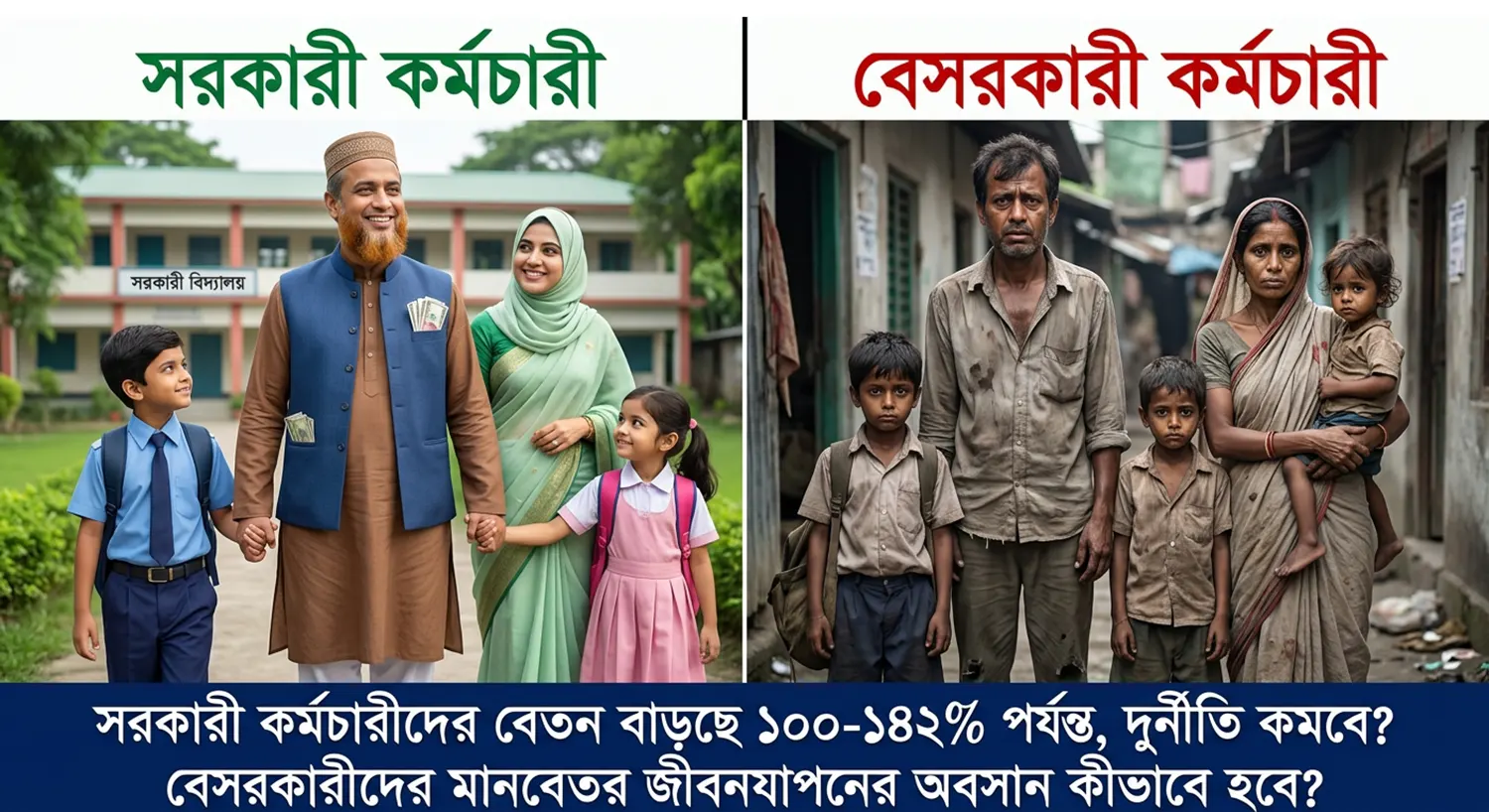
Government Employees’ Salaries Are Rising by 100% to 142%: Will Corruption Decrease? How Can the Inhumane Living Conditions of Private-Sector Workers End?
When I was at university, I dreamed of getting a job with a salary of BDT 10,000 after graduation. At that time, the most coveted jobs were at Grameenphone, Aktel, Citycell, large private banks, various UN organizations, major NGOs, and companies. Government jobs were mainly prioritized by those who sought power, social prestige over ordinary people, and opportunities for corruption. By “power,” I mean the ability to grant unfair advantages to someone outside established rules. In one of my early jobs, when I earned more than BDT 20,000, my roommate, a first-class government officer, earned around BDT 6,000. Even though our room was the same size, I paid about 60% of the rent while he paid 40%. I did this out of compassion because his family expenses were higher and his income was lower. Yet today, government salaries in Bangladesh have increased so much that, comparatively, private-sector employees earn far less. Many private-sector workers struggle to maintain a decent standard of living, and their opportunities for corruption are also limited. Now the government has once again moved to increase the salaries of government employees by 100% to 142%. What will happen to private-sector employees?
The New Pay Structure: What the Numbers Say
According to a recent report by Prothom Alo, the Cabinet has approved a new national pay structure for civilian government employees, effective from July 1. The key details are summarized in the table below.
| Topic | Previous Structure | New Structure |
|---|---|---|
| Basic Salary, Lowest Grade (20th) | BDT 8,250 | BDT 20,000 (Increase of 142%) |
| Basic Salary, Highest Grade (1st) | BDT 78,000 | BDT 156,000 (Increase of 100%) |
| Lowest-to-Highest Salary Ratio | 1 : 1.945 | 1 : 1.78 |
| Implementation Phases | — | Three phases: 40% in July 2026, 30% in January 2027, remaining 30% in July 2027 |
| Allowances Effective | — | From January 1, 2028 |
| Beneficiaries | — | Approximately 2.4 million active employees + 925,000 retirees = total 3.3 million |
| Additional Annual Government Cost | — | Estimated BDT 105,580 crore |
| Pension Increase (BDT 9,000/month or less) | — | 100% increase |
| Pension Increase (Above BDT 40,001/month) | — | 55% increase |
The report also quoted experts saying that funding this additional expenditure would require approximately 45% growth in revenue collection, whereas the highest growth recorded in the last five years was only 12.5%. In other words, these numbers also conceal a significant economic risk, which we will discuss later.
The Most Important Question: Does Increasing Salaries Reduce Corruption?
For government employees who have lived honestly, managed households on limited salaries for years without taking bribes, lobbying, or engaging in brokerage activities, this news is undoubtedly a relief. A decent standard of living deserves reasonable compensation, and that is a fair demand. But Bangladesh’s history suggests something different: there has been no clear correlation between salary increases and a reduction in corruption. In fact, public experience indicates that after every pay commission or salary revision, both the scale and rates of corruption have increased.
If you observe carefully, you may find that a large portion of corrupt individuals strictly observe Islamic religious practices, leave service seekers waiting during office hours to perform prayers, wear beards, and keep skullcaps on their heads. Yet no religious discipline seems capable of transforming their character. A large segment of government employees are also highly inefficient, with little interest in improving their professional skills. Remaining incompetent as a service provider is itself a form of unworthiness, arguably another form of deception and corruption.
Generally speaking, the financial corruption we observe stems from several structural causes:
1. Corruption is not caused by low salaries; it is caused by a lack of institutional accountability. In a system where citizens cannot be sure of receiving government services without bribes or political influence, increasing salaries alone changes little. The opportunities for rent-seeking created by monopoly power and lack of accountability remain intact. A higher salary may be a necessary condition, but it is not a sufficient one.
2. Inflation of Expectations. As salaries increase, so do expectations regarding lifestyle, social status, and spending. In practice, higher salaries create new standards of consumption, requiring additional income to maintain them. The easiest source of that extra income often becomes the abuse of power.
3. Weak Accountability Institutions. If institutions such as the Anti-Corruption Commission, judiciary, media, and parliamentary oversight bodies cannot operate independently, no salary structure can effectively reduce incentives for corruption. Unless asset disclosure and verification are mandatory, the risk of punishment remains close to zero.
4. The Political Economy Connection. Political corruption is implemented largely through government officials. Whether in tenders, transfers and postings, project approvals, project implementation, or revenue collection, the administrative machinery is required. As long as this connection of political patronage remains intact, both sides will continue to find incentives to use the administrative apparatus regardless of salary structures.
A New Dimension of Inequality: The Private Sector and Marginalized People
The report also warned that private-sector investment has fallen to its lowest level in 14 years, dropping below 22% of GDP. In such circumstances, even if government salaries are increased by more than 100%, private firms will not be able to raise employee salaries proportionately. According to researcher Selim Raihan, unless business activities gain momentum, private entrepreneurs will have little interest in increasing wages. This is creating a new kind of dual economy: on one side, a class of state-paid employees; on the other, private-sector workers, day laborers, and farmers who feel the impact of inflation first and most severely, yet have no institutional mechanism to increase their incomes.
This shift also resonates symbolically with my own experience. There was a time when private-sector salaries were several times higher than government salaries, making it easy to sympathize with honest government employees. Paying a greater share of the rent felt like a humane decision. Today, as circumstances have reversed, that sympathy arguably belongs more to lower- and middle-income private-sector employees. Yet in reality, they have no structural protection.
Allowance for Children with Disabilities: A Humane Decision, but Incomplete Justice
One aspect of the new package initially appears heartwarming: for the first time, government employees will receive a monthly allowance of BDT 3,000 for children with special needs. This decision is undoubtedly positive and humane. But the question remains whether the state guarantees equivalent support to private-sector employees and even to those who are unemployed. The needs of a child with disabilities do not depend on the employment status of the parents. Linking state assistance to the type of job a parent holds creates a profound form of inequality. The issue of supporting children with disabilities is fundamentally a matter of universal social protection that should apply equally to all citizens.
Providing monthly allowances only to the children of a specific professional group will not bring meaningful change unless opportunities for the development of children with special needs, including specialized education, therapy services, accessible infrastructure, and full participation in society and the state, are expanded nationwide for all children. A financial allowance may alleviate symptoms of the problem, but it does not provide a structural solution.
There is also a practical risk. There is no guarantee that some government employees will not falsely register perfectly healthy children as children with disabilities in order to receive this allowance. If the verification process is weak, this benefit could become yet another avenue for corruption, much like allowances, transfers, promotions, and other systems that have historically been prone to abuse.
The Teaching Profession: A Case Study in Brain Drain
Because teachers’ salaries remain relatively low, talented students rarely choose teaching as their first career preference, and many who do enter the profession leave at the first available opportunity. The direct consequence is a decline in educational quality, which ultimately affects national productivity and institutional capacity over the long term. The new salary structure notes that a separate arrangement for the judiciary will be determined later, but there has been little serious discussion regarding teachers’ pay. The professions that contribute most significantly to nation-building continue to be among the most neglected.
The Expatriate Experience: Exporting Influence
A common observation among expatriates who work hard abroad to support their families is that some family members of government employees from Bangladesh, including spouses and children, enjoy comfortable lifestyles overseas without employment and sometimes carry the influence and privilege accumulated at home into foreign countries. Discussions about large properties allegedly linked to Bangladeshi government officials in Canada’s so-called “Begum Para” have circulated in the media and public discourse for years. Within Bangladesh as well, many members of the same class are perceived to possess substantial wealth and disproportionate influence that seem inconsistent with their declared incomes.
This observation is not proof against any specific individual, but it reflects a widespread public perception. The underlying mindset is also important. For many government officials, “power” means the ability to grant unfair advantages outside formal rules. The ability to facilitate such advantages is often viewed as the true source of authority and prestige rather than legally providing services. As long as this mentality remains embedded within institutional culture, no modernization of salary structures will stop the disproportionate expansion of wealth and influence.
The Other Side of the Equation Deserves Consideration
At the same time, it is worth remembering that the arguments in favor of salary increases are not weak. For nearly four decades, Bangladesh’s government pay structure has rarely been adjusted in line with inflation, and pay commissions have been established only after long intervals. It had become increasingly difficult to retain qualified personnel under low salaries, and some international studies have found that extremely low wages may actually encourage corruption by weakening professional commitment and institutional loyalty. In that sense, higher salaries can reasonably be viewed as a necessary, though insufficient, component of anti-corruption efforts. Moreover, given revenue shortfalls and sluggish private investment, the financial burden of this policy presents a genuine challenge for the government. Experts have also expressed concern that it could place pressure on allocations for health, education, and social protection programs.
Conclusion
The numbers speak for themselves: a salary increase of 100% to 142% is a historic decision that will directly affect the lives of 3.3 million people. Yet salary increases alone cannot solve deeper problems unless they are accompanied by structural reforms such as transparent asset declarations, independent oversight institutions, swift and certain punishment for misconduct, and the digitization of public service delivery. Past experience suggests that while higher salaries improve living standards, they do not necessarily reduce corruption. In fact, as financial capacity grows, there is a risk that the scale, sophistication, and volume of corruption may also expand. Real change will come only when accountability mechanisms are strengthened alongside salary structures.
Related Posts

সরকারী কর্মচারীদের বেতন বাড়ছে ১০০-১৪২% পর্যন্ত, দুর্নীতি কমবে? বেসরকারীদের মানবেতর জীবনযাপনের অবসান কীভাবে হবে?
আমি ইউনিভার্সিটিতে থাকতে স্বপ্ন দেখতাম পাশ দিয়ে ১০০০০ টাকা বেতনের জব নিবো। তখন সবার কাছেRead More

Why is the rate of rape low in Islamic Sharia‑ruled countries? Is it real?
Because of my writing and as an outspoken activist against sexual violence against women, IRead More
ইসলামী শরিয়া শাসিত দেশে ধর্ষণের হার কম কেন? এটা কি বাস্তবতা?
লেখালিখির কারনে এবং নারীদের উপর ঘটা যৌন সহিংসতার বিরুদ্ধে একজন সোচ্চার অধিকারকরমী হিসাবে ধর্ষণের পরিসংখ্যানRead More
Comments are Closed