
Story
Sustenance is Allah’s Mercy
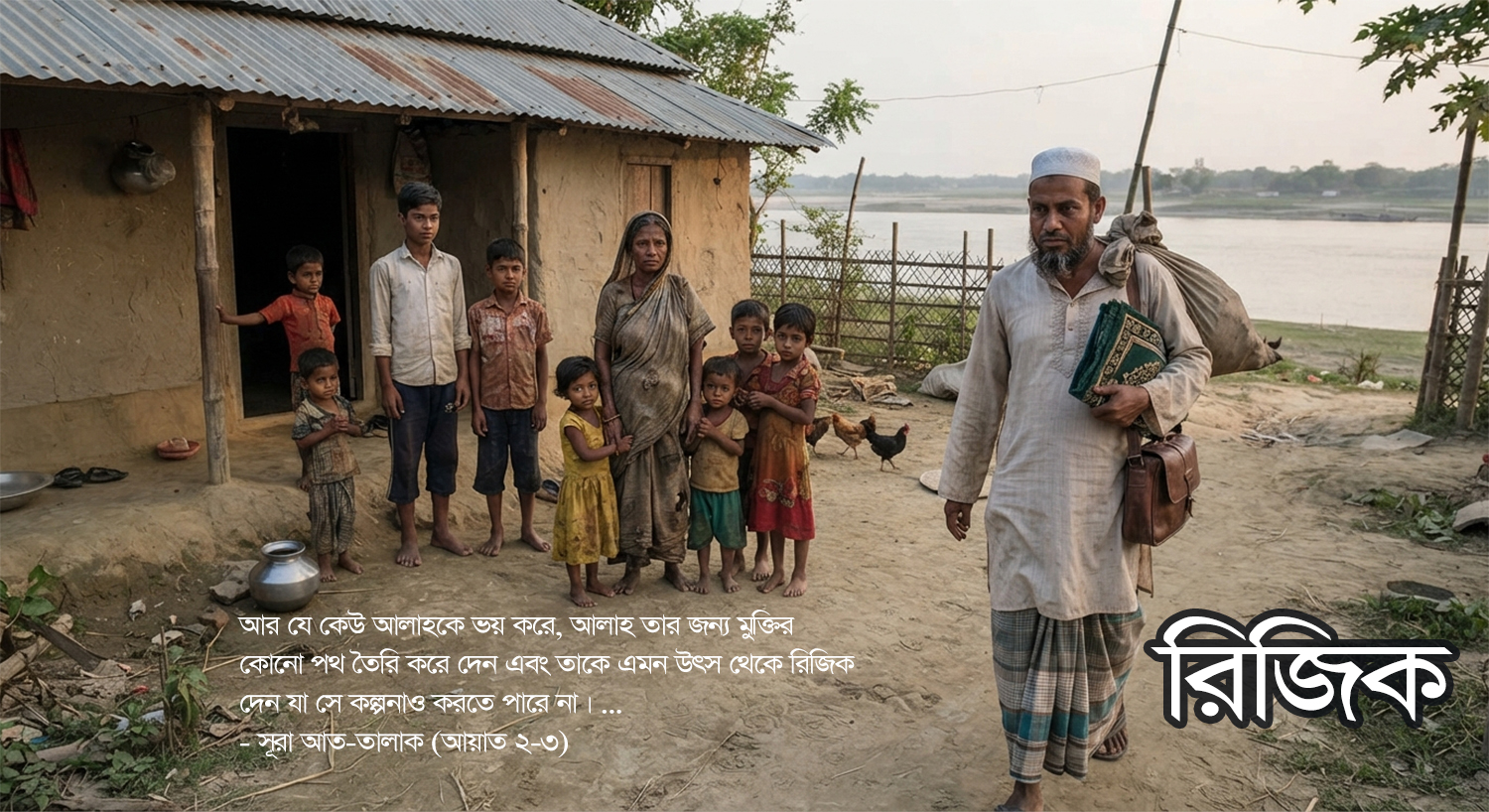
The skin on Kulsum Begum’s palms peeled off long ago. What is there now is like a hard wooden layer—the mud of paddy fields, the soda from scrubbing other people’s dishes, and the marks of time burnt in the sun. Her age is close to forty-five, but her face bears signs of at least ten years more. She is the mother of seven children—her eldest son Hasmat has just turned sixteen, the youngest daughter Rabeya is four. In between there are six more, each growing up step by step through deprivation, as if deprivation itself is another member of their household who never leaves.
The village is called Charkumaria, right on the river’s edge. In the monsoon it erodes, in the dry season it rises again—people’s lives here are much the same, swaying between breaking and rebuilding. Although Kulsum’s husband Abdul Kader Mia is from this village, his presence in the village is maybe two or three months a year, in some years only two or three days. The rest of the time he is away on Tabligh work—sometimes on a forty-day chillah, sometimes three chillahs, sometimes again on a year-long trip abroad. People say Kader Mia is a very pious man, he never misses his prayers, he has a beard, a cap, and always Allah and the Prophet’s name on his lips. Many villagers bring glasses of water for him to blow over, some come for breaking spells, charms, curses, or jinn’s influence. Kader Mia happily does all this without taking any payment. He has one thing to say: he is not a man who sells Allah’s words to earn his living.
Whenever Kader Mia returns to the village, each time he tells many stories of Allah, the Prophet, and the Prophets to the villagers. He tells his wife Kulsum about the importance of serving one’s husband, the virtue of being obedient to one’s husband. But Kulsum knows that behind the words coming from this same mouth, three more households are hidden—four wives in four villages of four districts in Bangladesh, four families, each with five or more children. Kader Mia says he walks on the path of religion, and while walking along that path he stops here once, there once. At each stop a new child is born, a new household, a new woman’s lonely struggle.
Kulsum has never asked too many questions about this. The elders of the village used to say that speaking too much about one’s husband is a sin. Her family also said—whatever is written in a woman’s fate will happen, if she incurs her husband’s curse she will never see Paradise. So Kulsum kept her mouth shut and fought the battle of survival alone with seven children. Harvesting paddy in various households in the village, boiling paddy, looking after cows and goats, working in the scorching sun in the fields like men—whatever work she could get, she did.
That day too, Kulsum had gone to the house of the village headman Hashem Ali to work as a day laborer. It was the season of bringing in the paddy, work in every hand, in exchange for a whole day’s labor she would get one hundred and fifty taka and two meals of rice, and even that money would be paid at the end of the week. In the evening when she returned home, she saw her youngest daughter Rabeya crying from hunger, her eldest son Hasmat sitting silently on the veranda, with that tired look in his eyes which is not supposed to be there at his age. There was no rice at home, no lentils. As she boiled a handful of rice borrowed from a neighbor and divided it among eight children, tears came to Kulsum’s own eyes, but she did not let anyone see those tears.
Just at that time, after almost seven months, Kader Mia returned home. Without any prior notice, quietly, just as he always does. Entering the yard, he saw the children sitting on the ground, mixing a little rice with salt and eating, with no sign of curry on anyone’s plate. Kader Mia stood silently for a while, then went inside, spread out his prayer mat and sat down, as if this scene was nothing new to him.
After dinner that night, he called the children to sit in the yard, under the moonlight. He began telling stories of Islam—the hardships in the life of the Prophet (peace be upon him), the sacrifices of the Companions, the endless mercy of Allah. The children listened in awe, though their stomachs were still not completely full. Kulsum watched this scene from a distance, boiling with anger inside. This man can tell stories to his children for hours, but the responsibility of putting two meals of rice in their mouths seems not to be his.
When the storytelling ended and the children went to sleep, Kulsum could no longer hold herself back.
“You tell so many stories, talk about the Prophet, talk about Allah—don’t you see that your children are going hungry?” Her voice was trembling, as if years of accumulated anger were coming out all at once. “You’ve set up four households in four places, but you haven’t properly fulfilled your responsibilities in any of them. People call you pious, but I know what you are like. Only Allah knows how many more households you’ve set up.”
With a forced smile on his face, Kader Mia said, “Wife, if you speak to your husband in such a loud voice, you won’t be able to go to Paradise. Allah has told women to be obedient to their husbands. Don’t hurt your husband’s heart, Allah won’t tolerate it.”
Kulsum, even more enraged, said, “You talk about Paradise, while you’ve turned this world into hell! Just look once at the faces of your children.”
Then Kader Mia, in a calm voice, almost proudly, said, “The One who has given these mouths will also give them food. The owner of sustenance is Allah, not me, not you. If He wills, we will eat korma and pilaf tonight itself.”
Kulsum laughed scornfully, almost in a mocking tone, “Yes, then feed us korma and pilaf! Where will you bring it from, will it fall from the sky?”
Kader Mia’s face shrank immediately. He said nothing, just let out a long sigh. Then he woke two sons from among the sleeping children—Hasmat and his younger brother Karim. “Come, let’s go out a bit with me, if you can’t trust Allah, people have no worth in this world.”
Grumbling in anger, Kulsum went inside, thinking that the man might get angry and go spend the night in some mosque again, that is his habit, and her concern is only for those two sons.
Walking along the road, Kader Mia and his two sons saw lights shining in the distance at a house, and a crowd of thousands of people. On going closer, they learned that it was a wedding house, a grand ceremony of a large family from a neighboring village. There was a huge arrangement—large cauldrons of korma, pilaf, and sweet rice had been cooked, and after the ceremony all that food was being distributed among the surrounding people so that nothing would be wasted; in the long line of people taking food, almost everyone was poor, needy-type people, all returning with basins full of korma and pilaf.
Kader Mia stood there with his two sons. One of the organizers called out to them, “Uncle, did you bring a bowl? There’s a lot of food left, take some.” Kader Mia didn’t have a bowl, but the organizers themselves handed him a big basin and filled it with korma and pilaf. Kader Mia had not imagined that he would receive such an immediate glimpse of Allah’s greatness in this way. He became confident that Allah, pleased with his worship and devotion, had given him this reward; people do not know how Allah’s mercy will arrive. He told his two sons, “Your mother doesn’t believe that Allah arranges sustenance.”
Kader Mia returned home with the basin on his head, an odd, peaceful smile on his face. When Kulsum opened the door and saw the basin full of korma and pilaf, her mouth fell open, she lost the words to speak for a few moments.
Putting down the basin, Kader Mia said in a calm voice, “You see, wherever Allah keeps someone’s sustenance, it will come there. We just have to keep faith in Allah’s mercy. No matter how much people worry, the owner of sustenance is He alone.”
By then the other sleeping children had also woken up, the smell of korma and pilaf seemed to make their hunger even greater. That night the seven children ate korma and pilaf to their fill, after many days smiles appeared on their faces. Kulsum also ate, but a discomfort remained in her mind, as if something was not quite adding up. Such a big coincidence shook her faith as much as it left a nagging unease inside, for which she could not yet find a name. Some regret was working in her mind for having hurt the feelings of her pious husband.
The next morning, as usual, Kulsum went to Hashem Ali’s house to work. But when she arrived, she saw the yard was deserted, there were cows in the cowshed but no people, the pots and pans in the kitchen were lying just as they had been, there was no fire in the stove. While sweeping the yard, neighbor Rahima’s mother said, “Kulsum, you don’t know? Just yesterday Hashem bhai’s wife and children went to her father’s house. Her sister’s wedding was there, a grand arrangement. They were supposed to return at night, but…”
Before Kulsum could understand anything, Rahima’s mother lowered her voice and said, “But the wedding party and the groom’s side couldn’t reach the wedding house, sister. On the way there was a terrible accident. The groom’s car overturned and fell into the river, the groom himself and several members of the wedding party died on the spot. There was crying and wailing at the wedding house, the bride, meaning Begum Sahib’s sister, almost lost consciousness. In such a situation, how could Hashem bhai’s wife and children return? They are all still there.”
Something twisted inside Kulsum’s chest, a suspicion was peeking into her mind, beyond everything else her thoughts were on the korma and pilaf that Kader Mia had brought. “What are you saying? Then… then what happened to all that food cooked for the wedding?”
Rahima’s mother shook her head, “What else would happen, so much cooking, so much korma and pilaf for so many people—the wedding didn’t happen, the bride became a widow before the wedding. The food couldn’t be allowed to go to waste, so the cooks called the surrounding people and distributed it. Who knows what is written in whose fate, some people, they say, even carried basins full of food on their heads.”
Kulsum stood there silently, feeling as if the ground beneath her feet was slipping away. Last night’s korma and pilaf, about which Kader Mia had boasted so much while talking about Allah’s sustenance, that food had come in exchange for the death of a young man, in exchange for the tears of an unfinished wedding of a girl, in exchange for the eternal grief of a family. The food that had been cooked for joy was distributed under the shadow of mourning. The korma and pilaf that had gone into Kulsum’s stomach now seemed as if it would come out immediately—her body began to feel queasy. But she did not let Rahima’s mother understand anything.
That day Kulsum could no longer work. Her head spun and she sat down in a corner of the yard. She thought to herself—were the words her husband had said last night really true, or was it just a strategy of painting coincidence in the colors of faith? A man who leaves his own children hungry and spends years away while talking about Allah’s sustenance, how much truth is there in his words, and how much is just a cover to hide his own irresponsibility—this question remained etched in Kulsum’s mind.
Returning home, Kulsum saw Kader Mia praying in the yard, with a satisfied look on his face. After the prayer he called Kulsum and said, “You see, wife, how Allah arranges things when you keep faith. Remember, the owner of sustenance is Allah, if something is in your sustenance, your food will come from ten miles away, and if it is not in your sustenance, even if it is right in front of your mouth you won’t be able to eat it.”
Today Kulsum did not remain silent. In a slow yet firm voice she said, “Yes, I heard the news from Hashem bhai’s house today. The korma and pilaf you brought yesterday came in exchange for a boy’s corpse, in exchange for a girl’s lifelong tears. You call it Allah’s mercy, I see that my children’s stomachs are being filled at the price of a mother’s empty arms. A sister’s tears are mixed in that food.”
Kader Mia froze. At first he could not find anything to say. He has a habit of remaining silent. Even in difficult times he does not get angry.
Kulsum spoke again, “You wander year after year, four wives in four districts, four households. In every place five to seven children, in every place the wives pull the household alone. You come, tell stories of the Prophet, talk about Allah, and then disappear again. I don’t know what kind of religion this is, but I do understand that this is a way of escaping responsibility. The owner of sustenance is Allah, fine, but isn’t it also the servant’s duty to work hard to earn sustenance? You didn’t do the hard work, you just kept talking about trust and left.”
Kader Mia sat with his head bowed for a long time. For the first time, he could not find any answer to his wife’s words. The afternoon light was falling in the yard, in the distance Hasmat and Karim were returning from the field with the cows, little Rabeya was playing in the yard in pure joy, no one knew where today’s rice would come from. But they were happy with their father, having eaten korma and pilaf to their fill.
Kulsum walked toward the kitchen; whatever was available for tonight, she would have to cook with that. One question was still circling in her mind—the fine line between faith and irresponsibility, a line her husband had crossed all his life without ever realizing which side he truly stood on. Kulsum thinks about many things, many questions peek into her mind, but fearing sin, she once again avoids answering her own questions.
The river of Charkumaria village was still flowing in its own rhythm, without keeping account of anyone’s breaking or rebuilding. And Kulsum Begum, with her eight children, was once again preparing for another day’s struggle—a struggle where faith exists, but the only person she can truly rely on is herself, no one else. Even if she wants to rely on someone, she can no longer trust any of it now; she only avoids it fearing sin.
Though Kader Mia had returned home with the intention of staying a few days, the next morning he set off again with his bundle on his shoulder. Kulsum did not know where he was headed. He only told Kulsum and the eight children while leaving that they must never lose hope in Allah’s mercy under any circumstances.
Related Posts
Jinnah was a thoroughly secular atheist, yet by playing the religious card he divided the country!
The first killing in India over writing and accusations of hurting religious sentiments took placeRead More
জিন্নাহ ছিলেন আপদমস্তক একজন সেকুল্যার নাস্তিক, অথচ ধর্মীয় কার্ড খেলে তিনি দেশ ভাগ করেন!
ভারতবর্ষে লেখালিখির কারনে ও ধর্মীয় অনুভূতিতে আঘাত দেয়ার অভিযোগে প্রথম কোন হত্যাকান্ড ঘটে কলকাতায়, ১৯২৪Read More

Bengali Women and Their Love for Jewelry: History, Modern Trends, and the Culture of Excess
When the first gold bangle was put on Nalini Devi’s wrist, she was only seven.Read More
Comments are Closed