
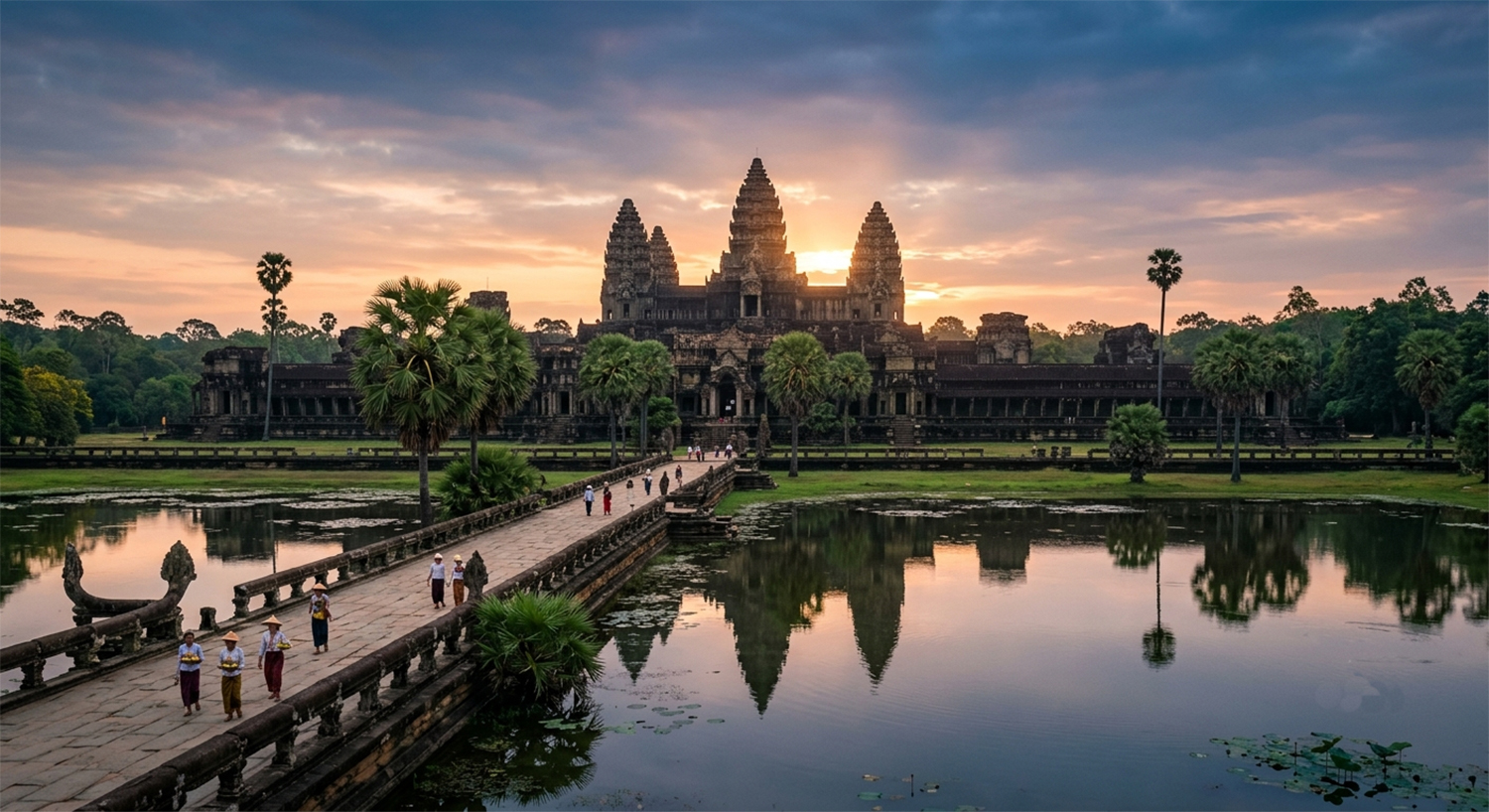
Angkor Wat
Ancient India’s soft power or cultural influence was extensive
During my undergraduate years, one of my teachers once showed a documentary on the projector. It was about Angkor Wat, an ancient temple lost in the jungles of Cambodia. Don’t assume the teacher was Hindu—he had long been a devout follower of Islam. But he showed it to help us understand the historical value of the site and because it was relevant to our course. Back then, teachers didn’t constantly discuss what was halal–haram or Islamic–un‑Islamic in class. How did a Hindu temple appear in such a distant country where the majority of people are Buddhists? After all, Buddhism itself originated in the Indian subcontinent. All of this shows how deeply ancient India and its people influenced other Asian civilizations.
From two thousand years ago and for several centuries afterward, Indian merchants, migrants, and scholars traveled to China, Indonesia, Malaysia, Cambodia, Vietnam, Thailand, and other Southeast Asian regions. The deep impact of those interactions is still visible today in their languages, literature, and architecture. For example, like us, they also celebrate their New Year around the time of Pahela Baishakh. Indonesia’s Bali island preserves the same cultural lineage. Cambodia’s heritage site Angkor Wat is still an extension of Indian culture—it is the largest religious monument in the world, built in the 12th century by King Suryavarman II in honor of the Hindu god Vishnu (later it was converted into a Buddhist temple). This glorious chapter of history is known as “Greater India” or the “Indianization” of Southeast Asia. Thailand’s national epic Ramakien is essentially the Thai version of the Indian Ramayana. The country’s ancient capital was Ayutthaya, the Thai pronunciation of India’s Ayodhya. Even today, Thai kings bear the title “Rama” (for example, the current king is Rama X). Without any military invasion or forced imperial expansion like Islam or Europe, the people of the Indian subcontinent won the hearts of this vast region through trade, religion (Hinduism and Buddhism), and culture alone. The soft power of ancient India was so strong and enduring that it remains vibrant even after a thousand years.
The Bengali Atish Dipankar is still a timeless and unforgettable “Light of Asia” in Tibetan history. About a thousand years ago, he brought the light of reform to Tibet’s dark religious and social conditions, and his influence remains undiminished today. Tibetans give this great son of Bengal the second-highest seat of reverence after the Buddha and lovingly call him Jowo‑je or “Great Master.”
As mentioned earlier, Angkor Wat was originally built as a Hindu temple. Its walls are carved with sculptures of various Hindu deities and famous mythological scenes such as the Churning of the Ocean of Milk. But toward the end of the 12th century, when the Khmer kings adopted Buddhism, the temple gradually transformed into a Buddhist shrine and has remained a Buddhist pilgrimage site ever since.
The historical truth is that Angkor Wat was never completely “undiscovered” or abandoned. Local Cambodians and Buddhist monks always knew of its existence and regularly worshipped there. However, in the 15th century, when the Khmer kings moved their capital elsewhere, the vast complex lost royal patronage. As a result, the palace and surrounding areas slowly became overgrown with dense forest, and for nearly 400 years it remained largely hidden and neglected from the outside world.
The person who brought this temple back to the attention of the modern world was the French explorer Henri Mouhot. In 1860, while conducting natural research in the Cambodian jungle, he discovered this vast and astonishing ancient city with the help of local people. After his death in 1861, his beautiful sketches and travel diaries were published in 1863, creating a sensation across Europe. Reading his thrilling descriptions of a lost civilization hidden in the jungle, French archaeologists began restoration work, and thus Angkor Wat re-emerged onto the world stage.
Related Posts

Islam’s Circular‑Logic Fallacy
Place: Cabin of a Dhaka–Sylhet-bound trainCharacters: Maulana Abdur Rahman (a responsible member of Tabligh Jamaat)Read More
ইসলামের সার্কুলার লজিক ফ্যালাসি
স্থান: ঢাকা থেকে সিলেটগামী ট্রেনের কেবিনচরিত্র: মাওলানা আব্দুর রহমান (তাবলিগ জামাতের একজন দায়িত্বশীল) ও অধ্যাপকRead More
Comments are Closed