
Fear of ‘Allahu Akbar’
The Buddha remained alive within the stone for fifteen hundred years; Islam killed him in a single week
One
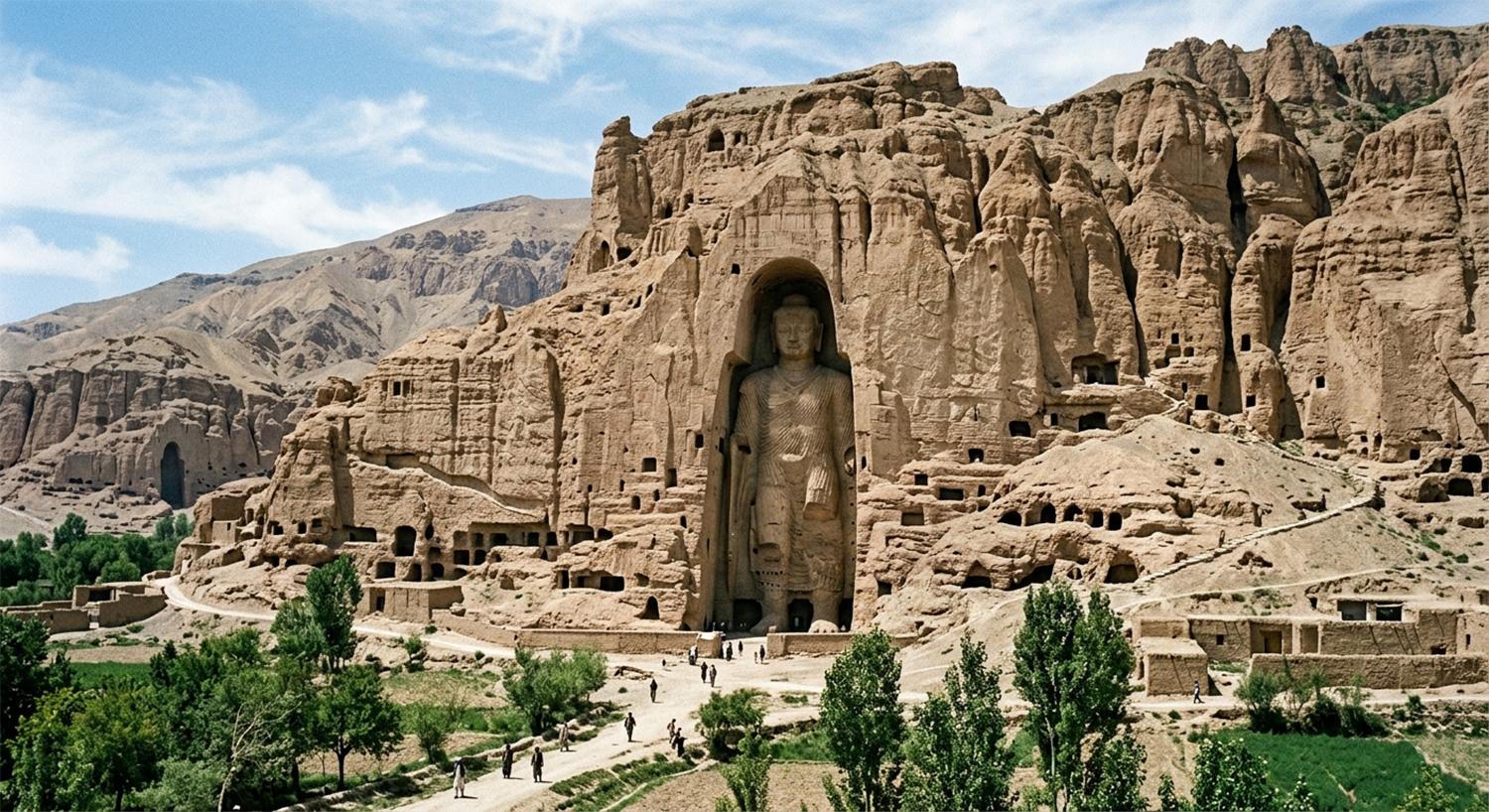
In the lap of the Hindu Kush, in the heart of the Bamiyan valley, a river once flowed in silence. On both its banks stretched vast sandstone mountains—burnt by the sun, eroded by the wind, yet standing with a kind of soft firmness within. Sometime in the sixth century, when in many parts of the world people had not yet properly learned to write, some people stood on the face of these mountains with chisels in their hands. From within the stone, they wanted to bring out a man—one who had become the Buddha from being a man.
Year after year, perhaps decade after decade, those chisel blows fell upon the stone. Slowly, two gigantic figures emerged. One fifty-five meters high, the other thirty-eight meters—the tallest standing Buddha statues in the world at that time. Their bodies were adorned with paint, gold, and precious gems—in the seventh century, the Chinese pilgrim Xuanzang (Hiuen Tsang), who passed along this route, wrote how those gold-covered figures glittered in the sunlight, how thousands of monks chanted before them in ten Buddhist monasteries. Weary merchants of the Silk Road, pilgrims crossing the mountains—everyone would pause at the mouth of this valley. From afar, two shadowy figures could be seen, carved into the rock, as if the mountain itself had opened its eyes and was gazing out.
Two
One and a half thousand years. Can you imagine how immense that number is? Since the fall of the Roman Empire, when people were searching for ways to build a new world, these two statues had been standing. Before their eyes passed the rise and fall of countless empires. The wave of a new religion rising from the deserts of Arabia, the storm of Mongol invasions, the expansion of the Mughal Empire, the shadow of British colonialism, the roar of Soviet tanks—all swept over this valley. And through all those storms, the two stone Buddhas stood, unmoved, as if time itself could not touch them.
To historians, these two statues were a living document—the last great masterpieces of Gandharan art, where the craftsmanship of Greek sculpture had merged with Indian spirituality. To anthropologists, they were proof of the cultural confluence of the Silk Road—silent witnesses to how Buddhism traveled from India through Central Asia to China. UNESCO had declared them a World Heritage Site. They were not only a part of Afghanistan’s heritage, but of the memory of all humankind—testimony to a time when this valley was a grand meeting place of religions, languages, and cultures.
Three
But no matter how strong stone may be, it is helpless in the face of human hatred.
March 2001. Taliban leader Mullah Mohammed Omar issued an order—the two statues must be erased from the face of the earth. The justification given was religious—idols mean paganism, and paganism must be destroyed. Yet these same statues had stood for hundreds of years, even under many Muslim rulers in the past, and no one had laid a hand on them. History bears witness that once a Muslim ruler even refrained from causing them any harm. Then why, after one and a half thousand years, did this sudden urge arise?
In truth, this destruction was more a language of power display than of religious sentiment. At that time, the Taliban were seeking recognition from the international community, and the world was rejecting them. In response to that rejection, they chose to destroy something that the whole world loved yet could not protect. The two statues became cruel messengers—“Even your most cherished heritage lies in the grip of our hands, and you can do nothing.”
Four
First, cannons were brought in. Shells were fired at that stone body, which had endured a thousand years of sun and rain. But the stone still did not break easily. The statues seemed to remain awake even under the blows of the cannons, like some ancient ascetic who stays still in meditation amid violence and turmoil.
Then came tanks and anti-aircraft guns. When even that did not suffice, dynamite was finally used—holes were drilled into the statues’ bodies, explosives were planted inside, and the figures that had once been wrapped in gold, before whom thousands of pilgrims had bowed their heads, were blown to pieces. For several weeks this orgy of destruction continued. When the smoke of the explosions cleared, only two empty niches remained on the mountain’s face—two wounds, as if the mountain’s own eyes had been gouged out.
The world watched then, protested, but could not stop it. It is said that even within the Taliban, some young members later felt at least somewhat conflicted when they remembered this act of destruction.
Five
Today, if you go to those mountains of Bamiyan, you see two vast voids. People still go there, stand before those empty niches, and in that emptiness what they see is actually an absence—but that absence, too, speaks. What stone could not do, the emptiness has done—it reminds us how fragile civilization is, and how destructive intolerance can be.
The statues that had survived for one and a half thousand years through sun, rain, earthquakes, and the fall of empires—those statues vanished in just a few weeks of explosions. What history builds over centuries, hatred can shatter in a matter of days. And those two empty niches still stand today in the lap of the Hindu Kush—as a permanent scar on the body of human civilization’s memory, as a silent question: who has the right to destroy what humans lovingly create? Yet standing against human love, history, and heritage is a slogan of violence, hatred, and destruction—“Allahu Akbar.” I imagine that most people in the world are afraid of this slogan, that civilized people increase their distance when they hear it.
Related Posts

Islam’s Circular‑Logic Fallacy
Place: Cabin of a Dhaka–Sylhet-bound trainCharacters: Maulana Abdur Rahman (a responsible member of Tabligh Jamaat)Read More
ইসলামের সার্কুলার লজিক ফ্যালাসি
স্থান: ঢাকা থেকে সিলেটগামী ট্রেনের কেবিনচরিত্র: মাওলানা আব্দুর রহমান (তাবলিগ জামাতের একজন দায়িত্বশীল) ও অধ্যাপকRead More
Comments are Closed