

Religious vs Humanistic Education
Religious education does not bring any sustainable change in a person’s moral character
The LAUSD is the second-largest school district in the United States. In America, education from kindergarten to twelfth grade is free for everyone — a child simply needs to exist; unlike Bangladesh, parents do not need to provide digital birth certificates. As a result, single mothers who cannot obtain the father’s documents face no problem enrolling their children, and those with errors in their birth certificates do not need to visit council offices or pay bribes.
The annual budget of a single school district in one part of an American city is larger than the entire education budget of Bangladesh. For example, LAUSD’s budget this year is about 19 billion dollars — roughly 233,700 crore Bangladeshi taka — nearly one‑third of Bangladesh’s entire national budget. Most of this funding comes from local residents. How? A large portion of the annual property tax collected from houses and land is allocated to the school district. In some areas, this tax can be 2–3% of the current property value, amounting to 2–20/30 lakh Bangladeshi taka. The better the school district, the higher the property tax. Even households without school‑age children must pay this tax — meaning the responsibility for children’s education and development is universal, not just on the parents.
That is not the main point — this context is to show their curriculum. Their education includes dance, music, art, and theater as integral parts. But they do not have any “Islam and moral education” type books. Their long‑term research has not found evidence that religious instruction alone builds moral character. In fact, there is not a single word about religion in any of their classes. They also have fewer books. Books stay in the classroom; no child has to carry a heavy load on their back, bending their spine from a young age.
Regarding the claim that a religion followed by hundreds of millions for 1400 years has improved moral character — you argue that in countries like Bangladesh, many individuals involved in corruption, bribery, fraud, land‑grabbing, food adulteration, petty theft, or abuse in religious schools are outwardly religious. You note that in many news reports, those involved often appear with beards and caps. Your argument is that religious education has not produced sustainable moral change in any nation or region. You also argue that societies with lower levels of religious practice tend to show lower crime, corruption, and fraud. In some European countries, prisons are closing due to a lack of inmates — and these countries have high numbers of non‑religious people.
You mention that some people cite low reported rape rates in Saudi Arabia. You argue that official statistics are low because many cases are not legally counted as rape, victims fear reporting, and certain legal frameworks may punish victims. You reference reports of migrant domestic workers facing abuse, including Bangladeshi workers returning home with allegations of assault. You cite that in August 2019, 111 Bangladeshi women returned from one flight after abuse, 38 reporting sexual assault. You note that around 30% of those returning are pregnant, and that official statistics recorded only 8 rape convictions in Saudi Arabia in 2019.
In most developed countries, education emphasizes science and humanistic values while keeping religion out of institutional curricula, ensuring a neutral and non‑discriminatory environment for students of all cultures and faiths. Experience shows that religious rules alone do not always produce sustainable moral development; institutional religion can sometimes encourage blind imitation or narrow thinking, which may hinder universal moral qualities like tolerance and empathy. Morality based on fear of punishment or hope of reward may be temporary and not internally motivated. This is why modern education emphasizes logic, scientific thinking, philosophy, and universal humanistic values (Humanism), which teach people to rise above fear or desire and make ethical decisions based on conscience, creating a stable moral foundation.
In developed education systems, dance, music, fine arts, and theater are integral because they contribute not only to entertainment but also to psychological, social, and intellectual development (Holistic Development). These creative subjects help build critical thinking, problem‑solving skills, confidence, and teamwork. They also provide emotional expression and stress relief, helping students focus better academically. The combination of science, technology, literature, and culture fosters empathy, cultural awareness, and a broad, open‑minded worldview — essential for becoming humane and successful global citizens.
Related Posts
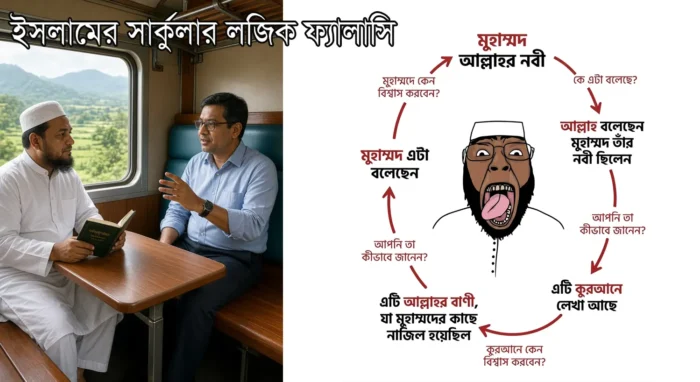
Islam’s Circular‑Logic Fallacy
Place: Cabin of a Dhaka–Sylhet-bound trainCharacters: Maulana Abdur Rahman (a responsible member of Tabligh Jamaat)Read More
ইসলামের সার্কুলার লজিক ফ্যালাসি
স্থান: ঢাকা থেকে সিলেটগামী ট্রেনের কেবিনচরিত্র: মাওলানা আব্দুর রহমান (তাবলিগ জামাতের একজন দায়িত্বশীল) ও অধ্যাপকRead More
Comments are Closed