
Is Qur'an Important?
Reading the Qur’an, its translations, tafsir, sirah and hadith – no person with common sense can remain in Islam
Will you continue to remain a blind believer?
Blind faith prevents a person from seeing the truth. If someone reads the Qur’an, its translation, tafsir, sirah and hadith with an unbiased and objective mind and applies simple common sense (if they have it), they will see—behind the veil of the miraculous—the reflections of a seventh‑century Arabian man who was politically shrewd, war‑oriented, cunning, sexually driven, greedy, attracted to minors, and politically successful. Therefore, instead of blind imitation, seeking truth through deep thought and reason is the work of an intelligent human being.
You assume that we do not read the Qur’an and hadith. We read them ourselves, and we encourage you to read them too, although reading these texts is simply a waste of valuable time in one’s life. They will not add any special knowledge to your life that will benefit you or the world. Rather, we have to read them to protect the world from religiously motivated extremist forces and militants. Because they want to infiltrate our personal, social, and state life with the dark virus of Islam and take control over us. Just a few days ago you saw how these fundamentalist forces collectively bullied and destroyed a multi‑talented girl named Najia Samanta. If these fundamentalist forces and militants are allowed to grow, they will try to destroy human life—especially the personal and social life, rights, choices, desires, freedom, and dignity of women.
Since this ancient mythology—this book written to satisfy the desires of a desert chieftain of Arabia—is followed by 2 billion people in the world; among them many extremists who believe that free‑thinkers and non‑believers like us must be killed to establish Islam in every household on earth, and since a large portion of those 2 billion Muslims support the actions of these extremists, it becomes necessary for many to know what lies inside this book and to inform conscientious people about it. The militants of Islam want to kill free‑thinkers and non‑believers, and the silent believers—who call Islam a religion of peace—want the militants to kill us on their behalf. Remaining silent under Islam is not politeness. A large portion of them simply wait for the right opportunity; when that moment comes, their violent face becomes visible. Since we fight with the pen, with words—we do not use machetes or swords like the jihadists of Islam—we must know the inhumane, extreme, and dark instructions in these books and inform the other 6 billion peace‑loving people of the world.
Professor Philip Khuri Hitti, born June 22, 1886, was a Lebanese‑American professor and scholar who taught at Princeton and Harvard University. He was a leading expert on Arab and Middle Eastern history, Islam, and Semitic languages. It can be said that through his individual effort he established “Arabic studies” as a formal academic discipline in the United States.
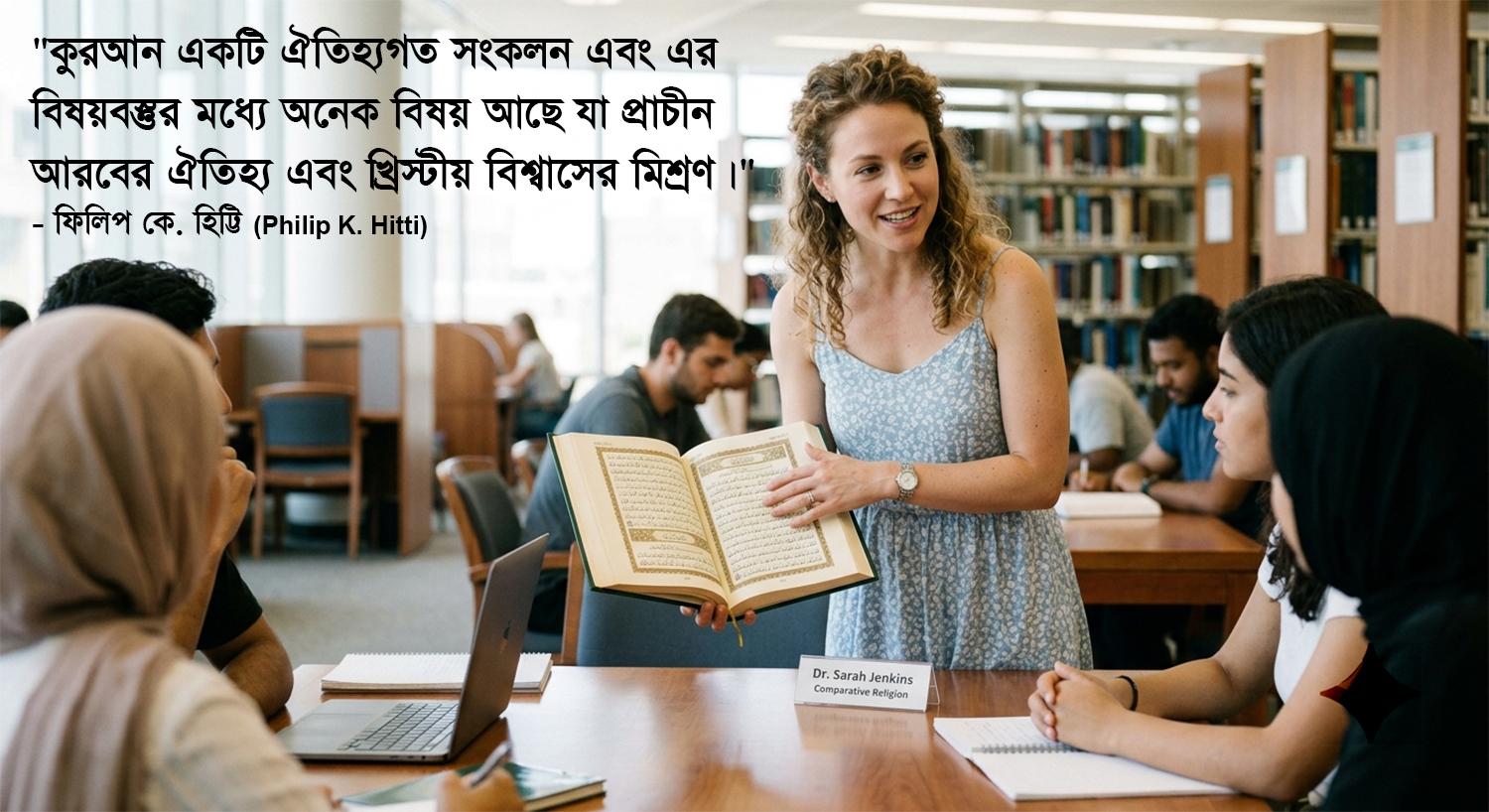
According to Hitti, the Qur’an did not bring anything from the void or anything miraculous that was completely unknown in Arabia at the time. Rather, it is a structured compilation of various oral histories, religious narratives, and social norms that were already prevalent in that society. He meant that the knowledge and traditions that existed in Arabia during and before the time of Prophet Muhammad were adopted and reorganized by the Qur’an.
Although pre‑Islamic Arab society is called the era of ignorance (Ayyam al‑Jahiliyyah), it had its own rich culture, poetic traditions, fairs (such as the Ukaz fair), and tribal laws. According to Hitti and many Western scholars, the linguistic style and rhythm of the Qur’an were influenced by the poetic forms of the best Arab poets of that era (especially the Mu’allaqat or “hanging poems”).
Visiting the Kaaba, the prohibition of war during certain months, and some rituals of pilgrimage existed in pre‑Islamic Arabia and were later incorporated into the Qur’an in a refined form. One of Hitti’s main criticisms concerns the prophets and historical events described in the Qur’an. He believed that the Qur’an is essentially a continuation of the Abrahamic religious tradition, deeply intertwined with the beliefs of Jews and Christians present in Arabia at the time.
In support of this, Orientalists present several arguments: the Qur’an contains characters such as Adam, Noah, Abraham, Moses, and Jesus, and descriptions of their events, which resemble stories from the Bible (Old and New Testaments) and the Jewish Talmud. Because of trade journeys to the north and south of Arabia, the people of Mecca came into contact with Christian and Jewish scholars from Syria and Yemen. According to Hitti, through this cultural exchange, biblical ideas took on a new form in the Qur’an adapted to the realities of Arabia.
Related Posts

Actresses Shabana, Moushumi, Popy – Religious Sentiment and the Politics of the Public Sphere
In the history of Bangladeshi cinema, names like Shabana, Moushumi and Popy mark important chapters.Read More
নায়িকা শাবানা, মৌসুমী, পপি – ধর্মানুভূতি এবং জনপরিসরের রাজনীতি
বাংলাদেশের চলচ্চিত্র ইতিহাসে শাবানা, মৌসুমী কিংবা পপির মতো নাম গুরুত্বপূর্ণ অধ্যায়। তারা আশি, নব্বই ওRead More

In Bangladesh, the very meaning of the “blasphemy” law is to find a new pretext for persecuting minorities
The attack on the house, shop, and temple of Deepto Roy in Tahirpur, Sunamganj isRead More
Comments are Closed