
Sharia and Rape Justice
In countries governed by Islamic Sharia, it is extremely difficult to obtain justice for rape, and the situation in Saudi Arabia proves this
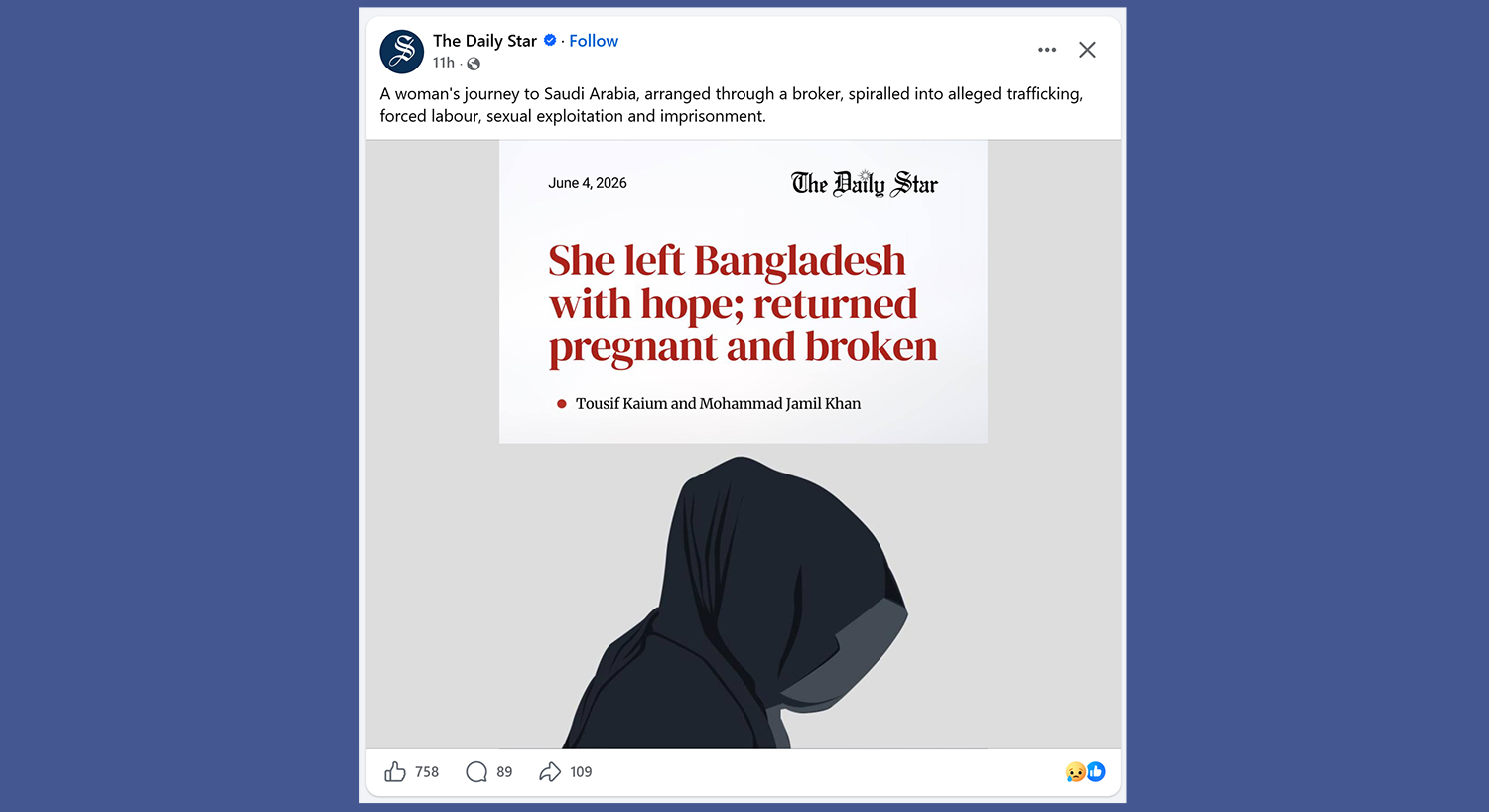
Today’s Daily Star published this report.
Our cute “mumin brothers” claim that no rape happens in Saudi Arabia. In reality, their statistics show fewer cases because thousands of incidents there are not even counted as rape, and women do not dare to file complaints. The Sharia system itself is such that there are many allegations of the victim being punished instead. The rapist can simply say that the woman provoked him by wearing revealing clothes, and that’s it—then the woman is punished for zina. This is Islamic Sharia, where there is no definition of rape, no specific punishment; everything is treated as zina, adultery. Officially, even though they abolished slavery, concubinage, and sexual slavery later than almost every other country in the world, the desire, fantasy, and obsession still remain in their minds. They still consider domestic workers as Islam‑approved sex slaves. Even now, online buying and selling of maids occurs. How many such cases do they actually prosecute? Are there examples?
Read the report. This woman was sexually assaulted multiple times, in different forms. The employer told her they had “bought” her. When she filed a rape complaint against the employer’s son, she was blamed instead. The police did not help her. Even after being raped again later, the police jailed her.
During the time of Prophet Muhammad, people were not familiar with any term equivalent to “rape.” At that time, no one even imagined that sexual relations with a woman required her consent. That is why in the classical sources of the Qur’an and Hadith, there is no term for rape; what exists is zina. Are the punishments for zina and rape the same? Zina, which is usually consensual sex, is not considered a crime under modern law. But Islam prescribes 100 lashes for the unmarried or stoning to death for the married. On the other hand, to prove rape, the victim herself must prove that zina occurred but without her consent. Under Sharia law in Indonesia’s Aceh province, it is not the police but the victim who must bear the full burden of proving rape. Islamic law requires four adult male eyewitnesses who saw the sexual act with their own eyes.
Under Pakistan’s infamous 1979 Hudood Ordinance (specifically the Offence of Zina Ordinance), which was based on Sharia, the highest or hadd punishment for rape required four adult Muslim male witnesses. The law defined rape as zina‑bil‑jabr (forced adultery). Because of the deeply flawed and controversial structure of this law, rape victims fell into a horrific legal trap. When a woman said she had been raped, the court treated it as an admission that she had engaged in extramarital sex. Now, without four witnesses, when she failed to prove the coercion, the court assumed the relationship was consensual. As a result, the rapist walked free due to lack of evidence, and the victim herself was convicted of consensual zina and sent to prison. Because of this law’s horrors, where before 1979 there were only about 70 women imprisoned for zina in Pakistan, by 1988 the number exceeded 6,000. A large portion of them were actually rape victims who became criminals in the eyes of the law while seeking justice.
Due to intense international criticism, pressure from human rights organizations, and protests, Pakistan’s government passed the Women’s Protection Bill in 2006. This amended the Hudood Ordinance by removing rape from the religious legal category and returning it to the regular Pakistan Penal Code, where the requirement of four male witnesses was abolished and forensic evidence, DNA, and circumstantial evidence were accepted. But the Jamaat‑e‑Islami chief and clerics strongly opposed this law because it was not supported by Islam. These are clear examples of the ineffectiveness of Sharia law.
Even today, some people claim that such medieval, barbaric laws are suitable for this era. In Indonesia’s Aceh province, where Sharia law is enforced, the highest number of rape cases occur—because rapists know the victim cannot prove rape. You don’t have to take my word for it; there are countless reports and studies on this. You can look them up yourself.
On the other hand, in modern civilized states, even touching someone without consent or making sexually suggestive gestures is recorded as sexual harassment, and one can seek remedy. A husband cannot have sex with his wife without her consent; that is also rape. Forcing a sex worker without her consent is also rape. Late at night, hundreds of working women walk alone on deserted city streets in short clothing, and no one makes obscene gestures at them, let alone touches them.
Related Posts

Actresses Shabana, Moushumi, Popy – Religious Sentiment and the Politics of the Public Sphere
In the history of Bangladeshi cinema, names like Shabana, Moushumi and Popy mark important chapters.Read More
নায়িকা শাবানা, মৌসুমী, পপি – ধর্মানুভূতি এবং জনপরিসরের রাজনীতি
বাংলাদেশের চলচ্চিত্র ইতিহাসে শাবানা, মৌসুমী কিংবা পপির মতো নাম গুরুত্বপূর্ণ অধ্যায়। তারা আশি, নব্বই ওRead More
In Bangladesh, the very meaning of the “blasphemy” law is to find a new pretext for persecuting minorities
The attack on the house, shop, and temple of Deepto Roy in Tahirpur, Sunamganj isRead More
Comments are Closed