
Without Non‑Muslims, Islam is Nothing
The concept of Islam is unrealistic, short-sighted, and inhumane — without the existence of non-Muslims, an Islamic economy is zero
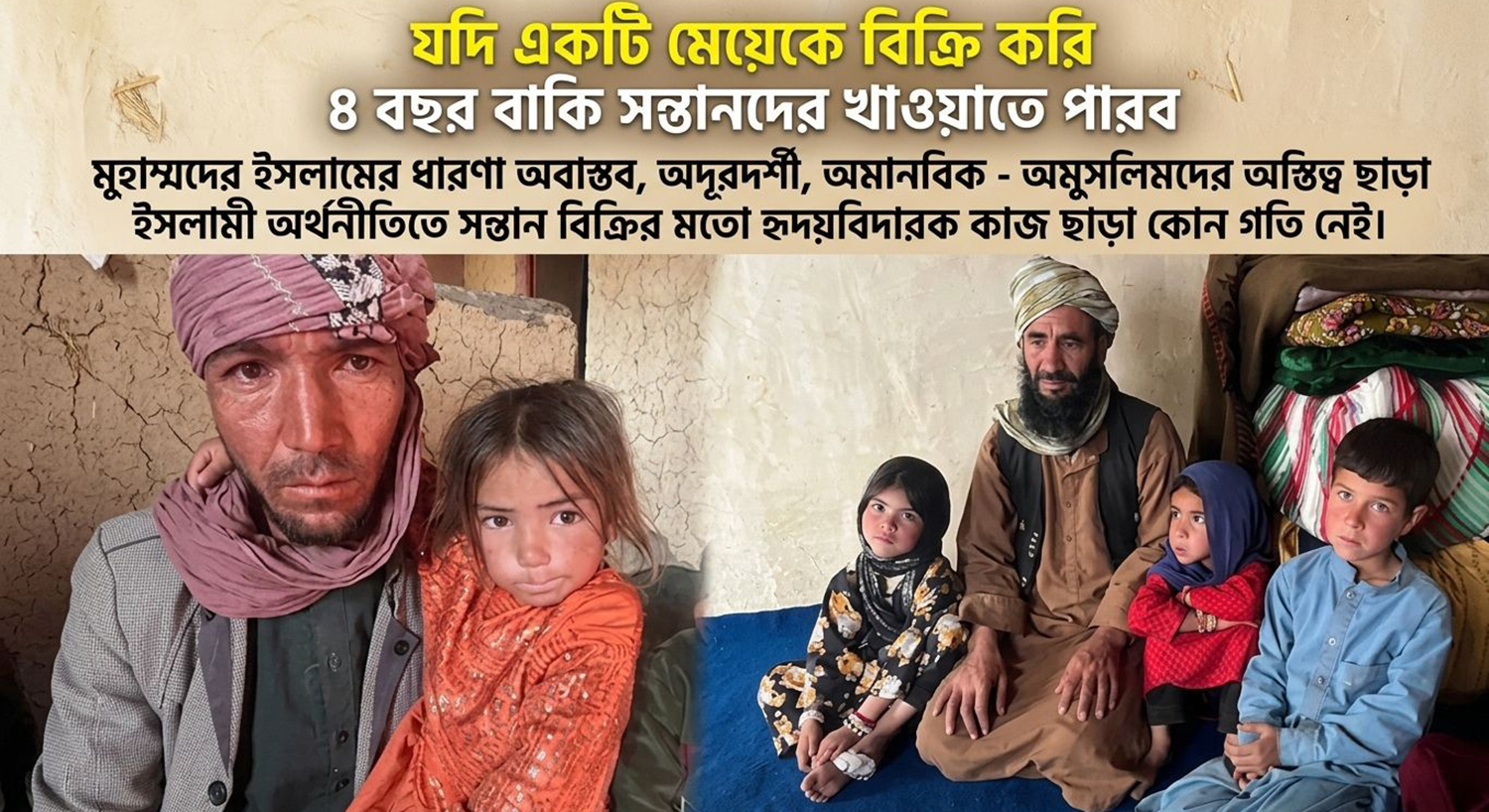
The concept of Muhammad’s Islam is unrealistic, short-sighted, and inhumane — without the existence of non-Muslims, an Islamic economy has no way forward except heartbreaking acts like selling children, as seen among the unfortunate people of Afghanistan.
Islam is presented by its followers as a complete way of life — a system applicable for all times and all places. But when a system that originated in the geographical, social, and economic context of 7th-century Arabia claims universality, certain fundamental contradictions emerge. Critics of Islam — including historians, economists, philosophers, and ex-Muslims — have been identifying these contradictions for a long time.
The claim of universality in Islam vs. its dependence on non-Muslims
The central theological goal of Islam is to transform the entire world into Dar al-Islam — a world under Islamic rule. Until that goal is achieved, Islam prescribes jihad and qital (fighting/killing). However, critics observe that the classical Islamic economic structure depended heavily on the existence of non-Muslims for its sustainability. This contradiction is not merely theoretical but structural and practical. The idea that an average Islamist in Bangladesh who argues that Islam is the solution to everything would understand these matters is unrealistic.
Primary sources of income in an Islamic state were:
Ghanimah — plunder from non-Muslims during war
Jizya — a special tax on non-Muslim citizens
Kharaj — tax on conquered land
Slave trade — selling non-Muslim war captives as slaves
Beyond this, Islamic sources describe numerous instances of caravans traveling to Mecca from places like Syria or Yemen being looted. Even if we exclude these from formal accounting, what other sources of income existed in classical Islam besides the four mentioned above?
Each of these four sources depended on the existence of non-Muslims. If Islam’s stated goal were fully realized and everyone became Muslim, this entire economic structure would collapse.
British historian Edward Gibbon noted in The History of the Decline and Fall of the Roman Empire that the economic driving force of early Islamic conquests was largely plunder and taxation — not a productive economy.
Early Islamic economy — extraction, not production
A key observation among critics is that early Islamic society emphasized an extractive economy rather than a productive one.
Islam shows disregard for agriculture — a vital and honorable profession
Various hadith literature includes narrations that seem to discourage agriculture. In Sahih Bukhari, a hadith attributed to Ali reports that the Prophet said engaging in agriculture can divert people from jihad. While Muslim scholars offer alternative interpretations, critics see this as reflecting a broader mindset within early Islamic society. The Prophet Muhammad and his companions were not engaged in productive occupations.
In the desert nomadic Bedouin culture, agriculture was never central. However, sustainable civilization requires it. Many early Muslim fighters were professional warriors whose livelihoods depended on jihad campaigns. As mentioned earlier, they had no stable productive professions. Jewish communities in the region were largely engaged in agriculture, generating resources from nature, while Islamic forces seized those resources.
Limitations of a plunder-based economy
American historian and Islam scholar Robert Spencer, in The History of Jihad, explains that early Islamic economic systems formed a chain: conquering one region financed the next campaign. If this cycle stopped, the system fell into crisis.
After victory in war, women and children of defeated tribes were enslaved. Some were sold in markets, often purchased by wealthy individuals as sex slaves. The money funded further military campaigns. To maintain their sale value, practices emerged to avoid pregnancy among slaves before resale. This reflects the integration of warfare, slavery, and economic survival in that structure.
Historical evidence suggests that when conquests slowed or non-Muslim populations declined, Islamic states faced economic crises. Critics view this as evidence of structural weakness in the model. Regardless of ideological claims, no lasting example of a successful Islamic economic system is widely recognized today — with Afghanistan often cited as a contemporary example of failure.
Jizya tax — a major but discriminatory revenue source
Jizya is a fundamental element in Islamic jurisprudence, referenced in Quran 9:29. It was a tax imposed specifically on non-Muslim citizens (People of the Book).
Rate and nature of jizya
Historical records indicate that the Jews of Khaybar were required to give up to 50% of their produce to Muhammad. Though rates varied across regimes, the principle remained: non-Muslims bore additional financial burdens due solely to their religion.
Critics view this as structural discrimination. It is not just taxation — it often involved a symbolic acknowledgment of second-class citizenship.
Afghanistan as an example — a harsh and inhumane test case
Afghanistan is among the poorest countries in the world. Under Taliban rule, it has become isolated from international aid. Instead of adopting globally proven economic models, they claim to rely on a 1,400-year-old system. Reports of families selling their children for survival are tragically common today.
Critics ask: in a country with almost no non-Muslim population, where are sustainable revenue sources under an Islamic economic model? If jizya, ghanimah, and slavery are absent or impractical, how can economic stability be achieved? Some argue that if large non-Muslim populations existed, governments might rely heavily on such taxation rather than conversion.
Pre-Islamic Arabia and limitations of knowledge
Why did Muhammad introduce concepts critics see as impractical today? They argue it reflects limitations in contemporary knowledge. While some earlier philosophical ideas from Greece still hold relevance, Muhammad and his society had limited exposure to them.
7th-century Arabia was relatively isolated from major civilizations like the Sassanid Empire, Byzantine Empire, Gupta India, or Tang China. Bedouin societies lacked advanced state structures, and this influenced the framework of early Islamic rules.
Local context presented as universal
Critics argue that many Islamic rulings addressed specific conditions of 7th-century Arabia but were later framed as eternal and universal.
Examples:
Dress codes — suited for desert climates but applied globally
Dietary rules — pork prohibition possibly linked to preservation challenges in hot climates
Rules of warfare — shaped by tribal conflicts but applied to modern warfare contexts
End-times beliefs and lack of long-term planning
Some hadiths indicate that Muhammad believed the Day of Judgment was imminent. One narration suggests it would arrive within the lifetime of a present child.
Critics argue this belief creates a problem:
If the world is expected to end soon, there is little incentive to build long-term institutions, economic systems, or sustainable governance.
This mindset, they suggest, explains why Islamic legal tradition includes detailed rules on war spoils and slavery but lacks structured long-term economic planning for agriculture, industry, or innovation.
Modern Islamist dreams in post-colonial contexts
Some Islamist groups in countries like Bangladesh or Pakistan envision conquering India, imposing jizya on millions, and establishing a caliphate. Critics consider these fantasies unrealistic for several reasons:
Practical: Military victory against a nuclear-armed modern state is implausible.
Ethical: Religious taxation violates modern human rights standards.
Economic: Modern economies depend on productivity, technology, and trade — not conquest or discriminatory taxation.
Critics argue such thinking is detached from reality and modern global systems.
From Aurangzeb to the Taliban — relevance of jizya today
Mughal emperor Aurangzeb reintroduced jizya in India in 1679, after Akbar had abolished it. Historians argue this decision contributed to weakening the empire by alienating Hindu allies and strengthening resistance movements.
This serves as a historical lesson: discriminatory taxation can create long-term instability and weaken states.
In Afghanistan today, the absence of non-Muslim populations removes even those traditional revenue options, reinforcing economic challenges. Critics argue the country must integrate with modern economic systems to ensure basic welfare and stability.
Conclusion
The central argument of critics is that a system developed in the specific socio-economic conditions of 7th-century Arabia — largely based on extractive practices and shaped by apocalyptic expectations — cannot realistically function as a universal model in today’s diverse, democratic, and technology-driven world.
They suggest that economic stagnation, limited scientific innovation, and political instability in many Muslim-majority countries may partly result from adherence to outdated economic concepts framed as religious obligations.
Related Posts

Operation Entebbe – the story of one night, and the Islamic execution suffered by Nazrul Islam and Sweety Akter
What can a state do to save the lives of its citizens abroad? Are thereRead More
অপারেশান এন্টেবে – এক রাতের গল্প এবং নজরুল ইসলাম ও সুইটি আক্তারের ইসলামি হত্যার শিকার হওয়া!
একটি রাষ্ট্র বিদেশে তার নাগরিকদের জীবন বাঁচাতে কী করতে পারে? এর কোন টেক্সটবুক উদাহরণ আছে?Read More

A random page from Muhammad’s self‑made book Qur’an and its unscientific statements
Sometimes I flip through random pages of Muhammad’s self‑made book Qur’an, and today this pageRead More
Comments are Closed