
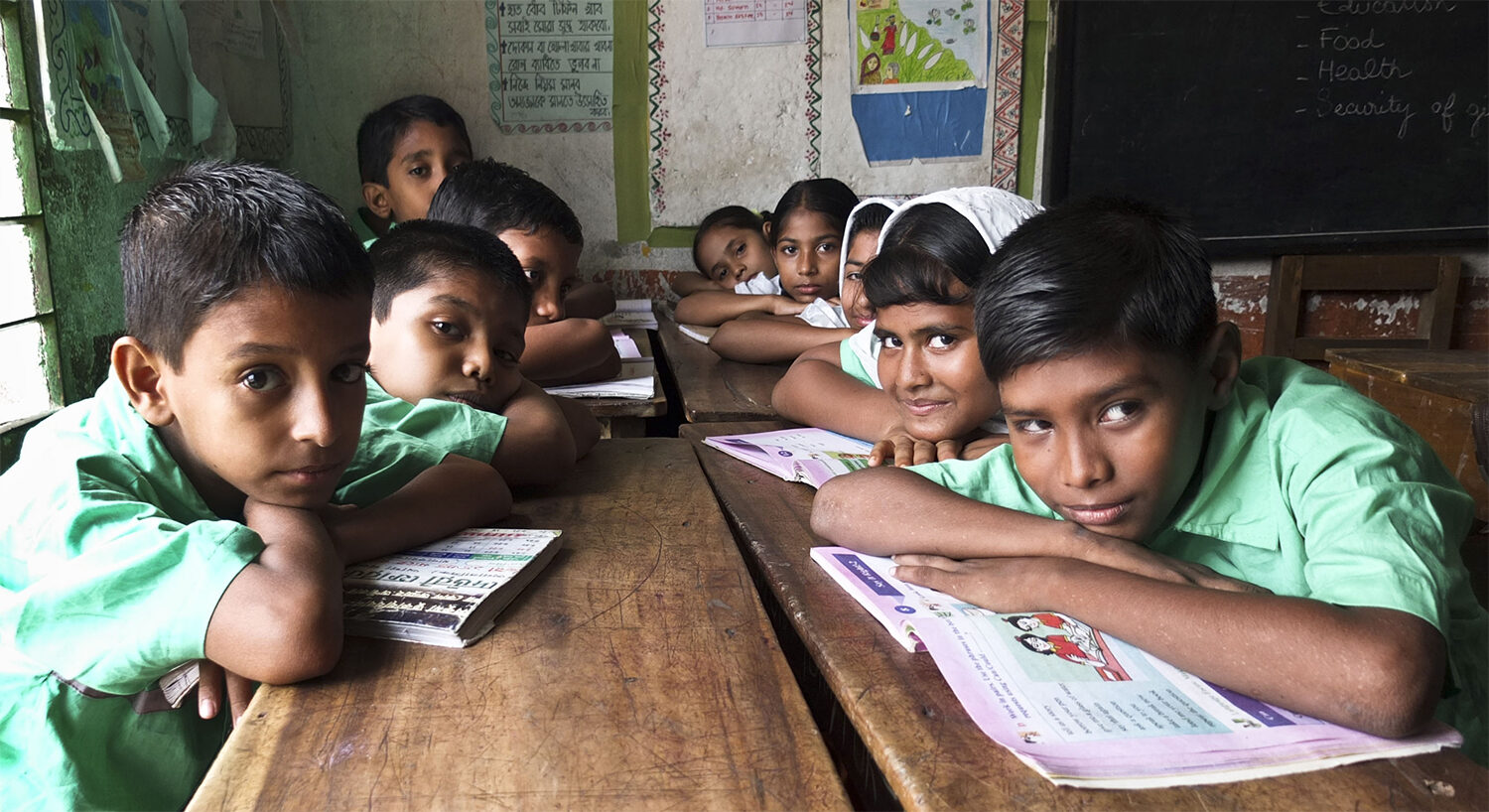
No learning by memorization
The education system, the pressure to memorize, and the decline of intellectual creativity!
When we were in the tenth grade, we had a teacher who taught General Science. He would come in, sit on the chair, and one of the students would hand him the book. He would read aloud two or three pages. He would even read things like “Figure No. 9” and “Let’s Do It Ourselves 7.2.” He never once went to the blackboard, nor did he explain anything verbally. He was always busy with politics. Later, he even became the headmaster. This is the picture of a teacher and of our school management. One of our classmates had earned two scholarships. He couldn’t become a teacher at the school, but an incompetent boy involved in politics could. In almost every village school now, teachers are recruited in exchange for money. Where is the evaluation of merit? Where is the reward for honesty?
The biggest problem in our country’s education system is rote memorization. Children in our country are taught from a young age that studying means memorizing books. When I was young, many students from the southern region used to stay in our village as boarders. Sometimes I heard them say that one of their students had a “good head” because he could memorize everything, while another had a “bad head” because he couldn’t. This obsession with memorization creates fear about education in the minds of students. Of course, our education system, teachers, and job exams all promote this memorization. Even at the university level, I have seen many teachers give higher marks to memorized writing rather than genuine understanding.
The purpose of education and memorization-based learning are two completely opposite positions. The purpose of education is to create independent learners. What does that mean? In lower grades you learn addition and subtraction, and in higher grades you should be able to solve problems on your own. Education is a tool or mechanism that helps you learn new things throughout your life. One stage of learning should help you independently learn the next. Education does not mean knowing everything; it means knowing how to learn what you do not know. The purpose of education is to give you the ability to navigate freely through different layers of human knowledge. Through this step-by-step process, intellectual development is ensured. But when a student remains stuck only in memorization, all other aspects of cognitive development become blocked.
You may have heard of Bloom’s taxonomy, which outlines six levels of the cognitive domain. What does it look like?
- First, a student reads a topic and remembers the information (Remembering),
- Next, the student understands what they have read (Understanding),
- Then the student gains the ability to apply what they have learned in real life (Applying),
- In the next stage, the student can analyze the learned content or similar content (Analyzing),
- After that, the student can evaluate (Evaluating), and at the highest stage, the student gains the ability to create something new through learning (Creating).
According to educational science, education should help a person think from simple to complex, understand from easy to difficult. Memorization is the very first and lowest level of intellectual development. Five more levels remain after that. Our entire education system has, for years, continuously promoted this lowest level – rote memorization. The higher levels of intellectual development remain completely out of reach. When this is the state of the system, how can we expect thoughtful, analytical people to emerge from it?
Is it reasonable to expect much from people stuck at the very first and lowest level of intellectual development? These are the people who will slow down the internet every few days to prevent question leaks, shut down the internet entirely, recommend installing escalators in schools that don’t even have toilets, buy a 1,000-taka fan for 100,000 taka, build roads at costs higher than India, America, or Switzerland, puncture a kidney while operating on a gallbladder stone, use one government car for each family member instead of one official vehicle, create separate lanes on narrow roads for their own convenience, build buildings using bamboo instead of iron, detain dead patients and extort money from their families – so many things!
But are there no people who reach the highest level of intellectual development? There are. Those who cannot blend into the mainstream leave the country and become scientists, researchers, engineers, doctors. Those who stay in the country are so few that they are crushed under the pressure of the majority. The state or the education system contributes nothing to their reaching this highest level. It is entirely the result of their personal dedication and discipline.
We spend our entire student life memorizing, but what is the state of the job market? From BCS to bank jobs, guidebooks are available in Nilkhet for every government exam. Even for private teaching jobs, guidebooks are sold. A student who can memorize an entire BCS guidebook has about a 90% chance of passing the exam. That is why you will see countless university students start memorizing BCS guidebooks from their first year. This cycle of memorization-based success continues from early education all the way to securing a job for survival. What constructive contribution can they make to the country? They cannot escape the clerk mentality inherited from the British era.
So what must be done to make students morally upright human beings? Many people say moral education should be taught from school. But if students memorize moral education just like any other subject and score 90 out of 100 without understanding anything, then what? If moral education is also passed through memorization, the student still has the potential to become a thief, doesn’t he? So where is the problem? Even many PhD holders in our country become large-scale thieves. Their education cannot stop them from stealing. After passing the BCS exam, many government officials feel they have received a permit to steal. That is why an engineer sees no problem in using bamboo instead of iron. That is why thousands of educated doctors see no problem in detaining patients for money. This proves that the current education system has completely failed to produce morally upright human beings.
The recruitment process for teachers, administrators, doctors, lawyers, engineers, and public representatives in our country is fundamentally flawed. Questions are designed based on the lowest level of thinking, evaluations are done accordingly, and the entire system is structured around that. This process must change. Until honesty, competence, merit, qualification, and experience become the criteria for recruitment, no good change will come to this country. Positions must be given to those who reach the highest level of education – those who can create something new in their domain. Otherwise, this vicious cycle will continue endlessly. Money will turn people into two-legged creatures, but not into human beings.
[PC: © CC BY-SA 4.0 ]
Related Posts
Islam’s Circular‑Logic Fallacy
Place: Cabin of a Dhaka–Sylhet-bound trainCharacters: Maulana Abdur Rahman (a responsible member of Tabligh Jamaat)Read More
ইসলামের সার্কুলার লজিক ফ্যালাসি
স্থান: ঢাকা থেকে সিলেটগামী ট্রেনের কেবিনচরিত্র: মাওলানা আব্দুর রহমান (তাবলিগ জামাতের একজন দায়িত্বশীল) ও অধ্যাপকRead More
Comments are Closed