
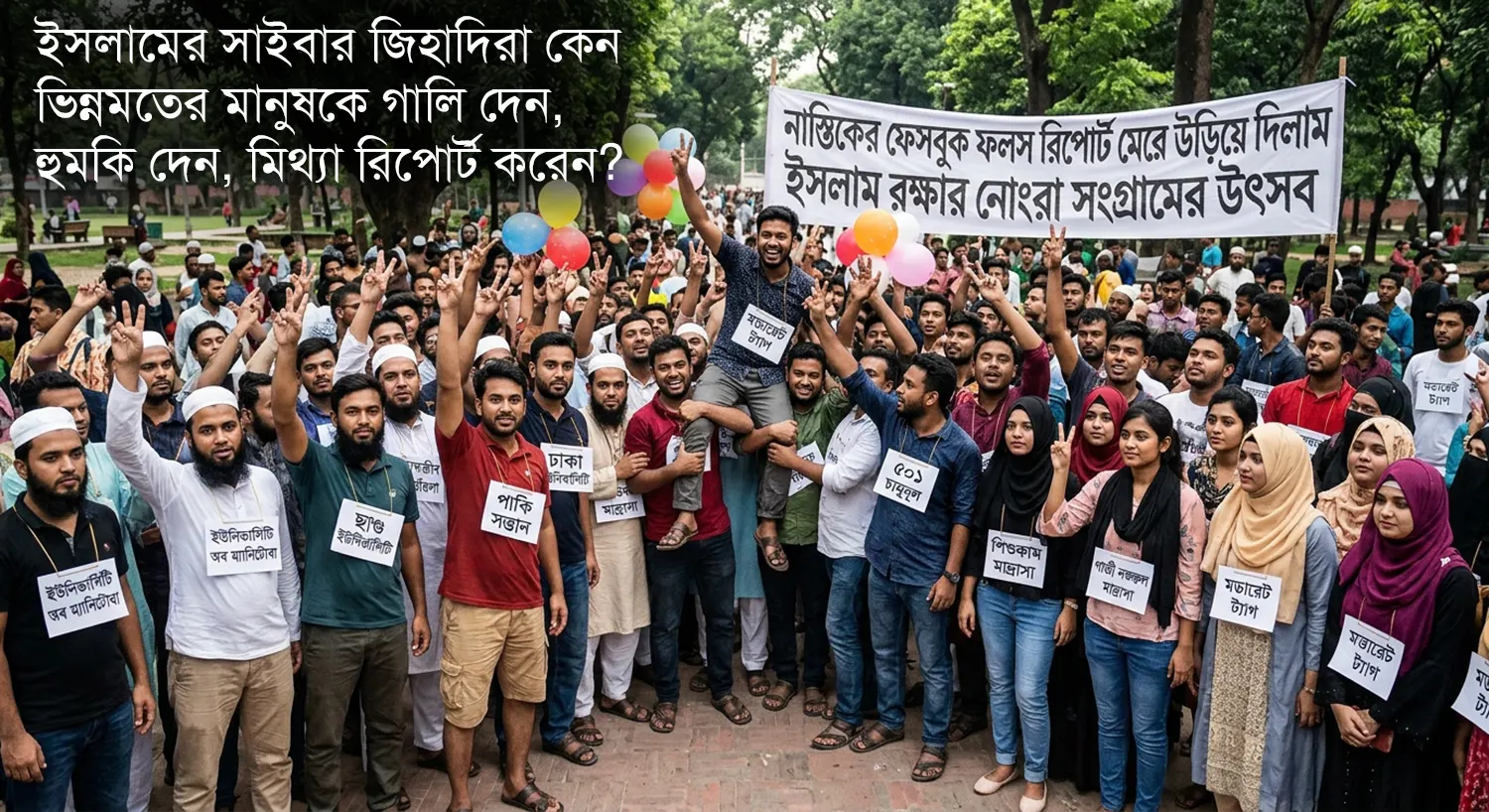
Islamic Online Jihadis
Why do Islamist cyber‑jihadis insult, threaten, and file false reports against people with different opinions?
Maulana Azhari once advised Islamists that sharing his Facebook posts is also an Islamic act; that too is a way to receive special rewards from Allah on Allah’s path. Yet in Islam, drawing images of living beings, capturing them, recording videos, displaying them, looking at the bodies of non-mahram women—all these are completely haram. But since Islam is propagated there, and they earn income through share–view business, they have now made that halal.
Azhari claims that on the way from Egypt (Cairo) to Qatar he saw the Himalaya mountains from the airplane. He further claims that Neil Armstrong, after going to the moon, saw the crack caused by the Prophet Muhammad’s splitting of the moon, heard the azan, and after returning to Earth accepted Islam. No matter how false these weed-induced tales are, you must share them to make Azhari’s sermons go viral—this will increase his income, and your service to Islam will also be done. When you cannot wage jihad to kill people of other religions, apostates, atheists, then disabling their Facebook posts–profiles by resorting to spying on them is also Islamic jihad. If necessary, you will not hesitate to do any kind of brutal act—even by presenting yourself as homosexual, of a different religion, or as an atheist—in order to serve Islam; all of these are service to Islam, your path to attaining Islamic paradise.
Many young people in Bangladesh—indeed many who have even studied at universities in secular countries—become extremely agitated when they see criticism of Islam, the Prophet Muhammad, and Allah. Without verifying whether that dark chapter exists in Islam, they start hurling obscene abuse at the critic, insults involving the critic’s parents, insults about birth identity, even threats of raping the critic’s mother and sister, killing the critic, burning them alive, shooting them, beating them—an endless flood of abuse and threats. In this group are also those who in their personal lives hardly practice religion; in fact many are involved in alcohol, women, gambling—many things that Islam forbids they continue in their personal lives. The great corrupt man who does not speak without bribes; the adulterator, the rapist—everyone will join in attacking that critic. Many singers, many dancers of folk theatre, many cut-piece film heroes and heroines, child-raping pedophiles, women of brothels, pimps—all will join that group. BNP, Awami League, Jamaat, Charmonai, Communists, NCP, progressives—everyone will forget their divisions and join that procession. Very few people will protest for us, those who want us to speak—yet others will chase them calling them India’s agents, enemies of the Messenger!
Suppose Taslima Nasrin enters her birthplace Bangladesh tomorrow through the Benapole border—who will not want to go to resist, obstruct, or kill her, who will not support extremism? Who are they? How many in number? On the other hand, there will be no shortage of extremist people for resistance. The person who has never performed prayers or fasts in his entire life, but for Islamic nationalism he will not think twice about giving his life. From the above list of politicians, businessmen, ordinary people, and clerics—whom will you not find there?
My Facebook is being suspended almost every day with false accusations of promoting “adult sexual content” as the believers file hundreds of reports, and I have to appeal every day by submitting selfies—by causing me this suffering they are doing their jihadi work. My previous ID from 2010 with 27,000 followers and 13,000 posts was completely gone last June. Why do they file such false reports on my Facebook ID? Because they cannot get hold of me, nor my relatives. In America’s Arizona Cultural Academy & College Prep (ACA) mosque, a man named Ahsan Habib—an old man—gives the azan and leads prayers; he also threatens that if he ever meets me in person he will shoot me dead. A man named Mohammad Asiful Hossain, who studied at the University of Manitoba in Canada and lives with his wife and children in British Columbia, Canada, threatens to track down my relatives in the country and “take care of them”; he is syndicating people to report my Facebook. There are more like him—someone from Florida used to give authoritarian threats and abuse. There are hundreds of such people who, even though they live in countries like America, Canada, and Europe and have studied there, the social values of those countries have not been able to remove the darkness from their minds; they do not care about the essence of freedom of speech and individual freedom in those countries. Their goal is population explosion, bringing Islamists abroad under false identities—even by showing themselves as homosexuals—and conquering all countries with Islam.
You know, recently in England many people have been caught who sought asylum there with false documents claiming to be homosexual. The highest number are Pakistanis, followed by Bangladeshis. Yet they are all Islamists, devout. Islam has ordered the killing of homosexuals. But pretending to be homosexual to capture secular countries for Islamists is permissible for them.
In countries like America, Canada, and Europe, freedom of speech and individual freedom are treated with great importance. Their laws state that criticism—even false criticism and abuse—of religion, religious great men, religious scriptures, and the Creator is part of people’s right to freedom of speech. Under the First Amendment of the American Constitution, people have been given unrestricted opportunity to speak. The fact that this is a very fundamental right of human beings does not register in the minds of people in countries like Bangladesh who carry fundamentalist consciousness. They are used to seeing and knowing black laws like Islamic blasphemy; they think that no one can hurt the so-called airy thing called religious feelings! When other religions are criticized, people are not usually attacked; only Islamic terrorists launch attacks.
But why do they have this tendency? What does research say? Even while living in lands of unrestricted free thought and free expression, why can they not abandon their bigotry? Why do many young people in Bangladesh, even while living in an age of such unrestricted information flow on the internet, want to strangle people’s right to freedom of speech? This tendency of filing false reports on Facebook to get IDs removed—what kind of mindset gives rise to such attempts in people’s heads?
A. The psychology of belief and identity
1. Sacred values
Some beliefs are beyond bargaining for people. In other matters people can compromise, but compromising on sacred matters is seen as moral collapse. So criticism of these is not perceived as “difference of opinion” but as “attack” or “desecration”. As a result, instead of dialogue, resistance appears to be the only moral response.
Source: Atran & Axelrod, “Reframing Sacred Values”, Negotiation Journal, 2008; Jonathan Haidt, The Righteous Mind, 2012 (the moral foundations of sanctity and loyalty).
2. Different conceptions of “being hurt”
In secular thought, religion is an ideology whose criticism is part of freedom of speech. But for many believers, the relationship with the Prophet or religion is personal and emotional, somewhat like insulting a family member. Talal Asad and Saba Mahmood highlight this gap: one side sees “expression of opinion”, the other side feels “personal injury”. This does not legitimize threats or false reporting; it only explains the source of the reaction.
Source: Talal Asad, Formations of the Secular, 2003; Saba Mahmood, Is Critique Secular?, 2009.
3. Identity-protective cognition and “us versus them”
When a belief becomes part of group identity, criticism of it is perceived as an attack on oneself and the group. Then protecting the group becomes more important than examining arguments. Tajfel and Turner’s social identity theory says that people’s self-esteem is closely tied to the status of their group, so when the group seems attacked, defending it becomes a moral duty.
Source: Dan Kahan’s research on identity-protective cognition (post-2012); Tajfel & Turner, “An Integrative Theory of Intergroup Conflict”, 1979.
4. The stricter form of religious identity in the diaspora
Separated from their culture and society in immigrant environments, many people’s religious identity shifts from “local tradition” to a “pure, ideal-based” form. The insecurity of being a minority in a new country and cultural tensions can intensify this strictness. Thus someone may live in a secular country yet not internalize its values, instead clinging more tightly to their own identity.
Source: Olivier Roy, Globalized Islam, 2004.
5. Long-distance nationalism
Expatriates often engage in their home country’s politics and social debates from afar more intensely than those living there. They do not have to bear any local consequences, so taking positions becomes easier and more extreme. Digital media further facilitates this connection.
Source: Benedict Anderson, “The New World Disorder”, New Left Review, 1992.
B. Information and technology: why abundance of information does not increase tolerance
6. Confirmatory bias and motivated reasoning
People do not judge new information neutrally. They easily accept information that supports their own beliefs, and doubt or avoid information that goes against them. So even if all information is available on the internet, there is little urge to read sources outside one’s own belief, and even if one reads them, one looks for reasons to reject them.
Source: Ziva Kunda, “The Case for Motivated Reasoning”, Psychological Bulletin, 1990; Raymond Nickerson, “Confirmation Bias”, Review of General Psychology, 1998.
7. Echo chambers and algorithms
Platforms like Facebook arrange content according to users’ preferences, so opinions among like-minded people become stronger and more polarized. However, research shows that simply seeing opposing views does not soften people. In Bail’s research, some people became even more extreme after seeing content with opposing views. There is disagreement among researchers about how strong the effect of filter bubbles is.
Source: Cass Sunstein, Republic.com, 2001; Chris Bail et al., PNAS, 2018.
8. Digital contagion of moral outrage
Online, the cost of expressing moral outrage is almost zero, yet in return one receives group praise and the feeling that “I am protecting religion or values”. Research shows that morally emotional messages spread more widely in social networks. In other words, showing outrage is socially rewarded, and pressing the report button becomes the easiest way to express that outrage.
Source: Molly Crockett, “Moral Outrage in the Digital Age”, Nature Human Behaviour, 2017; William Brady et al., PNAS, 2017.
9. Misuse of reporting systems (brigading)
The platform’s “flag” tool was created to detect harmful content, but volume-dependent automated systems are easily misled. When many reports are submitted, an account can be temporarily suspended, so coordinated mass reporting becomes an effective weapon. This tactic is used not only by religious groups but also by political parties, nationalists, and other ideological groups.
Source: Kate Crawford & Tarleton Gillespie, “What Is a Flag For?”, New Media & Society, 2016.
10. Online disinhibition and moral disengagement
Because identities are hidden, people are not face-to-face, and they do not see the consequences, people do things online that they would not do in person. This combines with Bandura’s “moral disengagement”: when people think their actions serve a noble purpose (for example, “they are insulting religion”), false reporting does not feel unethical, but rather a duty.
Source: John Suler, “The Online Disinhibition Effect”, CyberPsychology & Behavior, 2004; Albert Bandura, “Moral Disengagement in the Perpetration of Inhumanities”, 1999.
C. Social pressure and mindset
11. Social pressure and hiding preferences
Out of fear of social costs, many people publicly take positions contrary to their private views. This is why people who practice little religion in their personal lives can still pose as “defenders of religion” in public: if they are not in the group, they fear becoming targets of suspicion themselves. In many cases, therefore, this is more a strategy for social survival than a matter of belief.
Source: Timur Kuran, Private Truths, Public Lies, Harvard UP, 1995.
12. Authoritarian tendencies
Some people have a strong bias toward order, unity, and established rules. When they feel society is under threat, this tendency becomes active and support for suppressing dissent increases. This is seen in both religious and secular groups, meaning that mindset rather than religion is central here.
Source: Bob Altemeyer, Right-Wing Authoritarianism, 1981 and The Authoritarian Specter, 1996; Karen Stenner, The Authoritarian Dynamic, 2005.
13. Organized incitement
In the Danish cartoon controversy, a large part of the global outrage was not spontaneous but the result of organized campaigns by political and religious leaders. Online, syndicated mass reporting can be a similar kind of coordinated behavior, where one or a few organizers activate many people.
Source: Jytte Klausen, The Cartoons That Shook the World, Yale UP, 2009.
D. Law, politics, and the Bangladeshi context
14. The Legacy of Blasphemy Culture
People coming from societies where religious defamation was legally punishable or socially suppressed may consider those norms “natural.” After migration, the laws of the new country change, but familiar moral assumptions travel with them.
Source: Paul Marshall & Nina Shea, Silenced, Oxford UP, 2011; Human Rights Watch and Article 19 reports on the 2015 killings of bloggers including Avijit Roy.
15. The Message Sent by Law and State Behavior
Penal Code Section 295A and Section 57 of the ICT Act, along with later Digital/Cyber Security Acts, have defined “hurting religious sentiment” as a criminal offense. This sends a social message that suppressing criticism is legitimate and state‑endorsed, encouraging ordinary people to see themselves as participants in that suppression. (The current status of these laws is evolving, so please verify updated information.)
Source: Human Rights Watch and Article 19 reports on Bangladesh.
16. Political Use of Religion and Lack of Accountability
There is a long history of using religion as a tool for political support. Incidents such as the 2012 Ramu and 2016 Nasirnagar attacks were triggered by allegations over Facebook posts, and in many cases justice was absent or weak. This creates the perception that raising such accusations will gain social support and carry little risk of punishment.
Source: Ali Riaz, Bangladesh: A Political History Since Independence, I.B. Tauris, 2016; Passage to Authoritarianism, 2021.
17. Survey Levels of Support and Diversity
Pew surveys show that support for Sharia‑based laws varies across countries, and Bangladesh shows comparatively higher support. However, the same surveys also reveal wide internal diversity, so saying “everyone is the same” is not accurate. Surveys indicate trends in opinion, not individual behavior.
Source: Pew Research Center, The World’s Muslims: Religion, Politics and Society, 2013.
18. Gaps in Critical Thinking Training (Hypothesis)
Rote‑based education and a lack of debate culture may reduce the ability to handle dissenting views. There is research on weaknesses in Bangladesh’s education system, but direct studies linking this specifically to false reporting are limited. Therefore, this is not a proven cause, only a reasonable hypothesis.
Summary
Several factors usually work together behind the mindset that leads to false reporting:
Identity protection (1–5) + social rewards for outrage and low risk (8–10) + group pressure or organized incitement (11–13) + a sense of legal and political support (14–16).
The abundance of information on the internet does not eliminate any of these factors; rather, points 6 and 7 show that in many cases it amplifies them.
Related Posts
ইসলামের সাইবার জিহাদিরা কেন ভিন্নমতের মানুষকে গালি দেন, হুমকি দেন, মিথ্যা রিপোর্ট করেন?
মাওলানা আজহারি একবার ইসলামিস্টদের উপদেশ দিয়ে বলেছিলেন – তার ফেসবুক পোস্ট শেয়ার করাও ইসলামের কাজ;Read More
Palestine and Gaza merging with Israel, and all of Kashmir merging with India, would lead to greater humanitarian benefit
In modern politics, independence is often considered an almost inviolable value, where leaders aim toRead More
ফিলিস্তিন ও গাজা ইসরায়েলের সঙ্গে, পুরো কাশ্মীর ভারতের সঙ্গে মিশে গেলেই মানবতার বৃহত্তর কল্যান হবে
আধুনিক রাজনীতিতে স্বাধীনতাকে প্রায় অলঙ্ঘ্য মূল্য ধরা হয়, সেখানে নেতাদের লক্ষ থাকে দেশের নেতৃত্ব বাRead More
Comments are Closed