
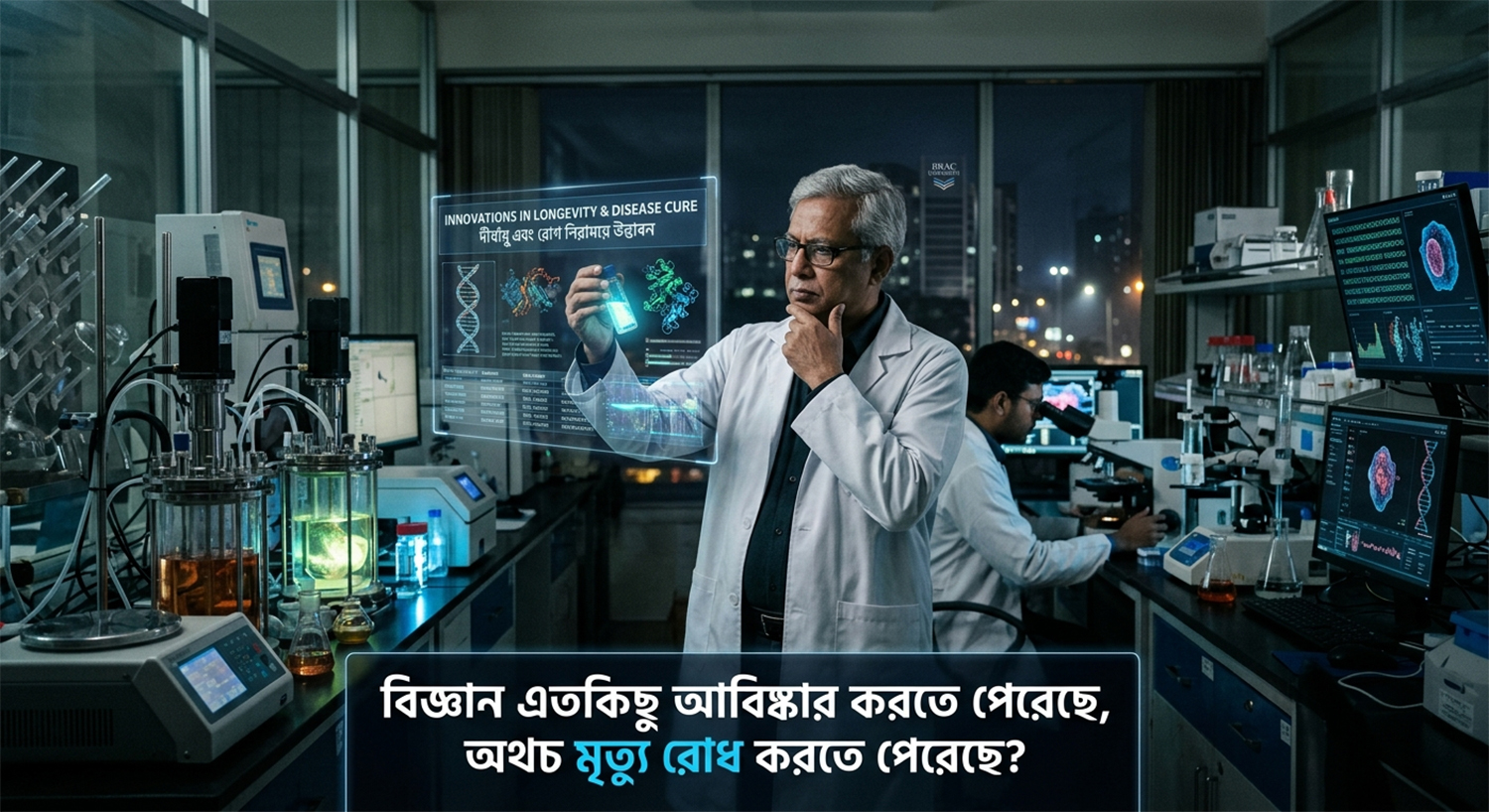
Human Death
Science has been able to discover so much, but has it been able to stop death?
Believers often strongly claim that science has discovered so many things, yet it has failed to stop death. This is essentially a form of consolation born from their frustration with life, and the mental crisis of falling behind in knowledge, science, and economics.
~Life has existed on Earth for about 3.8 billion years
~The human body contains about 37 trillion cells
Apoptosis (programmed cell death) is a reality
0 proven afterlife so far
1. Why does death occur?
Death is not a mysterious phenomenon — it is a calculated outcome of evolution. Life began on Earth about 3.8 billion years ago. Over this long journey, nature “discovered” that creating immortal organisms is not advantageous — rather, when one generation dies, resources are freed for the next generation.
At the cellular level, death occurs for three reasons:
Apoptosis (programmed cell death — the body itself eliminates old cells),
Telomere shortening (with each cell division, chromosome ends shrink until division stops),
And free radicals (oxidative damage that breaks DNA).
From an evolutionary perspective:
Natural selection has no “reason” to keep you alive after reproductive age. You have already passed on your genes — the job is done. Once your copy is preserved in the world, your role in nature is essentially complete.
2. Why is there no cure for death if there are cures for diseases?
This question is based on a misconception often made by believers. There is no cure for all diseases — cancer, Alzheimer’s, prion diseases, and many others remain unconquered. More importantly, death is not a “disease” that can be cured.
Death is the victory of entropy — according to the second law of thermodynamics, any complex organized system will eventually move toward disorder. Your body is an incredibly complex chemical machine — keeping it running forever would require infinite energy and infinite repair.
However, science is not standing still. Longevity research, senolytics (drugs that remove aged cells), and CRISPR gene editing — these fields may significantly extend human lifespan. Not “immortality,” perhaps, but a healthy lifespan of 150–200 years may not be impossible in the future.
3. Who causes death?
No one. Death is not an entity — there is no Azrael, no “angel of death.” It is the end of a biochemical process. Life is simply biochemistry.
Causes of death:
Internal
Aging, genetic diseases, cancer, heart disease — originating within the body
External
Accidents, infectious diseases, environmental pollution, violence — originating outside
Fundamental cause
In every case it is the same — brain cells die due to lack of oxygen and glucose
Death is neither punishment nor reward. It is chemistry.
4. Where do people go after death?
Short answer: Nowhere. Consciousness ceases.
Consciousness is a function of the brain — a complex coordination of electrical signals among neurons. When the brain stops working, this process stops. It is like sleep — but without waking up again.
Is there such a thing as a soul?
There is no scientific evidence for the existence of a soul. If there were a non-physical entity that thinks, stores memory, and makes decisions — why does memory disappear in Alzheimer’s disease? Why does personality change after brain injury? Why does consciousness vanish under anesthesia? The answer is consistent — the mind is a product of the brain, not something else.
Near-death experiences (NDEs) — tunnels, lights, seeing deceased relatives — are hallucinations caused by lack of oxygen in the brain and the release of endorphins.
Research (Parnia, 2014) has shown that what clinically dead patients “see” reflects the brain’s final activities.
Where were you before birth? Where were you in 1850? In the same place — nowhere. Death is a return to that prior state.
– A modern form of Epicurus’ argument
5. Why do people not return?
Because death is one-way — the second law of thermodynamics. Burnt paper never becomes unburnt again. Broken glass does not reassemble itself. Once the brain’s connections are destroyed, that exact organization does not naturally return.
Billions of people have died throughout history. Not a single one has reliably returned to describe an afterlife. Not one. This is not coincidence — it is evidence.
Your atoms do return — to the soil, to plants, to other living beings. Nothing in the universe is destroyed; it only changes form.
6. Using fear of death as a tool
Throughout history, every authoritarian system — political or religious — has used fear of death as a tool of control. For example, Islam survives by leveraging this fear. “You will be punished after death” — this idea is one of the most effective ways to ensure compliance, because the punishment is never visible, and thus cannot be disproven.
But this fear comes at a cost — it fragments the present life. When people believe this life is merely a “test,” literature, music, art, love, curiosity — all these seem like “waste.” Yet these are the very essence of being human.
Life becomes greater by understanding death
Understanding death scientifically does not increase fear — it reduces it. When it is understood that death is not a mysterious punishment or the decision of an entity, but an inevitable chemical process of nature — life can be lived with greater awareness.
Humans are children of the stars. Carl Sagan said: we are star dust, a way for the universe to know itself. In this brief life, watching a beautiful sunset, listening to music, reading books, loving someone — these are not meaningless. They are the only meaning that is real.
Death is inevitable — but how you live is up to you. There is no reason to waste this life waiting for imaginary rewards of an afterlife. Time is limited — that is why it is valuable. Taking care of yourself and others, and living well, is therefore essential.
Next article: Afterlife, Fear, and Morality — Is it possible to be good without reward or punishment?
Related Posts
Humans cannot even see 1% of the beauty and colors of Earth and the universe! Are humans really the best of creation?
The human eye can generally detect visible light or color in the wavelength range ofRead More
পৃথিবী ও মহাবিশ্বের সুন্দর জিনিসের ১% সৌন্দর্যের রঙও মানুষ দেখতে পায় না! মানুষ কি সৃষ্টির সেরা?
মানুষের চোখ সাধারণত ৩৮০ থেকে ৭৪০ ন্যানোমিটার (nm) তরঙ্গদৈর্ঘ্যের (wavelength) দৃশ্যমান আলো বা রঙের রেঞ্জRead More

Why does Allah show such preference for women with large breasts and large buttocks? Do men feel the same way? Does this give women any advantage?
If you leave Prophet Muhammad in Pattaya’s Walking Street and Beach Road after evening, inRead More
Comments are Closed