
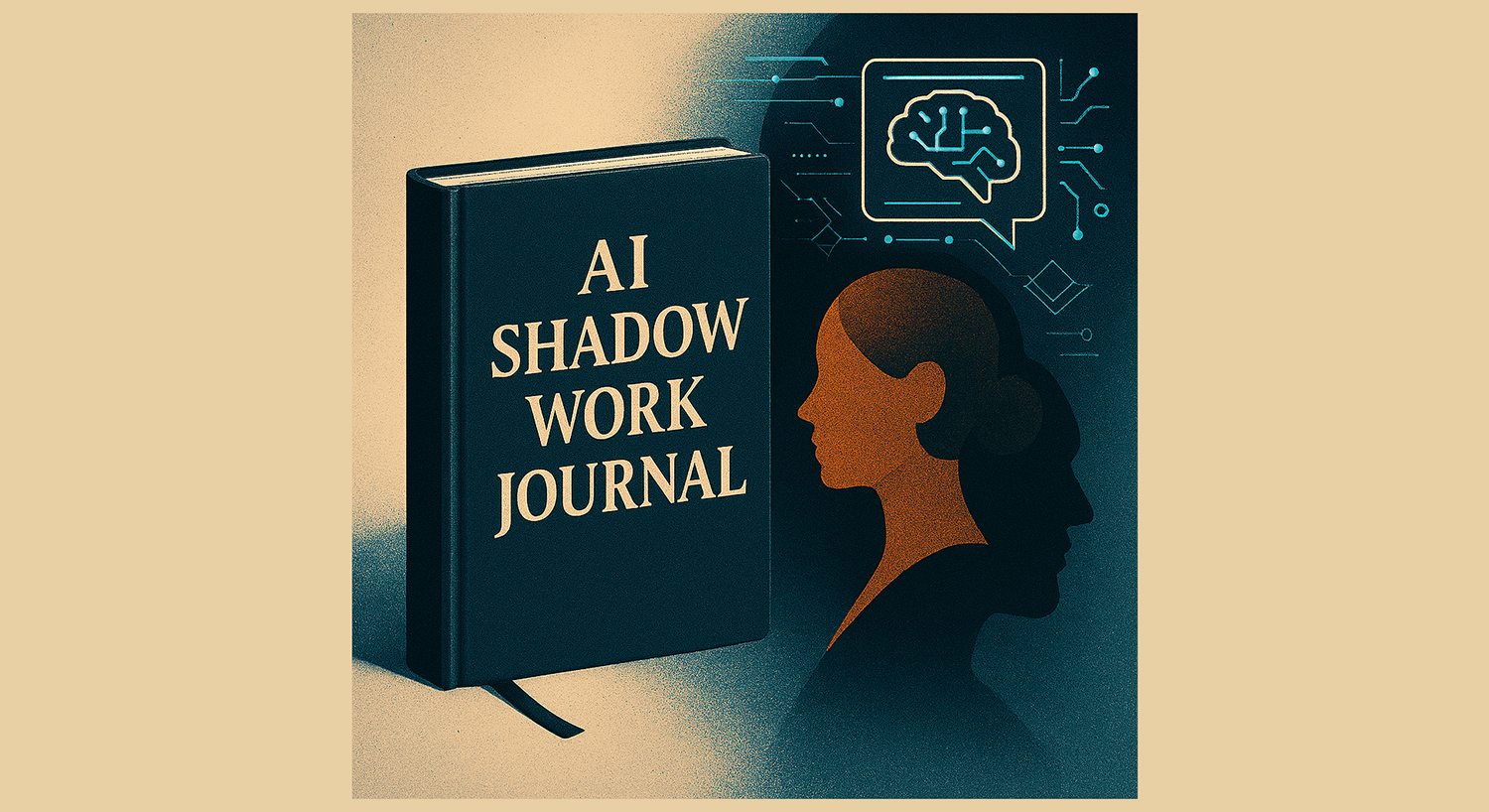
Your Hidden Self
AI Shadow Work Journal: A New Way to Discover Your Hidden Self
Her name is Nabila. Outside, she smiles, works, and blends in with everyone. Inside? A shadow always walks behind her. One night, she sits down to write in her journal. Suddenly, a voice rises from within – a question she asks herself.
Nabila 1 (Light): “Why do you get so angry when someone doesn’t value you?”
Nabila 2 (Shadow): “Because as a child I was ignored many times. No one listened to me. Back then I learned – ‘If you don’t scream, no one will notice you.’”
Nabila 1: “Are you still that little girl?”
Nabila 2: “Yes. I’m still afraid. If someone forgets me, do I even exist?”
Nabila 1: “Do you know that I haven’t forgotten you? You are a part of me. You are the side of me that I hide. But today, I want to see you.”
Nabila 2: (quietly) “Then am I no longer a shadow?”
Nabila 1: “No. You’ve stepped into the light. From now on, you’ll walk with me – not behind me, but beside me.”
That night, Nabila writes in her journal:
My anger, my fear, my neglect – they are all mine. I will not deny them. I will understand them, love them, and accept them.
The shadow and the light begin to walk together.

Inside every human mind, there is a light – what we show, what we want to show, and what others see. But right behind that light lies a shadow, where fear, shame, guilt, denial, suppressed emotions, and the parts of ourselves we don’t want to face accumulate. Psychologist Carl Jung called this the Shadow Self – an unfamiliar, uncomfortable, yet deeply important side of us that silently influences our behavior, relationships, decisions, and emotions.
In today’s world, Shadow Work is no longer limited to pen-and-paper journaling. Artificial Intelligence (AI) has added a new dimension to this deep journey of self-exploration. An AI Shadow Work Journal is a method where AI generates personalized reflections, questions, explanations, and guidance based on your emotions, conflicts, and experiences – things that are often difficult for humans to articulate.
What is Shadow Work and why is it important?
Shadow Work is the process of consciously seeing, understanding, and accepting the unconscious parts of yourself. The emotions or experiences we suppress – like anger, jealousy, fear of failure, memories of rejection – accumulate in the shadow. Denying them creates problems, but understanding them brings freedom.
Why Shadow Work matters:
- It increases self-awareness
- Helps identify emotional triggers
- Reduces relationship conflicts
- Builds confidence
- Makes decision-making easier
- Reveals your authentic self
But Shadow Work is difficult because it takes you to places you don’t want to go. This is where AI can help.
Why use AI for Shadow Work?
For many people, sharing their deepest, darkest sides with another human is difficult. There is fear of judgment, fear of being misunderstood, or simply the inability to express things in words. AI creates a safe, neutral, and non-judgmental space.
Benefits of an AI Shadow Work Journal:
- Neutrality: AI does not judge you
- Privacy: You can express your feelings safely
- Personalization: It generates questions based on your words
- Depth: It asks questions you might not think of yourself
- Consistency: Makes daily journaling easier
- Pattern recognition: AI detects recurring themes in your writing
It is not a replacement for therapy, but it is a powerful tool for self-exploration.
What is an AI Shadow Work Journal?
It is a journaling method where you share your emotions, experiences, fears, conflicts, or questions with an AI – and the AI gives you deep reflective questions, explanations, and insights. It works like a digital mirror that helps you see the unfamiliar parts of yourself.
An AI Shadow Work Journal usually works in three parts:
- Emotion Dumping – writing whatever you are feeling
- AI Reflection – AI analyzes your words and asks questions
- Integration – you answer those questions and learn to understand your Shadow Self
How to start an AI Shadow Work Journal?
1. Set your intention
- Do you want to understand trauma?
- Do you want to find the source of your anger?
- Do you want to explore your fears?
- Or understand your relationship patterns?
2. Choose an AI platform
You can use any AI chatbot – the key is the depth of the questions.
3. Spend 10–15 minutes daily
Shadow Work must be done slowly. Pushing too hard can backfire.
4. Don’t hide your feelings
The more honest you are with the AI, the deeper the insights you’ll receive.
30 Deep Prompts for an AI Shadow Work Journal
These are designed to guide you into deep reflection with the help of AI.
🔹 Self-awareness
- “Why do I avoid this feeling?”
- “Which of my behaviors makes me uncomfortable with myself?”
- “What truth am I afraid to admit?”
🔹 Fear and Insecurity
- “Where did my biggest fear come from?”
- “In which situations do I feel small, and why?”
- “Why am I so afraid of rejection?”
🔹 Relationships
- “Why am I attracted to the same type of people?”
- “Which of my behaviors damages relationships?”
- “Can I receive love? If not, why?”
🔹 Anger and Control
- “In which situations do I lose control?”
- “What emotion is actually hidden beneath my anger?”
- “Why do I want to control everything?”
🔹 Childhood Shadows
- “Which childhood experience still affects me today?”
- “Am I carrying my parents’ fears?”
- “Which childhood emotion have I still not let go of?”
Steps to Create Your Own AI Shadow Work Session
1. Give the AI some context
“I’m feeling very frustrated today. I can’t figure out why.”
2. Ask the AI to enter Shadow Work mode
“Ask me deep questions like a Shadow Work session.”
3. Answer the AI’s questions
Being honest is the most important part.
4. Ask the AI to analyze your answers
“Based on my answers, what patterns do you see?”
5. Integration
Finally, ask the AI:
“What did I learn from today’s session?”
Which AI Tools Are Best?
- General AI chatbots
- Journaling apps with AI
- Therapy-style AI (though not a replacement for therapy)
- Custom prompt-based AI notebooks
The key is that the AI must be able to ask reflective questions.
Precautions When Doing Shadow Work
Shadow Work can trigger deep emotions. So:
- Don’t do a session when you’re mentally unstable
- If you have trauma, seek help from a professional therapist
- Don’t treat the AI’s answers as absolute truth
- Know your limits
- Take breaks when needed
AI is a tool – not a human. It can guide you, but your emotions are your responsibility.
An Example of a Full AI Shadow Work Session
You: “I’m feeling very angry today. I don’t know why.”
AI: “Anger often hides fear, hurt, or unmet expectations. Which emotion do you think is underneath your anger?”
You: “Maybe I felt unimportant.”
AI: “In what situations do you feel unimportant? Does this connect to any childhood experience?”
This is how AI slowly guides you deeper into yourself.
Conclusion
An AI Shadow Work Journal is a new, powerful, and profound method of self-exploration. It helps you see the unfamiliar parts of yourself – parts you may have been avoiding for years. AI doesn’t judge, doesn’t get tired, and asks questions based on your words that bring you face-to-face with your truth.
The journey of knowing yourself is never easy, but AI makes this journey safer, more consistent, and deeper.
Related Posts

Why does Allah show such preference for women with large breasts and large buttocks? Do men feel the same way? Does this give women any advantage?
If you leave Prophet Muhammad in Pattaya’s Walking Street and Beach Road after evening, inRead More
নারীর বড় বক্ষ ও নিতম্বের প্রতি আল্লাহর এতো পক্ষপাত কেন? পুরুষেরও কি তাই? এটা কি নারীকে সুবিধা দেয়?
আপনারা যদি পাতায়ার ওয়াকিং স্ট্রীটে ও বীচ রোডে সন্ধ্যার পর আলো আঁধারিতে নবী মুহাম্মদকে ছেড়েRead More

Do women like the color pink? What is the psychology behind it?
Last winter my friend Lamia went to buy a birthday present for her niece. TheRead More
Comments are Closed