
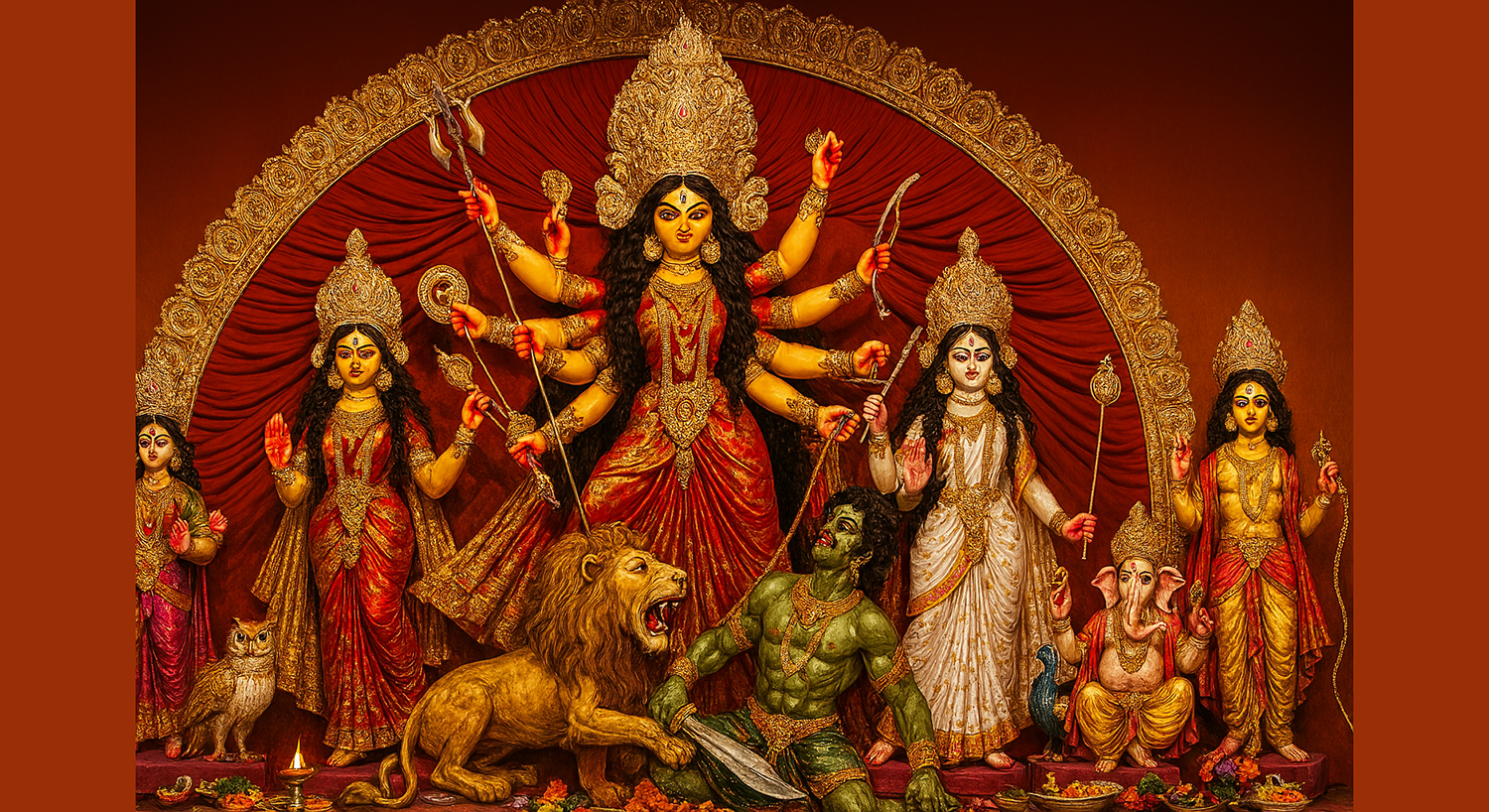
Durga vs Mahishasura
Durga or Mahishasura – who is the true hero of the mythological legend?
Some Indian extremists have now (in 2025) created an effigy of Mahishasura modeled after Professor Yunus and Donald Trump for Durga Puja. To them, the fallen ruler who fled in the face of Bangladesh’s mass uprising—the one accused by many of killings, fascism, and atrocities—is Durga, while the thousands who sacrificed their lives, the tens of thousands who were gravely injured, and the collective struggle of the people of Bangladesh are reduced to a joke. This is their mocking attitude toward the highest form of sacrifice made by an entire nation. One wonders how much hatred toward a country’s people is required to do something like this. Although this hatred does not represent the entire Indian population. These extremists, just a few years ago, were even making Donald Trump idols and worshipping them door to door. Such irony—beyond their own interests, nothing else seems to matter to them. However, India has many states, especially in the south, where people are comparatively more educated, polite, and civil.
Beyond the ten-armed Durga and the tale of the Asura emerging from the belly of a buffalo – these drug-induced fantasies – logic also tells us that dark-skinned people were the original inhabitants of this region, our ancestral forebears. Since history and mythology are always written by the victors, Durga is portrayed as the savior, and our ancestors – the sons of the soil who fought for their land – are cast as demons! Had the Asura won, history would have called him a great hero, a liberator. Some tribal communities in West Bengal, Jharkhand, Chhattisgarh, and Odisha still remember Mahishasura as “Hudur Durga.” According to them, Mahishasura was an indigenous king who fought against Aryan aggression. In this view, Durga is a foreign aggressor, a symbol of occupying forces who suppressed tribal society. From this perspective, Mahishasura is called a patriot, a martyr who gave his life for the freedom of his land and people. The tribal festival “Dashai” – celebrated during Durga Puja- is a symbolic expression of mourning his death.
From this viewpoint, he is seen as a patriot or martyr. This cultural narrative is primarily found among the Santal and Asura communities. Although there is a lack of historical evidence, and the idea has emerged from a fusion of various myths, the entire mythology itself is a myth – devoid of logic, reality, or scientific explanation. Since the 2000s, some leftist and Dalit movements have begun portraying Mahishasura as a martyr. University campuses have hosted “Mahishasura Memorial Gatherings,” where he is presented as a symbol of resistance against Brahminical aggression.
Mahishasura’s character has now become a symbolic battlefield – where religious mythology, tribal history, and political ideology clash. Is he an “Asura” or a “patriot”? The answer depends on which perspective you adopt. Mahishasura’s character teaches us that history is never one-dimensional. Behind every narrative lies a multilayered truth, which evolves with time and society. Whether he can be called a “patriot” depends on which history you accept and which culture you choose to recognize.
Related Posts
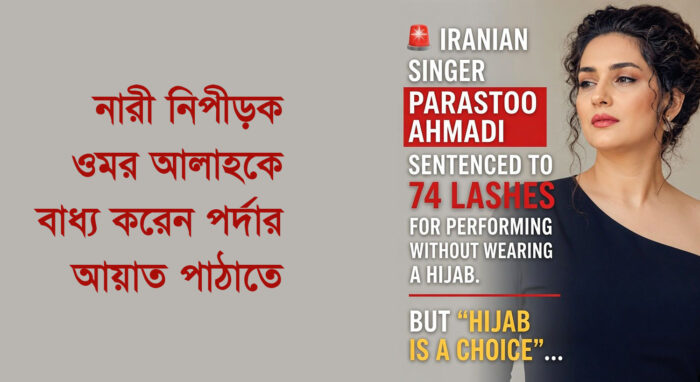
‘Hijab is my choice’ – the same people who make this claim in secular countries often force women to wear hijab in their own countries
Iranian singer Parastu Ahmadi has been sentenced to 74 lashes for the “crime” of performingRead More
হিজাব ইজ মাই চয়েস – এই বুলি সেক্যুলার দেশে যারা দাবী করেন তারা নিজেদের দেশে হিজাব পরতে বাধ্য করেন
ইরানি গায়িকা পারাস্তু আহমাদিকে হিজাব ছাড়া মঞ্চে পরিবেশনার অপরাধে ৭৪টি বেত্রাঘাতের সাজা দেওয়া হয়েছে। এইRead More
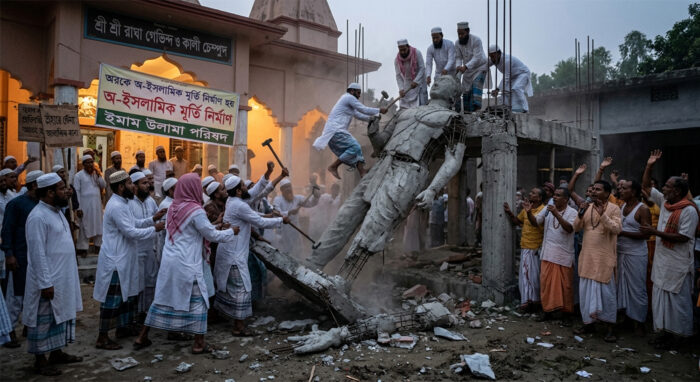
Attacks by “Tawhidi Janata” in Bangladesh and Obstruction of Minority Religious Practice
In Palashbari upazila of Gaibandha, local Sanatan (Hindu) devotees had taken the initiative to buildRead More
Comments are Closed