
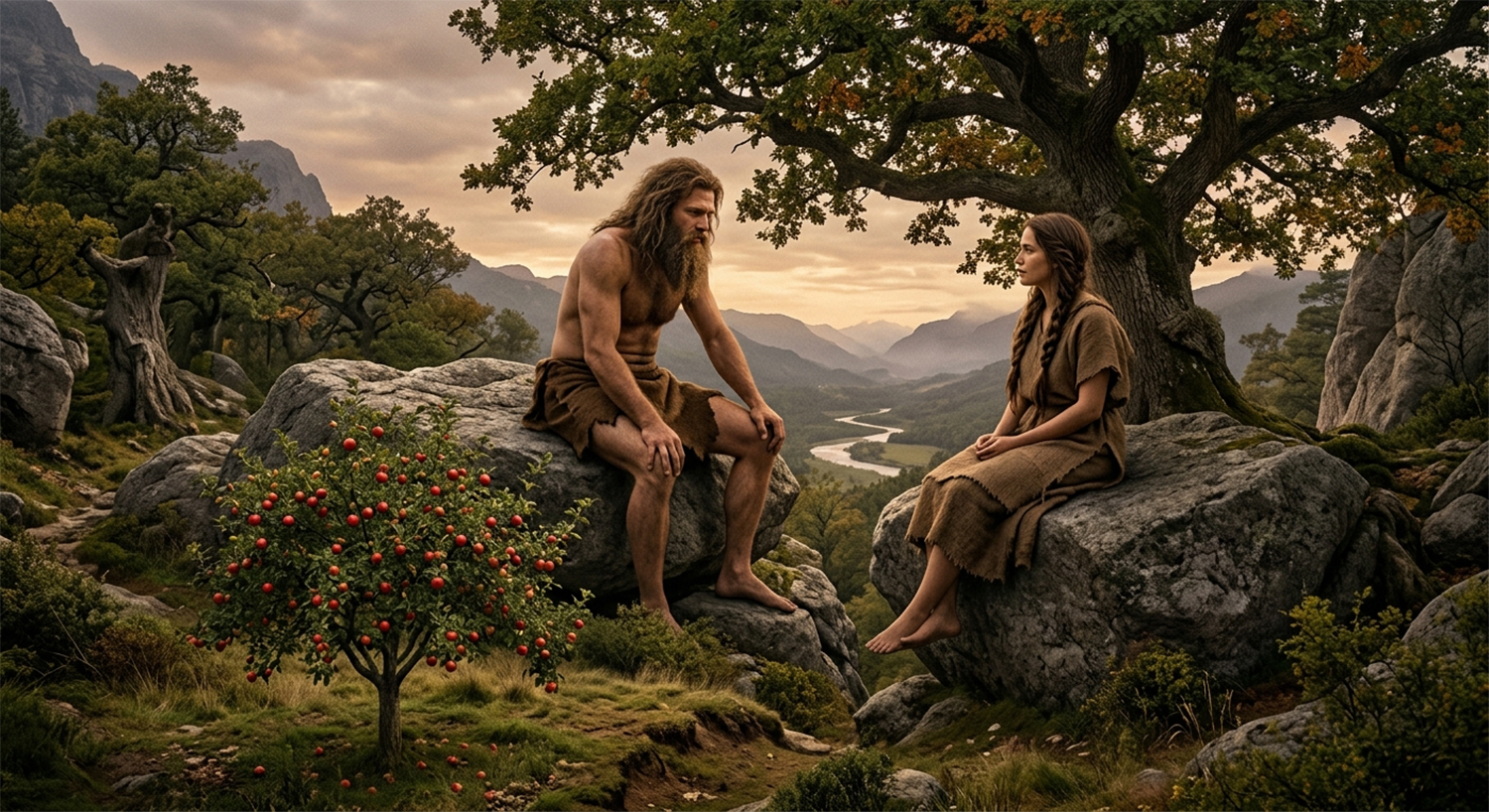
Adam and Eve
Can all of humanity originate from just two people – Adam and Eve?
In almost every civilization and religious tradition on Earth, there exists a shared narrative — that humanity began from a single primal man and woman. From the Indian subcontinent to the Middle East, from Africa to Europe, this idea is deeply rooted. But modern genetics, population studies, and evolutionary biology have allowed us to examine this question in an entirely new light. What does science say — is it possible for today’s population of 8 billion diverse humans to originate from just two ancestors?
Stuck at the Bottleneck: The Bottleneck Effect
In 1775, a devastating typhoon struck the small Pacific island of Pingelap. Nearly the entire population was wiped out. Only about twenty people survived. Today, every resident of that island traces their ancestry back to those twenty survivors.
This disaster carries a peculiar genetic legacy. Among the survivors was the island’s ruler, who carried a rare genetic mutation causing complete color blindness (achromatopsia). After the disaster, he had many offspring, and through his lineage, the mutation spread across the island. Today, about 10% of Pingelap’s population is affected by this rare condition, whereas globally it occurs in only about 1 in 30,000 people — roughly 3,000 times less common.
This is known as the bottleneck effect — when a population suddenly shrinks to a very small size, and future generations arise from a limited gene pool. But in Pingelap, at least twenty individuals survived. What would happen if there had been just two?
The Catastrophe Begins in the First Generation
If humanity began from just one man and one woman, their offspring would have had only one option — reproduction among siblings. In population genetics, this is known as first-degree inbreeding, which carries the highest risk of genetic damage.
Each human genome contains at least 200 rare harmful mutations hidden in a heterozygous form — meaning they do not manifest because the other copy is normal. But in sibling mating, there is roughly a 25% chance that these hidden mutations become homozygous and expressed. In subsequent generations, this probability increases further. Within a few generations, most members of such a population would suffer from severe genetic disorders.
The Fall of Royal Dynasties: The Cost of Inbreeding
History provides a powerful case study. The Spanish Habsburg dynasty once ruled one of Europe’s greatest empires. Founded by Philip I, it endured for 16 generations before collapsing with the death of Charles II in 1700.
The cause was not political, but biological. Close-relative marriages — between cousins, uncles and nieces, and other relatives — were common practice in the Habsburg family. This type of reproduction is called inbreeding, and over generations it increases the inbreeding coefficient, a measure of genetic relatedness.
A 2009 study in PLOS ONE by Álvarez, Ceballos, and Quinteiro analyzed the Spanish Habsburg lineage. The founding king Philip had an inbreeding coefficient of just 0.025, but by the 16th generation, Charles II’s coefficient had risen to 0.254 — nearly equivalent to first-degree relatives. Another study in Heredity (2013) found extremely high infant mortality rates across the dynasty’s history. Charles II suffered from multiple genetic disorders and was infertile, marking the end of the dynasty.
Homozygosity: The Hidden Enemy
At the core of the problem lies a fundamental biological principle. Humans, like all sexually reproducing organisms, carry two copies of each gene — one from each parent. When both copies are identical, the gene is in a homozygous state; when they differ, it is heterozygous.
A well-known example is the gene affecting sickle cell anemia, involving HbA and HbS alleles. There are three possible combinations:
HbA/HbA (healthy homozygous): Normal hemoglobin and oxygen transport, but little resistance to malaria.
HbS/HbS (disease homozygous): Sickle cell anemia, severely impaired oxygen transport, often fatal in childhood.
HbA/HbS (heterozygous): No anemia and strong resistance to malaria — advantageous in many environments.
This illustrates heterozygote advantage or hybrid vigor. Inbreeding reduces heterozygosity and increases homozygosity, weakening a population’s overall survival ability across generations.
Genetic Drift: Extinction by Chance
Beyond inbreeding, small populations face another serious threat: genetic drift — a process where random chance causes certain alleles (gene variants) to disappear over generations.
In large populations, drift has minimal effect because randomness averages out. But in a population of just two individuals, drift becomes dominant. Imagine a gene with four copies between the two founders. Their child inherits any two randomly. If a rare but crucial allele is not passed on in the first generation, it disappears forever. Over time, genetic diversity declines rapidly.
A 2026 study in Population Ecology mathematically demonstrated that the rate of loss of heterozygosity depends directly on the effective population size (Ne): smaller populations lose diversity much faster.
The 50/500 Rule: The Math of Survival
In the 1980s, Australian geneticist Ian Franklin and American biologist Michael Soulé proposed the 50/500 rule. According to this principle:
At least 50 breeding individuals are needed in the short term to avoid inbreeding depression.
At least 500 individuals are required in the long term to maintain genetic diversity and survive environmental challenges.
This principle has been incorporated into modern conservation strategies, including the 2022 Kunming-Montreal Global Biodiversity Framework.
A striking modern example is the northern elephant seal. In the early 20th century, its population dropped to about 25 individuals. It has since rebounded to over 200,000 — yet genetically, the population remains extremely uniform, making it vulnerable to disease outbreaks.
Minimum Viable Population (MVP): Species-Specific Survival
Using Population Viability Analysis (PVA), scientists estimate a species’ Minimum Viable Population (MVP) by considering factors such as:
– Age at reproductive maturity
– Number of offspring per reproductive cycle
– Prevalence of genetic diseases
– Tendency toward inbreeding
– Environmental risks
For humans, MVP is relatively high. As large-brained primates, we mature slowly, reproduce less frequently, and are highly sensitive to infant mortality rates.
Even in space colonization studies, research suggests that previously proposed populations of a few hundred individuals are insufficient for maintaining long-term genetic health during multi-generational journeys.
Our True Ancestors: What the Genome Reveals
Modern genomic research provides a clear answer. A 2012 study published in PNAS by Henn and colleagues found that before humans migrated out of Africa, the effective population size of our ancestors was approximately 12,800 to 14,400.
Even more strikingly, some genetic variants in modern humans trace back to a time before our species diverged from chimpanzees. This level of genetic diversity simply cannot arise from a population of just two individuals.
The Great Bottleneck 930,000 Years Ago
A groundbreaking 2023 study in Science (Hu et al.) analyzed the genomes of 3,154 individuals using a method called FitCoal. It revealed that between approximately 930,000 and 813,000 years ago, our ancestors experienced a severe bottleneck — reducing the breeding population to about 1,280 individuals for roughly 117,000 years.
Yet those 1,280 individuals survived and carried humanity forward to what we are today. And from this, one conclusion becomes clear — even starting from more than a thousand individuals, our species came dangerously close to extinction. Beginning from just two would have made survival virtually unimaginable.
Note: This bottleneck around 900,000 years ago is not yet fully settled in the scientific community. A 2024 preprint by Reppell and colleagues argues that limitations in the FitCoal method may have produced this signal as a statistical artifact. The debate remains active — and it is precisely this self-correcting process that strengthens scientific reliability.
Mitochondrial Eve and Y-Chromosomal Adam: A Story of Misinterpretation
Many people bring up “Mitochondrial Eve” in this context — the woman whose mitochondrial DNA is shared by all modern humans. Similarly, “Y-chromosomal Adam” refers to the man whose Y chromosome is carried by all modern males.
But these concepts are often seriously misunderstood.
A 2013 study by Poznik and colleagues at Stanford University, analyzing the genomes of 69 men, estimated that Y-chromosomal Adam lived roughly 120,000 to 156,000 years ago, while Mitochondrial Eve lived between 99,000 and 148,000 years ago. These timeframes partially overlap, but that does not mean they were a couple.
This is the key point to understand.
Mitochondrial Eve was not the only woman alive at her time. She was one among thousands. Her mitochondrial lineage simply persisted while others disappeared over time. It’s similar to how a family surname might survive through just one son’s lineage while others fade — but that doesn’t mean only one son ever existed.
This is a natural outcome of coalescent theory. As explained by biologist Dennis Venema (BioLogos), mitochondrial and Y-chromosome data cannot determine population size — autosomal (non-sex chromosome) data is required. And that autosomal evidence clearly shows that our ancestral population never shrank to just two individuals.
The World from Two People: What Math Says, What Science Knows
After all this discussion, the question becomes clearer: could today’s population of 8 billion humans have arisen from just one man and one woman?
The answer from genetics is straightforward: no. For three key reasons.
First, without sibling reproduction, the species could not continue — meaning immediate first-degree inbreeding, the most harmful type. By the second generation, the prevalence of harmful homozygous conditions would be so high that most offspring would not be viable. The Habsburg dynasty already demonstrated collapse through cousin marriages — sibling unions would lead to even faster and more certain destruction.
Second, even if such a population somehow survived, today’s 8 billion humans would be genetically almost identical. There would be no variation in eye color, skin tone, or disease resistance. Like the northern elephant seal, a single new pathogen could potentially wipe out the entire species.
Third, actual genetic data tells a different story. Modern genomic research shows that maintaining human genetic diversity required thousands of ancestors — a large population that evolved over hundreds of thousands of years in Africa.
Ashkenazi Jews: A Living Example of the Founder Effect
A clear example of how founder effects operate even in larger populations is the Ashkenazi Jewish community. During the Middle Ages, this population expanded from only a few hundred founders and remained relatively endogamous for centuries.
As a result, certain genetic disorders — such as Tay-Sachs disease and BRCA1/BRCA2 mutations (linked to breast and ovarian cancer) — occur at significantly higher rates within the community compared to the general population. Research published in the American Journal of Human Genetics (Risch et al., 2003) shows these high-frequency disease alleles are direct consequences of the founder effect and genetic drift in a population derived from a small initial group.
If such effects are already noticeable in a population founded by hundreds, imagine the scenario if it began with only two individuals.
Out of Africa: The Path of Lost Diversity
The Out-of-Africa migration itself is an example of the bottleneck effect. Around 65,000 to 50,000 years ago, a relatively small group left Africa and populated the rest of the world. Studies show that a significant portion of genetic diversity was lost during this migration compared to the original African populations.
As distance from Africa increases, genetic diversity decreases — a pattern known as the serial founder effect. Each new settlement carried only a subset of the previous population’s genetic variation, reducing diversity step by step.
This is why African populations today have the highest genetic diversity, while all non-African populations represent subsets of that variation. The true origin of humanity — the deepest reservoir of genetic diversity — lies in Africa, shaped over hundreds of thousands of years by countless ancestors.
Diversity: The Key to Survival
Science does not attack belief — but it teaches us to ask questions. The Pingelap typhoon, the collapse of the Habsburg dynasty, the genetic uniformity of elephant seals, the prevalence of inherited disorders among Ashkenazi Jews — these are not just historical anecdotes. They are natural genetic experiments.
And their results are clear: genetic diversity is life’s greatest strength. Building a stable, healthy, and diverse species from just two ancestors runs directly counter to the fundamental principles of genetics.
Nature did not follow that path. The true origin of humanity is far richer and more expansive — shaped by millions of years of evolution and the combined genetic legacy of thousands of ancestors. That diversity is what has allowed us to stand where we are today.
References and Further Reading
Primary Research Papers
1. Álvarez, G., Ceballos, F. C., & Quinteiro, C. (2009). The Role of Inbreeding in the Extinction of a European Royal Dynasty. PLOS ONE, 4(4), e5174. https://doi.org/10.1371/journal.pone.0005174
2. Ceballos, F. C., & Álvarez, G. (2013). Royal dynasties as human inbreeding laboratories: the Habsburgs. Heredity, 111(2), 114–121. https://doi.org/10.1038/hdy.2013.25
3. Hu, Y., et al. (2023). Genomic inference of a severe human bottleneck during the Early to Middle Pleistocene transition. Science, 381(6661), 979–984. https://doi.org/10.1126/science.abq7487
4. Poznik, G. D., et al. (2013). Sequencing Y Chromosomes Resolves Discrepancy in Time to Common Ancestor of Males Versus Females. Science, 341(6145), 562–565. https://doi.org/10.1126/science.1237619
5. Henn, B. M., et al. (2012). The great human expansion. Proceedings of the National Academy of Sciences, 109(44), 17758–17764. https://doi.org/10.1073/pnas.1212380109
6. Franklin, I. R., & Soulé, M. E. (1980). Conservation and Evolution. Cambridge University Press.
7. Ralls, K., & Ballou, J. (1983). Extinction: Lessons from zoos. In C. M. Schonewald-Cox et al. (Eds.), Genetics and Conservation. Benjamin/Cummings.
8. Risch, N., et al. (2003). Categorization of humans in biomedical research: genes, race and disease. Genome Biology, 3(7), comment2007. https://doi.org/10.1186/gb-2002-3-7-comment2007
9. Fedorca, A., et al. (2024). Dealing with the Complexity of Effective Population Size in Conservation Practice. Evolutionary Applications, 17(12), e70031. https://doi.org/10.1111/eva.70031
10. Yamaguchi, R., & Otto, S. P. (2026). Speciation through the lens of population dynamics. Population Ecology. https://doi.org/10.1002/1438-390X.70008
11. Reppell, M., et al. (2024). A previously reported bottleneck in human ancestry 900 kya is likely a statistical artifact. bioRxiv (preprint). https://doi.org/10.1101/2024.10.01.615851
12. Smith, C. M. (2014). Minimum viable population size for interstellar voyage: Assessment of long-term population dynamics in deep space missions. In Project Hyperion research, Icarus Interstellar.
Popular Science & Reviews
13. Venema, D. (2011, 2014). Mitochondrial Eve and Y-Chromosome Adam. BioLogos. https://biologos.org/articles/mitochondrial-eve-y-chromosome-adam-and-reasons-to-believe
14. Encyclopedia of Ecology / Britannica. Minimum viable population (MVP). https://www.britannica.com/science/minimum-viable-population
15. Wills, C. (1998). Children of Prometheus: The Accelerating Pace of Human Evolution. Perseus Books.
16. Maron, M. (2018). Minimum viable population size. Encyclopedia of Ecology, Elsevier.
[Updated on May 18, 2025]
Related Posts
Humans cannot even see 1% of the beauty and colors of Earth and the universe! Are humans really the best of creation?
The human eye can generally detect visible light or color in the wavelength range ofRead More
পৃথিবী ও মহাবিশ্বের সুন্দর জিনিসের ১% সৌন্দর্যের রঙও মানুষ দেখতে পায় না! মানুষ কি সৃষ্টির সেরা?
মানুষের চোখ সাধারণত ৩৮০ থেকে ৭৪০ ন্যানোমিটার (nm) তরঙ্গদৈর্ঘ্যের (wavelength) দৃশ্যমান আলো বা রঙের রেঞ্জRead More

Why does Allah show such preference for women with large breasts and large buttocks? Do men feel the same way? Does this give women any advantage?
If you leave Prophet Muhammad in Pattaya’s Walking Street and Beach Road after evening, inRead More
Comments are Closed