
God's Servant
The Trial of the Man Mr. Jamshed Who Said He Was Chosen by God Begins Today
As the boat touched the opposite bank, journalist Sazzad Hossain sensed that the village was different today. There was no crowd at the ghat, yet from afar came a muffled murmur, as if hundreds of people were holding their breath at once.
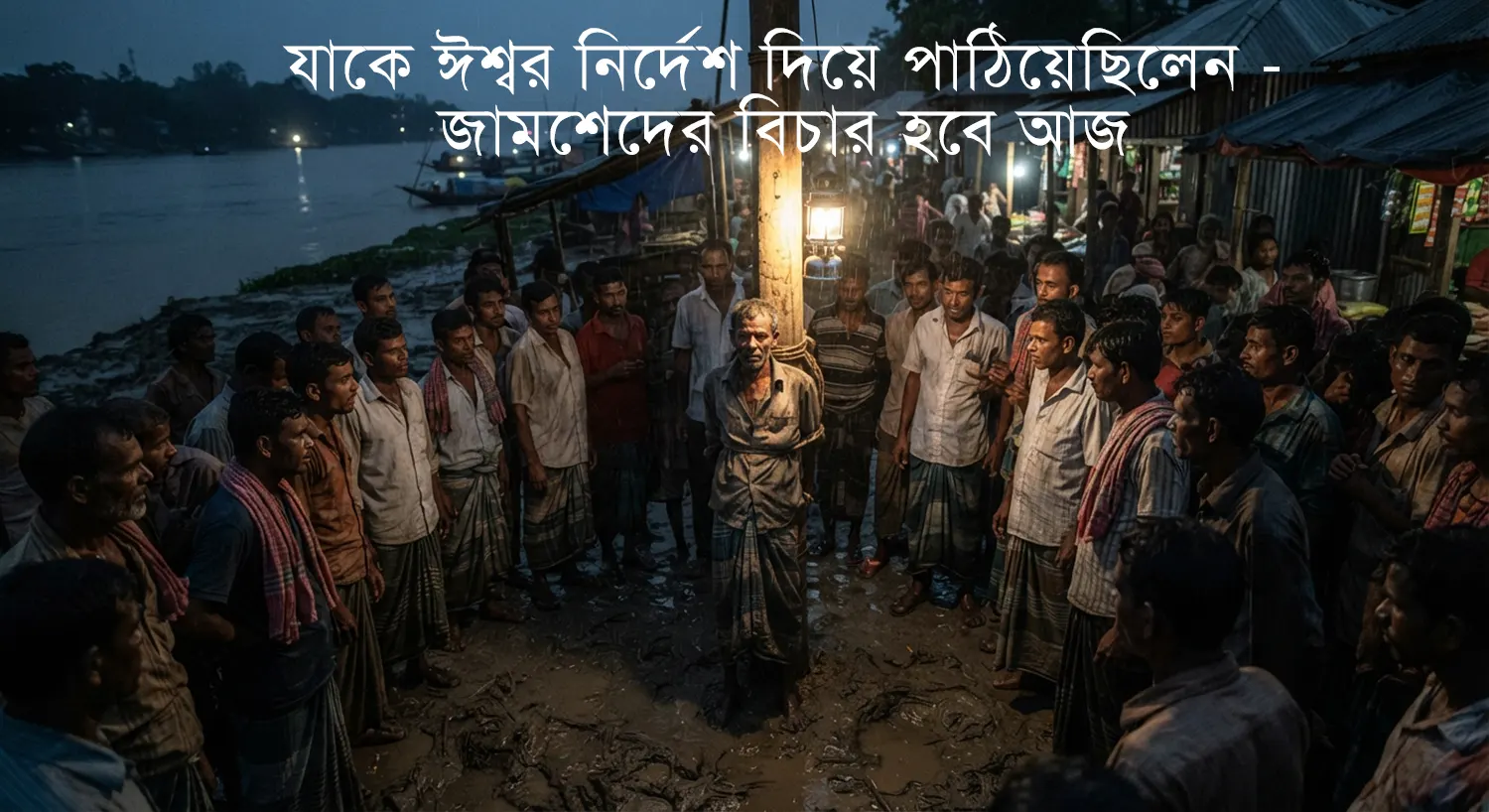
The monsoon was at its end. Shoes sank into the mud. With a notebook and an old camera in the bag slung over his shoulder, he walked toward the sound. In the courtyard of the Union Parishad, a hurricane lamp blazed, surrounded by a crowd of nearly two hundred people. In the center stood a bamboo post, and tied to it with rope was a gaunt man. Gray hair, a mud-stained kurta, and two swollen slap marks still visible on his cheeks. His eyes were closed as he muttered under his breath.
“What happened here?” Sazzad asked an elderly man standing nearby.
The old man turned toward him. “Who are you?”
“A journalist. I came from Dhaka to report on the flood.”
The old man remained silent for a moment, then said, “Forget the flood today, son. There’s another story here. Sit down, and I’ll tell you.”
Sitting on a bench at the tea stall, the old man, whose name was Rahmat Master, slowly began his story. The flickering lamp light danced across his face.
There is a sandbar in the middle of the river. It has no name on any map, but for those born there, it is the entire world. On a winter morning, a boy was born there. He was named Jamshed. Yet his father had died before he was born, and his mother passed away only a few months later. The infant was taken in by his uncle.
There was no place for affection in his uncle’s house, only a place for labor. From an early age, Jamshed herded cattle and goats. He would lie on the grass of the river char, gaze at the sky, and talk to the animals. He spoke little with people, because people never listened to him.
At the age of twenty-five, he got married. His bride was forty years old, a widow named Atar Banu. She was a respected businesswoman in the area. People said the shepherd boy had struck gold. But those who knew them closely understood that Atar Banu was the first person in Jamshed’s life to serve him a meal and ask, “Would you like a little more rice?”
Ten years passed. Then, when Jamshed was thirty-five, he had a dream one night.
He claimed that in the dream, the Creator Himself had appeared and said, “Go and sit beside the abandoned grave of Chunnu Mia at the edge of the village. Meditate there.”
Every year weeds covered Chunnu Mia’s grave, and jackals howled around it. Jamshed went there and sat. At first alone. Then a few curious onlookers came, followed by several believers. Those who did not believe called him Mad Jamshed. He paid no attention to them. He told his followers, “They do not understand. I am not mad. I am His representative. He has sent me to free you from your sins.”
As long as Atar Banu was alive, those words remained within limits. Perhaps she was the embankment that kept the river from overflowing. One dawn, she passed away. Jamshed spoke to no one for days.
Then the darkness began.
Rahmat Master paused. He did not sip his tea; he merely held the cup in his hands.
“In seven months, he married seven times. He claimed it was the Creator’s command. Who would question him? His followers bowed their heads. Those who were not followers stayed silent out of fear or habit.”
Sazzad’s pen rested motionless on the notebook. He was no longer writing.
“Then one day,” Rahmat Master’s voice dropped, “he called his closest disciple, Akkas, and said, ‘I will marry your daughter Pipasa. It is the Lord’s command.’ The girl was six years old.”
Sazzad looked up.
“Six, son. Six years old. Akkas did not object. Think about what one person can do to another in the name of religion. The marriage took place. There was no registrar, no paperwork. There was only one man’s claim and the silence of a few others.”
Silence was the greatest crime, Sazzad thought. But he said nothing.
“There were two more marriages after that. When Pipasa was nine, she was sent to Jamshed’s house. To consummate the marriage.” Rahmat Master set the cup down on the bench. His hands trembled. “A nine-year-old girl. A child who still played with dolls.”
In the hurricane lamp’s light, the shadow of the man tied to the post stretched long across the ground.
“One by one, he married thirteen times. People from neighboring villages called him Marriage-Crazy Jamshed. Yet no one asked where those girls went or how they lived. And did you know he had four household workers? Four. He openly claimed that he lived with them as if they were wives. Workers, dependents, vulnerable people who had nowhere to protest.”
Sazzad swallowed hard. Something inside his chest was tightening.
“So what happened today? Why was he finally caught?”
A faint smile appeared on Rahmat Master’s lips, though it was not really a smile, only a fragment of one.
“Because of a slap.”
Yesterday afternoon, Jamshed crossed the river with several of his followers and went to a neighboring village. Near the market, under a tree, sat a mother with her beautiful one-year-old daughter in her lap. Jamshed stopped and stared at the child the way people inspect something before buying it in a market.
“Your daughter,” he told the woman calmly, as if discussing the weather, “when she grows a little older, I will marry her. It is the Lord’s command.”
At first the woman did not understand. Then she did. Her face turned pale.
Standing a short distance away was the girl’s father, Ami. Everyone called him Bodybuilder Ami because he had trained at a gym in the city and continued lifting weights every dawn after returning to the village. He heard the words. For a few seconds he stood frozen, unable to believe his ears. Then he rushed forward.
Smack. Smack.
Two slaps. The sound spread through the market like pistol shots.
Jamshed’s followers lunged toward Ami in rage. But by then the people of the market had turned around. Someone shouted, “Catch him! Catch Mad Jamshed!”
One cry seemed to summon a hundred more. Within moments a crowd formed. The followers saw hundreds of eyes around them. They backed away and then ran in every direction they could. That day revealed exactly how far devotion could go.
Jamshed remained alone. Someone brought a rope. Someone else brought a post. He did not resist. He only looked up at the sky once and said, “Lord, are You watching?”
No answer came. Not from the sky, nor from the earth.
Rahmat Master stood up. “Come on. You’ll see. The chairman is about to begin the hearing.”
In the center of the courtyard, a chair had been placed. Sitting there was the Union chairman, a middle-aged man with a deep voice. To his right sat the village imam, and to his left several elders. In front of them stood Jamshed, still tied up.
Sazzad stood near the back of the crowd. Suddenly his eyes fell upon a group of girls huddled together at one side. Some were thirteen, some fifteen, some perhaps even younger. There was no clear emotion in their eyes. Neither fear nor anger nor relief. Only a void older than their years.
Rahmat Master whispered, “Those are them. His wives.”
Sazzad dropped his pen. He bent down to pick it up, but he did not write another word.
The chairman cleared his throat. The crowd fell silent. Only the hiss of the hurricane lamp and the distant splash of the river could be heard.
“Jamshed,” the chairman said, “the accusations against you are serious. Do you have anything to say?”
Jamshed opened his eyes. In the lamp’s glow, they seemed strangely calm, as though he had been preparing for this moment for a very long time.
“I have done no wrong,” he said. “I merely carried out His commands.”
From somewhere in the crowd, someone muttered the word “commands,” pronouncing it with such contempt that it felt like spitting.
The chairman raised his hand. “Where is He, the one who gave those commands? Let Him come here and say so.”
Jamshed did not answer. His lips moved, but no sound emerged.
At that moment, Sazzad realized that the real question in this trial was simple. How does a person transform personal desire into the voice of God? And how does an entire society bow its head before that voice for years? That bowed head belonged to the whole village, even those who now held the rope.
At the back of the crowd, a short distance away, Ami stood holding his one-year-old daughter asleep in his arms. His palms were still red. He never looked at Jamshed even once. He only kept stroking his daughter’s head, again and again, as if making sure that tiny body was still safe.
Sazzad opened a fresh page in his notebook. He stared at the blank sheet for a long time. Then he slowly wrote:
“Tonight a village is judging one man. But the true judgment should be reserved for the silence that allowed him to come this far.”
Across the river, the sky was beginning to brighten. Beside Chunnu Mia’s abandoned grave, there was no one now. Only weeds, and a few dried flowers swaying in the wind, left there by someone long ago.
For the first time, the man tied to the post lowered his head.
And no one noticed that at the far edge of the village, a little girl named Pipasa quietly rose to her feet and began walking toward the river, facing the rising sun, for herself, for the very first time.
Related Posts
যাকে ঈশ্বর নির্দেশ দিয়ে পাঠিয়েছিলেন – জামশেদের বিচার হবে আজ
নদীর ওপারে নৌকা ভিড়তেই সাংবাদিক সাজ্জাদ হোসেন টের পেলেন, গ্রামটা আজ অন্যরকম। ঘাটে মানুষের ভিড়Read More
When Arabia Was in Darkness, India Was Carrying the Torch of Knowledge – So What Darkness Does Islam Claim to Remove?
What Was the “Age of Jahiliyyah” in Arabia Really Like? The term “Jahiliyyah” is fundamentallyRead More
আরব যখন অন্ধকারে, ইন্ডিয়ায় তখন জ্ঞানের মশাল জ্বলে – ইসলাম কিসের অন্ধকার দূর করতে চায়?
আরবে “আইয়ামে জাহেলিয়া” আসলেই কি ছিল? “জাহেলিয়া” শব্দটি মূলত একটি ধর্মতাত্ত্বিক ধারণা। ইসলামী পরিভাষায় এরRead More
Comments are Closed