
Islam Versus Festivals
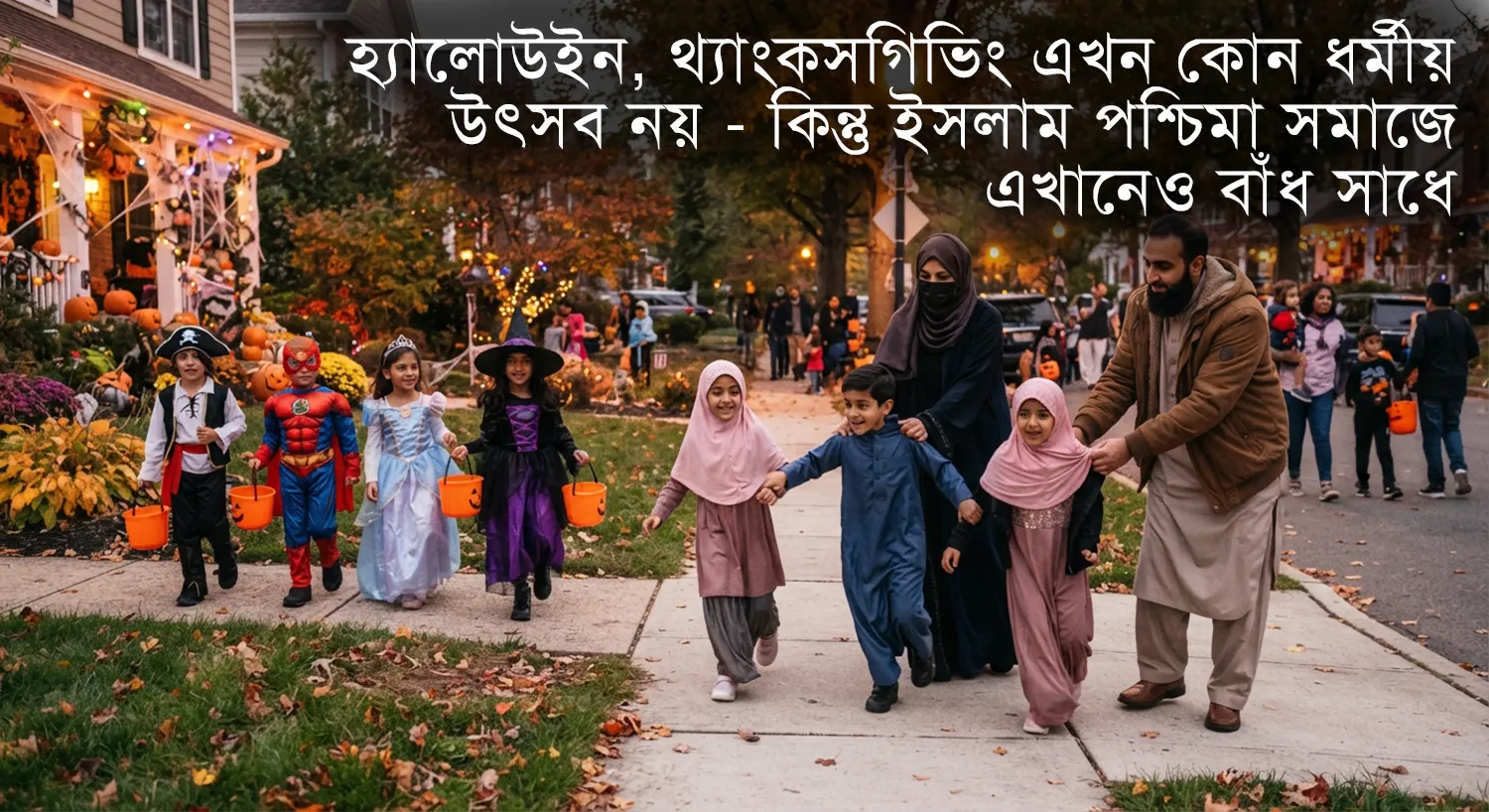
Halloween and Thanksgiving Are No Longer Religious Festivals, Yet Islam Continues to Object to Them in Western Society
According to religious doctrine, Islam is fundamentally culturally isolated. For hardline Islamists, joyful and festive moments are quite rare in life. Religiously, they have little connection to celebrations and festivals. The two days that Muslims celebrate religiously are Eid al-Fitr and Eid al-Adha. Although these are often called festivals, they do not align with what we generally understand or recognize as a festival. The two days fixed by Muhammad for Muslims are essentially extensions of worship. Both fasting and sacrifice are acts of worship, not festivals in any real sense. Only Muslims participate in these two events. In contrast, at Pohela Boishakh, Christmas, Halloween, Thanksgiving, or Durga Puja, a stranger may join in without anyone asking which religion they belong to or why they are there. Is there any Eid event where someone from another religion can participate in this way? Would Islamists accept it? Islam wants not only that they themselves refrain from festivals, but that others refrain as well. Where they become the majority, that is often what they do.
Every year, at the end of October and again at the end of November, a familiar debate resurfaces within Islamic communities in Western countries: should Muslims celebrate Halloween or Thanksgiving? One side argues that these have become purely social festivals and that participating is a sign of social integration. The other side argues that preserving one’s religious identity requires strictly avoiding them.
Halloween has its roots in the ancient Celtic festival of Samhain, which marked the end of the harvest season and the beginning of winter, much as Chaitra Sankranti or Nabanna do in Bengal. The Celts believed that during this time, the veil between the worlds of the living and the dead became thin and that spirits could return to earth. Later, with the spread of Christianity, November 1 became “All Saints’ Day.” The evening before it was “All Hallows’ Eve,” from which the name Halloween originated. Modern costume-wearing, “trick-or-treating,” and candy collection evolved from medieval European traditions such as “souling” and “guising,” combined with customs brought to America by Irish and Scottish immigrants. Today, most of it is commercial and child-oriented. While its origins involved religious ideas about death, spirits, and Christian remembrance, over time it has ceased to be a religious observance. No one participates while wondering whether it will earn religious merit or benefit their faith.
The same can be said about Thanksgiving. In 1621, the English Pilgrims at Plymouth shared a harvest feast with the Wampanoag people, an event generally regarded as the first Thanksgiving. For the Puritans, a “day of thanksgiving” was a religious observance expressing gratitude to God. In 1863, Abraham Lincoln declared it a national holiday. Even today, many American families pray before meals and thank God. Some do, some do not, and for most people it is simply a day of family gathering.
Many immigrant Islamists avoid these celebrations, and their arguments generally fall into four categories.
(a) The concept that Tashabbuh, or imitation of other religions, is forbidden
Based on a hadith, many scholars believe that whoever imitates another people becomes associated with them. This principle is applied especially to religious festivals and ceremonies. Institutions such as Saudi Arabia’s Permanent Committee for Fatwas do not generally approve of participation in non-Muslim festivals. One such fatwa explicitly states that participation in non-Muslim festivals is prohibited. islamway
(b) Concerns about shirk and supernatural beliefs
The foundation of Islam is tawhid, the oneness of Allah. The symbols of ghosts, witches, spirits of the dead, and magic associated with Halloween are viewed by some scholars as contrary to Islamic beliefs. Many argue that participation risks unintentionally becoming involved in polytheistic practices. This objection is less common regarding Thanksgiving, because gratitude and feeding one’s family are values compatible with Islam. Nevertheless, if prayers are explicitly Christian in nature (for example, in the name of Jesus), some Muslims remain uncomfortable. religionmediacentre
(c) Concerns about identity and future generations
Many immigrant Muslim families fear that small cultural compromises may gradually lead to the erosion of religious identity. This desire to preserve identity is natural among minority communities and is not unique to Muslims. Similar tendencies can be found among Orthodox Jews, the Amish, and conservative Hindu communities.
(d) Moral and social objections
Some people dislike Halloween’s commercialization, its glorification of violence and frightening imagery, its wastefulness, and its perceived excesses. Many Christian families share these objections as well.
It is important to recognize that there is no single position on this issue within the Muslim world. Egypt’s Dar al-Ifta, for example, considers Halloween to have become a social celebration and therefore believes there is room for flexibility so long as core beliefs remain intact. Regarding Thanksgiving, many Muslim writers and scholars in North America argue that it is a cultural rather than religious holiday and that people of all faiths take part. They contend that many of those who prohibit it have not directly experienced Western society. At the same time, they acknowledge that some scholars living in America also believe Muslims should avoid it, and that opinion deserves respect. Islam and Halloween: between preservation of faith and cultural adaptation
Because human beings are naturally drawn to colorful and festive celebrations, neither Islamic instructions nor the threat of religious condemnation can entirely prevent Muslims from participating in these events. In recent years, including this year, some people have taken to the streets to celebrate Halloween even in highly Islamic states such as Saudi Arabia and Iran. In Saudi Arabia, the government itself has encouraged entertainment of this kind in pursuit of economic diversification and tourism goals under Vision 2030. Although religious conservatives have expressed outrage on social media, the state has not retreated. In Iran, by contrast, the state views Halloween as a form of Western cultural influence and a threat to public order and therefore suppresses it. This demonstrates that the response of Muslim-majority countries to Halloween depends not only on religious opinion but also on political and economic priorities.
In 2018, more than 19 expatriates were arrested in Riyadh for attending a Halloween party. In 2022, Riyadh Boulevard hosted an event called “Scary Weekend,” where visitors wearing frightening costumes were allowed free entry. By deliberately avoiding the label “Halloween,” official organizers maintained what could be called a “strategic ambiguity,” making it difficult to classify the event strictly as a Halloween celebration. In 2025, various restaurants and entertainment venues in Riyadh scheduled Halloween-themed events, costume competitions, and nighttime activities between October 29 and November 1.
According to reports from Iran International, security forces and plainclothes personnel dispersed gatherings of young people wearing Halloween costumes and makeup near Tehran’s Artists Park on a Friday evening. Witnesses stated that several individuals were beaten and detained, and nearby cafés were forced to close. The Jerusalem Post reported similar incidents. Its coverage noted that despite restrictions and warnings, many people had celebrated Halloween in costume during the preceding week. The Iranian news site Rouydad24 published an article titled “The Government’s War Against Pumpkins,” criticizing the authorities’ approach. This continues a pattern seen in previous years. In October 2025, Iran warned of strict measures against Halloween, citing “cultural pollution” as the reason. Nevertheless, pumpkin decorations, ghost figures, and skeleton costumes could still be seen in the windows of Tehran’s shops, cafés, and restaurants. There are no official public celebrations, but private and youth-led initiatives continue.
Two things become clear from this. First, the issue is not “Islam versus civilization,” but rather an ongoing debate within Islamic jurisprudence itself, alongside many other issues Muslims continue to dispute. Second, the actual behavior of individual Muslims is highly diverse. Many Muslim families share Thanksgiving meals with neighbors and relatives, take their children trick-or-treating, or at least hand out candy at their doors. Others do none of these things and may even strongly oppose them.
Those who criticize opposition to such celebrations from outside Islam’s doctrinal framework argue that withdrawing from social participation in a multicultural society turns communities into isolated islands, weakens relationships with neighbors, and leaves children feeling excluded at school and in their neighborhoods. These concerns are real. They stem from individual human judgment and stand in opposition to Islam’s all-encompassing hardline tendencies. It is a basic principle of civilized society that when people move to another country and culture, they should build goodwill with that culture. If a foreigner in Bangladesh were to oppose Pohela Boishakh and the Bengali New Year, that would not be considered normal behavior. Participating in the celebration would be the more appropriate course.
Yet the arguments made by some on the other side are also reasonable. It is entirely possible to love one’s neighbors, participate actively in work, school, and community life, fulfill civic responsibilities, exchange greetings on others’ holidays, and show courtesy when people come to one’s door, while still choosing not to participate in certain rituals. The essence of a modern liberal society is that individuals have the right to abstain from practices that conflict with their beliefs. A vegetarian who does not eat at a barbecue, a Jew who does not decorate a Christmas tree, or a Jehovah’s Witness who does not take part in national celebrations is not considered uncivilized. The same standard should apply to minorities. However, when these choices are framed within Islamic doctrine in ways that separate Muslims as a distinct and detached people, such behavior becomes uncivil and incompatible with multicultural society.
Many Native Americans observe Thanksgiving as a “National Day of Mourning” because European colonization led to the destruction of their communities. In other words, Muslims are not the only people who do not view this “universal” holiday in the same way. Respect for their perspective is equally important.
Some Muslims avoid Halloween and Thanksgiving because they follow religious arguments related to tashabbuh, concerns about shirk, identity preservation, and moral objections. Others, including many Muslim leaders and ordinary Muslims, avoid religious rigidity and participate by viewing these events as social celebrations. However, in the end, the rhetoric of radical Islamists tends to receive the most attention, especially on social media. Negative portrayals and dismissive attitudes toward such celebrations often spread more rapidly.
A healthy multicultural society is measured by its ability to maintain mutual respect despite disagreement. Muslim communities should strengthen social ties and courtesy with their neighbors so that choosing not to participate never turns into social distance. Likewise, mainstream society should avoid assuming that anyone who declines to join a particular celebration is somehow isolated or hostile. The freedom to participate deserves respect, but so does the freedom not to participate. These are matters of individual choice. However, as a religion, if Islam’s principles and ideology are relaxed, it becomes difficult to prevent the expansion of radical Islam. If Islamists become the majority, a major question remains whether such celebrations would continue to be possible at all, because Islam and festivals do not go together.
Related Posts
হ্যালোউইন, থ্যাংকসগিভিং এখন কোন ধর্মীয় উৎসব নয় – কিন্তু ইসলাম পশ্চিমা সমাজে এখানেও বাঁধ সাধে
ধর্মীয় বিধান মতে ইসলাম মূলত কালচারালি আইসোলেটেড। কট্টর ইসলামিস্ট যারা, এদের জীবনে আনন্দঘন মুহূর্ত খুবRead More
Bangladesh’s Special Marriage Act Provides Legal Protection for Interfaith Couples and Non-Religious Individuals to Marry
When discussions of love or marriage arise in Bangladesh, one question keeps coming back: canRead More
বাংলাদেশের বিশেষ বিবাহ আইন দুই ধর্মের মানুষ বা নিধার্মিকদের বিয়ের সুরক্ষা দেয়
বাংলাদেশে প্রেম বা বিয়ের আলোচনা উঠলে একটি প্রশ্ন বারবার ফিরে আসেঃ ভিন্ন ধর্মের দুজন মানুষRead More
Comments are Closed