
Freethinking and Religion
Ayisha and Arpita: A Story of Free Expression and Honesty Between Two Sisters, One Muslim and One Hindu
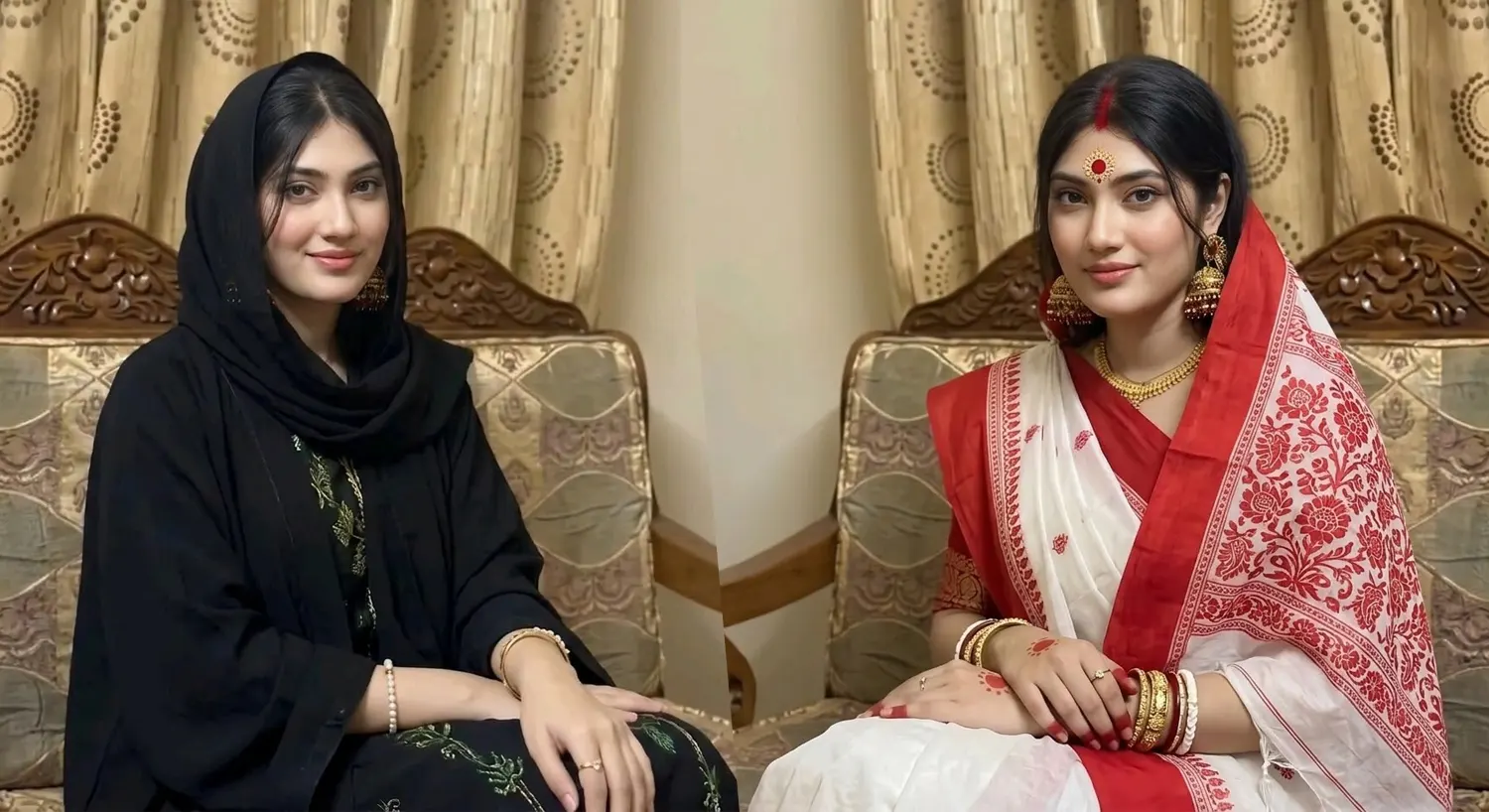
Ayisha and Arpita’s parents had dated for several years before marrying under Bangladesh’s Special Marriage Act. Neither converted religions; both continued practicing their own faiths, one Muslim and the other Hindu. When it came to their children, they decided that one would be Hindu and the other Muslim. So Ayisha is Muslim, and Arpita is Hindu. In the two sisters’ home, there is semai during Eid and naru during Puja, along with debates and conversations. However, neither of them is religiously fanatic. This afternoon, with cups of tea in hand on the rooftop, that debate has begun.
Arpita: Look, sis, I wear a sari and go to the temple, and you wear a burqa and go to the mosque. Yesterday, someone on the street said, “There go two sisters, one colorful and the other black. Totally opposite teams!”
Ayisha: Haha! We keep two wardrobe sets because of religious dress codes. Mom and Dad basically opened two franchises of the same shop.
Arpita: And when it comes to holidays, we’re super rich. Eid holidays, Puja holidays, we get both. It’s hard to find a blank day on our calendar.
Ayisha: Exactly! Around those times, we have Puja prasad the day after Eid and Eid semai the day after Puja. Even our digestive problems are interfaith!
Arpita: By the way, you should borrow my sari someday. It would really suit you. Try being colorful for once instead of always wearing black. Clothes aren’t the property of any religion; they belong to environment and culture. From what I’ve read about the history of clothing, most forms of dress were based on regional climate and culture long before religions came along. Later, religions brought them into their own traditions. In the hot Arabian desert, covering the entire body protected people from the sun and sand. That was simply practical.
Ayisha: But the Qur’an directly instructs it. Surah An-Nur 31 and Surah Al-Ahzab 59 specifically mention the khimar and jilbab.
Arpita: They do, and I also know scholars disagree on the interpretation. Some say covering the face is obligatory; others say modest clothing is enough. My issue lies elsewhere. How does clothing designed for the desert work in Europe’s cold climate or Bangladesh’s humidity? In sunny countries like Saudi Arabia, the UAE, and Iran, vitamin D deficiency rates among women are surprisingly high. The Arabian sun is free, but people don’t get enough opportunity to absorb it.
Ayisha: (laughing) So the sun-god is offering discounts, and we’re walking away without using the coupon! But seriously, the burqa isn’t the only factor. Staying indoors, avoiding sunlight, and dietary habits also matter. My doctor friend says even men who sit in offices all day face the same problem.
Arpita: True, I’m not saying it’s the only cause. My objection is to forcing it on people. If you wear it by choice and manage things with supplements, I have no issue. But look at what’s happening in Iran and Afghanistan. Even in Bangladesh, the way people flock to social media to lecture, insult, and shame others is genuinely irritating.
Ayisha: What’s happening there is wrong. A girl like Mahsa Amini losing her life over a hijab is oppression committed in the name of Islam. I wear a hijab because I choose to. I have no right to force anyone else.
Arpita: Exactly! That’s where we agree. People should wear whatever they want: sari, burqa, jeans, dhoti, lungi, or T-shirt. But if you judge someone’s character by their clothes, you’ll be disappointed.
Ayisha: Remember that long-bearded uncle from our neighborhood? Everyone says, “What a pious man!” Yet he sells adulterated mustard oil. Less mustard, more religion in the bottle! And Uncle Ziaul barely talks about anything except religion. How did he accumulate hundreds of crores in wealth? He used to be just a low-level tax officer!
Arpita: And the tilak-wearing elder beside our temple? He rings the bell in the morning, reviews land deeds in the afternoon, and shifts his neighbor’s property boundary at night. May God forgive him. Though he probably won’t be forgiven unless he returns the land.
Ayisha: Haha! The more religious the outfit, the more suspicious the paperwork.
Arpita: Remember how a woman’s clothing became the focus of a whole mob the other day? Think about mob violence. We have all seen shrines vandalized and people beaten to death over alleged blasphemy. Many who participate see themselves as religious.
Ayisha: And it’s unfair to judge an entire religion by them. Our aunt who prays regularly has spent her whole life sending food to poor neighbors, never cheating or hurting anyone, never seeking recognition. Someone whose faith motivates them to be honest is an asset to society.
Arpita: I agree. My grandmother is the same way. Her entire heart is devoted to the well-being of others, and she’d gladly give away her own meal. But how many people like that are there? They would have been kind even without religion. Look at this statistic. In the Netherlands, over half the population identifies with no religion. Yet the country is safe, organized, and prosperous. I’ve heard prisons there are actually closing because there aren’t enough prisoners. Prison managers are saying, “No customers, business closed!”
Ayisha: Wait a minute. I heard they were number one on the Global Peace Index. Is that actually true?
Arpita: That’s where you caught me. In the 2026 Global Peace Index, the Netherlands ranked 17th, three places lower than the previous year. Iceland is at the top, and around 40% to 44% of Iceland’s population identifies as non-religious or atheist. Seventeenth place is still impressive out of 163 countries. And the prison closures are real. Nineteen prisons have been closed there over the past several years.
Ayisha: So the claim that “without religion crime increases” clearly isn’t proven. That’s what religious extremists fail to understand. They try to push aside statistics and reality with sheer force.
Arpita: That’s my point exactly. The fearmongering claim that “society will collapse without religion” doesn’t hold up either. Peace comes from fair laws, education, equality, and low corruption. Whether religion exists or not, if those institutions fail, everything else is meaningless.
Ayisha: Fair enough. Now let’s get to my favorite part. One relative told us that Allah sends earthquakes because women wear revealing clothes.
Arpita: Then Japan and Chile must have frequent earthquakes because all the women there are fashion sinners? And apparently earthquake alarms only go off when clothes are too short? Seismographs must be reading fashion magazines!
Ayisha: Let’s reverse the argument. More than fifty thousand people died in the 2023 Turkey-Syria earthquake. That same year Herat in Afghanistan also experienced earthquakes, despite the Taliban’s strict dress code. And Pakistan’s 2022 floods killed more than seventeen hundred people.
Arpita: Then if the “disaster because of clothing” theory is true, punishments also occur in countries with strict dress codes. It seems divine wrath reaches Islamic, secular, and nonreligious societies equally!
Ayisha: The real factors are building codes, early warning systems, and preparedness. Not skirt length. Japan suffers major earthquakes but relatively fewer deaths because buildings follow strict standards. The strongest earthquake ever recorded was the 9.5 magnitude Valdivia earthquake in Chile in 1960, which killed about 1,700 people. In 2010, Chile experienced an 8.8 magnitude earthquake that killed 525 people. Meanwhile, in Afghanistan, a country with strict religious laws and dress codes, the 6.5 magnitude Takhar earthquake of 1998 killed 4,500 people. In Turkey, more than 53,537 people died in the 7.8 magnitude earthquake of 2023.
Arpita: And Bangladesh is perhaps the best example. Around three hundred thousand people died in the 1970 cyclone when the country was under the control of Pakistan, which strongly emphasized Islamic values. Today, thanks to cyclone shelters and early warning systems, that number has been reduced dramatically. Nobody had to change their clothes. What changed was preparedness.
Ayisha: When a storm approaches, you can respond to a siren and go to a shelter. But you can’t search your wardrobe for a “storm-stopping outfit.”
Arpita: (laughing) Pray if you want, but build shelters too. If you only pray and sit still, the wind won’t listen.
Ayisha: Now let’s get to the real point. What did you find in that blog you were reading about the status of women in Islam?
Arpita: The blog was written from a freethinking perspective, so you may not accept it as neutral research. Still, many of its quotations came directly from primary sources. For example, Surah An-Nisa 11 gives sons twice the inheritance of daughters. Surah Al-Baqarah 282 treats the testimony of two women as equivalent to one man’s in financial matters. Surah An-Nisa 3 permits a man to have multiple wives. And verse 34 contains a controversial instruction regarding disciplining wives.
Ayisha: I do have some responses. Will you hear me out?
Arpita: Of course. I want to debate, not win. If I wanted to win, I’d have to bribe you, and all I have is half a packet of spicy puffed rice.
Ayisha: I’ll accept that! First, in seventh-century Arabia women often inherited nothing at all. Islam granted them a share for the first time. Second, men were expected to provide financially for the family, while women were not. That’s the reasoning behind the rule. Third, many modern scholars argue that the Arabic word “daraba” in verse 34 may mean separation rather than physical striking. And the Prophet’s first wife, Khadijah (RA), was a successful businesswoman.
Arpita: I agree that it was progress for that era. But the question is whether those laws suit the twenty-first century. If our intelligence, work, and responsibilities are equal, is it fair that I receive less and you receive more simply because of gender?
Ayisha: (pauses for a moment) I can’t completely answer that. Some scholars say the law cannot be changed. Other modern thinkers argue that the Qur’an’s core principle is justice rather than literal implementation of every rule. I lean toward the second view.
Arpita: Hadith literature creates further complications. One hadith in Bukhari states that a nation led by a woman will not succeed. Some conservative scholars still use it to argue that women should not be heads of state. Yet Bangladesh has had female prime ministers for years. Pakistan had Benazir Bhutto. Turkey had Tansu Çiller.
Ayisha: If that hadith is taken literally, our country should have failed multiple times by now! Yet the country still functions, and here we are having this discussion. Another hadith speaks of women’s “deficiency in intelligence.” Some explain it in relation to legal testimony rules. But when women hear it today, many feel hurt. I do too. It’s difficult to believe that the creator of a religion would truly see women that way.
Arpita: And I’m not singling out Islam. Statements about women’s dependence in the Manusmriti are equally objectionable. Sati, child marriage, discrimination against widows, these are all parts of our own history. Though today they belong to the past, and Hindus generally don’t defend those practices or claim they must remain valid forever the way some do regarding Islamic rulings. For fairness, if Arpita’s beliefs are questioned, so should Ayisha’s. But human history often tells a different story from claims of divine law.
Ayisha: (laughing) So we’re basically submitting the same assignment on religious discrimination!
Arpita: Exactly. And we’re telling the teacher, “Sir, we’re marking both religions’ answer sheets and giving points for good answers from both!”
Ayisha: My issue isn’t with religion itself. It’s with the mindset that says, “My religion is perfect and cannot be questioned.”
Arpita: And those questions should be answered with arguments, not threats or violence. Unfortunately, Islam has still not built a consistent culture of responding to criticism with reason. I think of people like Avijit Roy. What a tremendous loss he was.
Ayisha: Exactly. Arguments should be met with arguments. Writing “You’re going to hell” in a Facebook comment doesn’t win a debate. It only overheats your phone.
Arpita: Then our agreement is settled. You’ll go to Allah, and I’ll go to my deities. But both of us will be honest, obey the law, and never cheat anyone.
Ayisha: And neither of us will tell others what they should wear. Saris, burqas, jeans, whatever people like. They can wear bindis, bangles, sindoor, anything they wish.
Arpita: And before judging others, we’ll keep our own conscience in order. After all, conscience is the strictest checkpoint. A conscientious person doesn’t need religion.
Ayisha: Then let’s go eat Mom’s pitha. Whatever religion we follow, everyone agrees on pitha.
Arpita: Pitha is our only truly universal religion! And whoever eats more earns more virtue… though how that’s calculated, only Mom knows!
Related Posts
আয়িশা ও অর্পিতা – মুসলিম ও হিন্দু দুই বোনের মুক্তবাক ও সততার গল্প
আয়িশা ও অর্পিতার বাবা-মা কয়েক বছর প্রেম করে বাংলাদেশের বিশেষ বিবাহ আইনে বিয়ে করেছিলেন। কেউRead More
Operation Entebbe – the story of one night, and the Islamic execution suffered by Nazrul Islam and Sweety Akter
What can a state do to save the lives of its citizens abroad? Are thereRead More
অপারেশান এন্টেবে – এক রাতের গল্প এবং নজরুল ইসলাম ও সুইটি আক্তারের ইসলামি হত্যার শিকার হওয়া!
একটি রাষ্ট্র বিদেশে তার নাগরিকদের জীবন বাঁচাতে কী করতে পারে? এর কোন টেক্সটবুক উদাহরণ আছে?Read More
Comments are Closed