
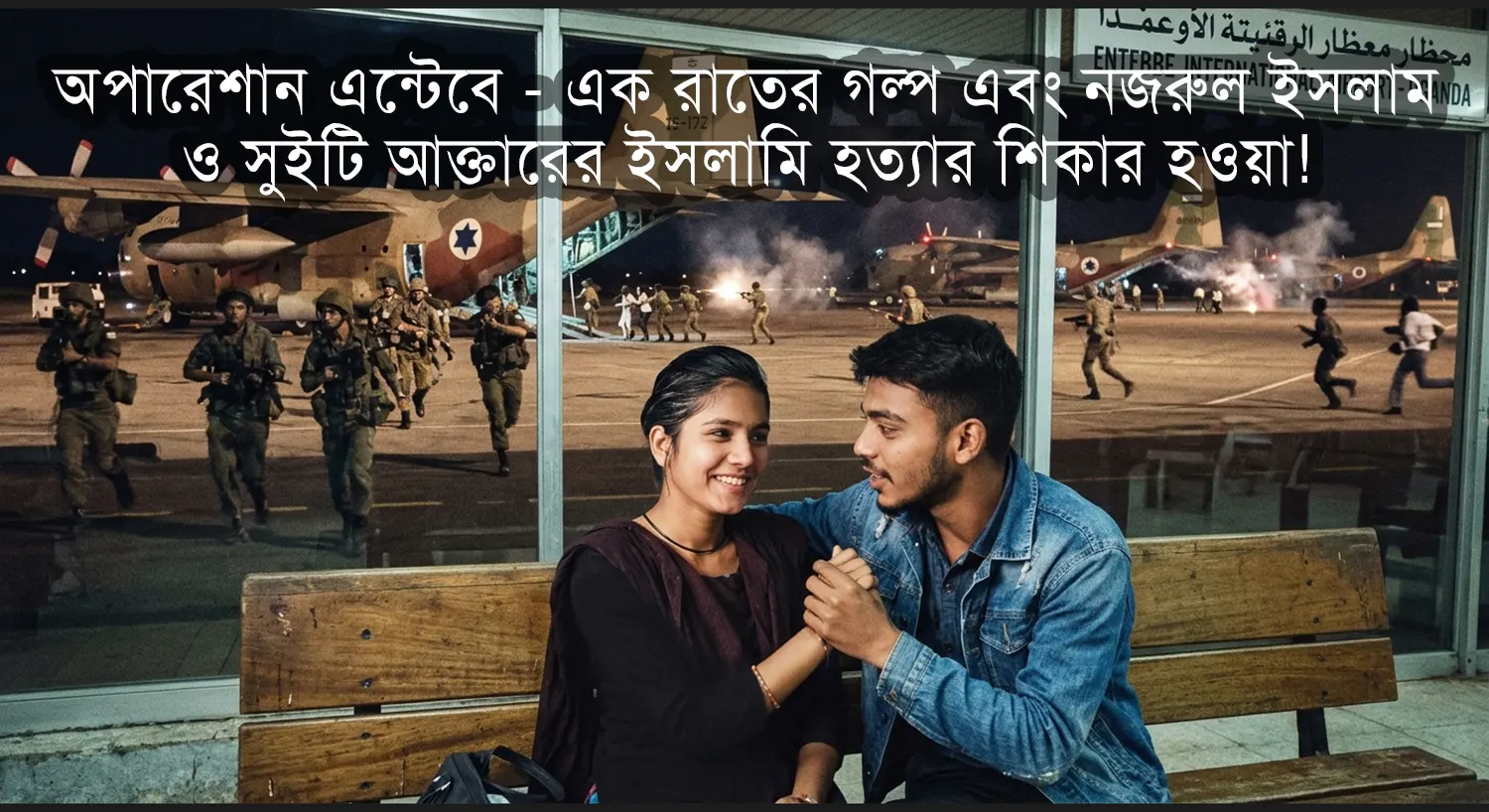
Operation Entebbe and an Islamic Murder
Operation Entebbe – the story of one night, and the Islamic execution suffered by Nazrul Islam and Sweety Akter
What can a state do to save the lives of its citizens abroad? Are there any textbook examples of this? Recently, you may have seen reports claiming that two Bangladeshi citizens lost their lives under Saudi Arabia’s legal system after being convicted of conduct considered unlawful there. The author argues that Bangladesh was unable to intervene on behalf of its citizens and reportedly was not informed in advance.
Operation Entebbe – The Story of One Night
The Blue Trap in the Sky
June 27, 1976. The morning drifting over the Mediterranean carried no sign of danger. Air France Flight 139 took off from Tel Aviv’s Ben Gurion Airport bound for Paris. It stopped in Athens, where more passengers boarded. Security screening was lax, as few could imagine that four pistols and grenades could pass through the soft-lit transit lounge of a Greek airport.
The plane took off again. Inside were about 250 people. Some slept, some gazed at the clouds through the windows. A mother gently stroked her child’s head. An elderly man unfolded an old newspaper. A newlywed couple was traveling to Paris for their honeymoon. A child cried loudly after becoming upset with his mother. Then four passengers rose from their seats.
One of them raised a pistol and shouted for everyone to remain still. The four hijackers consisted of two Palestinians and two Germans. They broke into the cockpit. Confronted with gun barrels, Captain Michel Bacos immediately understood that control of the aircraft was no longer in his hands. The sky that had once seemed familiar suddenly turned into a dark tunnel.
The aircraft turned south. It landed in Benghazi, Libya, for fuel and then departed again. As the sun reddened the skies over Africa, the wheels finally touched an unfamiliar runway. The sign read Uganda, Entebbe. The pilot realized that the journey had ended in Idi Amin’s Uganda.
The Roll Call
The air in Entebbe was humid and heavy. The passengers were taken into an old terminal building with peeling paint and cloudy windows. Ugandan soldiers stood guard outside with rifles. Uganda’s ruler, Idi Amin, personally visited and spoke with the hijackers. His demeanor made it clear where his sympathies lay.
The following day came a moment that survivors would never forget. One of the hijackers stood in the hall with a list and began calling out names. Those holding Israeli passports or identified as Jewish were separated from the others.
In one corner sat an elderly woman. Tattooed on her wrist were numbers from a Nazi concentration camp she had survived three decades earlier. She silently stared at them. It felt as though the darkness she had once escaped had returned to stand before her again.
Those who were released returned to Paris. Yet Captain Bacos and his crew made a historic humanitarian decision that ended their own chance of freedom. They refused to abandon the hostages. In that moment, a bond emerged among people from different countries that no law book could define.
The hijackers’ demand was clear: 53 prisoners held by Israel and several other countries were to be released. Otherwise, hostages would begin to be executed on July 1.
Inside the Rooms of Jerusalem
In Jerusalem, the lights remained on throughout the night at Prime Minister Yitzhak Rabin’s office. A map on the wall showed the immense distance to Entebbe, nearly 4,000 kilometers away.
Israel’s policy was not to negotiate with terrorists. Yet the lives of more than a hundred people now hung in the balance. Defense Minister Shimon Peres and military leaders faced a blunt question: what should be done if diplomacy failed?
Military planners rejected options one by one. A sea operation would take too long. A parachute assault was too risky. Flying commandos directly to Uganda seemed nearly impossible, but it remained the only viable strategy.
To buy time, Israel pretended to engage in negotiations. The hijackers extended their deadline from July 1 to July 4. Those three days proved invaluable.
Meanwhile, Mossad worked quietly. Released passengers were debriefed one by one about the number of hijackers, their positions, sleeping locations, and the layout of the terminal. Since the Entebbe terminal had originally been built by an Israeli company, complete architectural plans were available. Israeli forces constructed a replica of the building and rehearsed repeatedly.
On July 3, the Israeli cabinet approved the operation. The mission would send elite commandos to Uganda to rescue hostages. The aircraft would fly low to avoid radar detection. A Mercedes was modified to resemble Idi Amin’s official vehicle, accompanied by matching support vehicles loaded into cargo aircraft.
Wings Beneath the Radar
As the sun set, four massive Hercules transport planes stood ready at an Israeli airbase. Inside the lead aircraft was the black Mercedes disguised as Amin’s vehicle. The hope was that Ugandan guards would believe their president had returned.
Near the vehicle sat Lieutenant Colonel Yonatan Netanyahu, known as Yoni, leader of the assault force. Around him, soldiers sat quietly, some with eyes closed, others checking their weapons.
The planes flew at extremely low altitude across the Red Sea to evade radar. For hours they skimmed above the dark waters. Amid the deafening engine noise, soldiers exchanged only silent glances. Their mission was clear: bring the hostages home alive.
Night fell over Africa. Below lay the dark waters of Lake Victoria, and in the distance flickered the lights of Entebbe Airport.
Silence on the Runway
Shortly after 11 p.m., the first Hercules touched down. No lights were turned on, no announcement was made. As the rear ramp lowered, the disguised Mercedes and accompanying Land Rovers sped toward the terminal.
Two Ugandan guards stepped forward. They recognized the Mercedes but sensed something was wrong. Israeli commandos opened fire. One guard fell immediately; another managed to shout an alarm. The operation’s secrecy was lost. The soldiers abandoned the deception and charged forward.
Inside the terminal, exhausted hostages lay sleeping on the floor. Gunfire woke them. Over loudspeakers, voices shouted in Hebrew, ordering everyone to get down. Mothers shielded children. Elderly passengers pressed themselves against the floor.
Within seconds, the hijackers were killed. However, several hostages were also caught in the crossfire and lost their lives.
Outside, intense firefights erupted with Ugandan soldiers. While directing the assault, Yonatan Netanyahu briefly exposed himself outside the building and was struck by enemy fire. He later became the sole Israeli soldier killed during the operation.
The Journey Home
The operation on the ground lasted less than an hour. Hostages were rushed onto the aircraft. Some cried, some laughed, and some struggled to comprehend what had happened.
Israeli forces also destroyed several Ugandan MiG fighter jets to prevent pursuit. The Hercules aircraft then departed one by one.
They stopped in Nairobi, Kenya, for refueling and medical treatment before continuing north. At dawn on July 4, the planes landed in Tel Aviv, where thousands had gathered to welcome the rescued hostages home.
One hostage, however, was left behind. Dora Bloch had been hospitalized earlier and could not be evacuated. She was later murdered, becoming one of the enduring tragedies associated with the operation.
The Promise a State Made
Operation Entebbe is often remembered as an extraordinary military achievement. Yet its deeper significance may be political and moral. Israel conveyed a message to its citizens: wherever you are, the state will not abandon you.
History’s judgment is not entirely one-sided. The raid violated Uganda’s territorial sovereignty and resulted in the deaths of Ugandan soldiers. The operation sparked intense debate at the United Nations. Supporters argued it was a legitimate act of self-defense to save hostages; critics argued that international law had been breached. Both perspectives remain part of the historical record.
Nazrul Islam and Sweety Akter: The state did not even know the final fate of its citizens!
In Entebbe’s story, a state used all its power to bring back its citizen. This time it is a different story, where the state learned of the citizen’s death from the media. Here what is certain and what is uncertain, both need to be stated separately.
What is certain
On 14 October, Saudi Arabia carried out the death sentence of two Bangladeshis convicted of immoral acts inside a mosque in Mecca. The Saudi Ministry of Interior has given their names. The Saudi authorities have said that they were given the death penalty under their “Tazir” law. In front of many people, they carried out their death sentence through Saudi’s inhuman public beheading. Rejoicing in this inhuman, anti-humanitarian act of barbaric Sharia law, the people present there were shouting “Allahu Akbar”—a slogan that many people in the world fear.
According to the family’s statement, 25-year-old Nazrul went to Saudi Arabia on 10 November 2022 to improve the family’s financial situation. Six months later, Saudi police arrested him and a young woman named Sweety Akter from a mosque in Mecca on charges of “indecent acts.” Nazrul’s family has stated that he worked as a cleaner at Masjid al-Haram in Mecca, and the family claims that the allegations brought against him are not consistent with his character. His father, Abdul Bashir, had borrowed six lakh taka from relatives to send his son.
While both were working as cleaners in Mecca, love developed between them. One day, in the compound of some mosque, after a slight hug, Nazrul gave a light kiss on the forehead of Sweety Akter. A Pakistani again recorded it on video. Later, after seeing that video, under Saudi’s barbaric Sharia law, they received this tragic punishment, which no one in the civilized world could ever even imagine! Even people of a religiously devout majority country like Bangladesh are unable to accept the death penalty as punishment for this so-called crime.
Bangladesh did not know
The Bangladesh government was supposed to know; that is how it should have been. But a source at the Bangladesh Consulate in Jeddah has stated that the Saudi authorities did not formally inform Bangladesh beforehand. The State Minister for Foreign Affairs has said that on 14 October they learned that two Bangladeshis had been given the death penalty and that it had been carried out. Neither the Ministry of Foreign Affairs in Dhaka nor the Bangladesh mission in Saudi Arabia had been informed earlier. The Jeddah Consulate later wrote a letter to the Saudi Ministry of Foreign Affairs asking for details.
There is a difficult question here. Both Bangladesh and Saudi Arabia are parties to the Vienna Convention on Consular Relations. Under that convention, there is a right to consular communication with citizens detained abroad. Even more worrying is that it is still unknown whether they received legal assistance or had the opportunity to appeal. I cannot say that Saudi Arabia “did not deem it necessary,” because they have not yet given that reason. What can be said is that they did not inform Bangladesh beforehand, and Bangladesh learned of it later, through the media.
What have other countries done to save their citizens from the injustice of Saudi’s barbaric Sharia law?
I looked up incidents from a few countries. Sri Lanka, the Philippines, and Indonesia have not been able to save all their citizens from Saudi Arabia’s barbaric death penalty. However, each has shown different kinds of efforts, and in some cases they have succeeded.
Indonesia: The most relevant comparison
Indonesia’s experience matches Bangladesh’s the most, because they faced exactly the same problem: death sentences without prior notification.
Satina (2014): A successful example
Satina binti Jumadi Ahmad was a domestic worker who was sentenced to death for killing her employer’s wife. The Indonesian embassy in Riyadh had been fighting for her pardon since 2007 and negotiating with the victim’s family. Under Saudi law, the victim’s family can settle the case in exchange for blood money. The family demanded 7 million riyals (about 1.9 million dollars), and businesspeople and others’ donations fell short by three million riyals. In the end, the Indonesian government agreed to pay the remaining three million riyals and had previously managed to get the death sentence postponed five times. Media and public campaigns played a major role in this. The government had initially said it would not use state funds in criminal cases, but under public pressure it eventually changed that position. It is noteworthy that this process did not happen in one or two months; work on Satina’s case had been going on for many years.
Ruyati (2011): A failed example, similar to Bangladesh’s incident
Ruyati binti Sabubi was beheaded in June 2011 after confessing to murder. The Saudi authorities did not inform Jakarta beforehand, which angered Indonesia, and Indonesia imposed a moratorium on sending new domestic workers.
Tuti Tursilawati (2018): A repetition of the same incident
President Jokowi said that the death sentence had been carried out without prior notification and that the same had happened in previous incidents. Migrant Care stated that at least five Indonesian workers had been executed without official notification. Jakarta’s reaction was immediate: the government expressed “deep concern” and pressed Saudi Arabia for a mandatory consular notification agreement. The ambassador was summoned, and the Saudi ambassador was also called in. However, rights activists say that Saudi Arabia ignored requests made in previous discussions. There is a disagreement on one issue: whether Tuti killed in self-defense; reports are not consistent on this point, so I am not emphasizing that claim.
The Philippines: Both success and failure
Joselito Zapanta (2015)
He was accused of killing a Sudanese landlord. The Philippines’ efforts were extensive. President Aquino wrote a letter to the Saudi king requesting time for the family and personally contributed a large sum for the blood money. Due to repeated appeals, the Saudi authorities reduced the blood money from 5 million riyals to 4 million, but sufficient funds could not be raised. In addition, the Saudi government extended the deadline twice. Even so, the death sentence was carried out because the family and the government were able to raise a total of 23 million pesos, whereas the demand was about 48 million. One important point in this case was that the Philippine foreign secretary said that since the victim was not a Saudi citizen, the likelihood of intervention by the royal family was low. The same article mentions that in another Filipino’s case, Lanuza, the Saudi king himself paid about 2.3 million riyals (25 million pesos) out of 3 million riyals, as a result of which he was freed and returned home. In other words, the outcome depended on the nature of the case, the nationality of the victim, and even the king’s wishes.
However, criticism continued even after Zapanta’s death. The government said it had done everything, while social worker Susan Ople proposed forming a special unit for blood money cases. It is also noteworthy that the Philippine Department of Foreign Affairs said that death sentences in Saudi Arabia are not announced beforehand.
Sri Lanka: Attempts at the highest level, yet failure
Rizana Nafeek (2013)
She was a Sri Lankan domestic worker who was beheaded for the death of a newborn baby. She had worked for less than six weeks in 2005. There was controversy over her age, because human rights organizations claimed that she was a minor at the time of the crime. Government efforts were not lacking: President Mahinda Rajapaksa personally requested clemency twice, several ministerial-level delegations were sent, and in 2008 and 2011 her parents were taken to Saudi Arabia. In addition, an appeal was filed with the help of the Hong Kong-based Asian Human Rights organization.
Even so, there was no result. The baby’s mother refused to grant pardon, which under Saudi law is the most important condition for release. After the execution, Sri Lanka withdrew its ambassador from Saudi Arabia. Critics’ allegations were even harsher: a local rights organization said that the government had refused to pay the lawyer’s fee for the appeal. These two statements—from the government and from critics—are contradictory; I cannot take either as the absolute truth.
What this comparison shows
First, it is only partially true that other countries have freed their citizens because of their efforts. Satina survived and Lanuza was freed. But many like Rizana, Zapanta, Ruyati, and Tuti have died, even after their countries made extensive efforts. Efforts are not a guarantee of success.
Second, in the cases where people survived, the most important role was played by the victim’s family’s pardon and the money to buy that pardon. In all these cases, there were personal murder charges, where Saudi law gives the victim’s family the opportunity to grant pardon.
Third, in the case of Nazrul and Sweety, the Saudi authorities have said that the sentence was given under “Tazir” law. There is no private victim’s family there to whom blood money can be paid to seek pardon. This is my analysis; I have not found such a clear statement in reports, so treat this as a possibility. If this is correct, then the blood-money-based success model of Indonesia or the Philippines would not apply in this case, and the comparison is not so straightforward. Here there is no precedent of any serious crime like murder; what exists is merely a game of protecting the honor of a monster cult called Islam.
Fourth, the issue of not giving prior notification is not a problem unique to Bangladesh. Indonesia has faced such situations at least five or six times. In the cases of the Philippines and Sri Lanka, the Philippine Department of Foreign Affairs has said that Saudi Arabia did not inform them of the date of execution beforehand. In other words, there is no evidence here that Saudi Arabia has specifically ignored Bangladesh. It seems to be a general behavior of Saudi Arabia.
Fifth, still, there is a difference. Indonesia and the Philippines were involved in the cases for years through their embassies, arranged lawyers and public support, and after failure took tough measures (moratorium, withdrawal of ambassadors, demand for mandatory notification agreements). In the case of Nazrul and Sweety, it is so far unknown whether they received legal assistance or had the opportunity to appeal. The government’s response is still limited to letters and meetings with the ambassador. However, the process has just begun, so it would not be right to make a final judgment now.
Do the rapes suffered by female domestic workers get justice in Saudi?
Thousands of female workers have returned from Saudi Arabia to their own countries and described their horrific experiences. They have said that they were raped every day by the employer, repeatedly; father and son together raped them; friends raped them collectively; they were subjected to physical and mental torture, and even the women of those families did not object to these acts. Thousands of Saudi-returned Bangladeshi women have raised their cries in the media; we have seen these reports in all mainstream media. Those who have managed to return have said that those who could not return are living in a living hell. They want to survive; they want diplomatic intervention. Even then, statistics show that there is no rape in Saudi. Because those incidents were not recorded as rape. Many Saudi employers think that having sex with maids is their right, because they buy them; in Islam, sex with a female slave is permitted, and the slave’s consent is not required.
On paper, the rate of rape in Saudi Arabia is very low, almost nonexistent. In 2019, only 8 people were punished there on rape charges, and that was inevitably the death penalty for zina. That is, on paper, the number of rapes in 2019 was only 8. Did only 8 incidents of sexual violence occur in Saudi Arabia in 2019? Seriously?
On the other hand, among the expatriate Bangladeshi women who are forced to return or flee back to Bangladesh from Saudi Arabia, about 60% to 70% have mentioned physical, mental, or sexual abuse. 30% return with pregnancies. In 2019, around 1,600 women returned to Bangladesh after being sexually abused in Saudi Arabia. This is only Bangladesh’s count — many more women go there from other countries, their own national women are also present, and many women compromise with the abuse. Now, if you think Saudi’s rape statistics are true — then there is nothing more to say.
In Islamic-governed countries, women do not even dare to seek justice for rape. This is the reality. If they fail to prove it, the woman herself receives severe punishment; the rapist can instead blame the woman, claiming she provoked him by not observing purdah. If you examine the condition of women in Saudi Arabia, Iran, and Indonesia’s Aceh province, there is abundant evidence of this — the simple name for it is an environment of impunity. On 4 June 2026, The Daily Star reported that a Bangladeshi woman in Saudi Arabia had been sexually abused multiple times, in various forms. The employer told her that they had bought her. Even though she filed a rape complaint against the employer’s son, she was blamed instead. The police did not help her. Even after she was raped again later, the police jailed her. There are hundreds, thousands of such examples.
Many pregnant women have been abandoned by their families in Bangladesh. In a 2018 report, the head of BRAC said that there is no precedent of any employer being brought to justice for abusing Bangladeshi women. In another report, an official said that no accused employer has ever been charged or arrested by Saudi authorities. In a recent case, a BRAC official questioned why the embassy did not ask Saudi authorities to investigate, and said, “When a woman is abused, it is an injury to all of Bangladesh. Accountability must be real.” MJF has said that the embassy should have taken legal action against the employers and arranged compensation.
Related Posts
অপারেশান এন্টেবে – এক রাতের গল্প এবং নজরুল ইসলাম ও সুইটি আক্তারের ইসলামি হত্যার শিকার হওয়া!
একটি রাষ্ট্র বিদেশে তার নাগরিকদের জীবন বাঁচাতে কী করতে পারে? এর কোন টেক্সটবুক উদাহরণ আছে?Read More
A random page from Muhammad’s self‑made book Qur’an and its unscientific statements
Sometimes I flip through random pages of Muhammad’s self‑made book Qur’an, and today this pageRead More
মুহাম্মদের বানানো কোরআন বই এর একটা র্যান্ডম পৃষ্ঠা ও সেখানকার অবৈজ্ঞানিক বক্তব্য
আমি মাঝে মাঝে মুহাম্মদের বানানো কোরআন বই এর র্যান্ডম পৃষ্ঠা উল্টাই, আজ এই পৃষ্ঠা হাতেRead More
Comments are Closed