
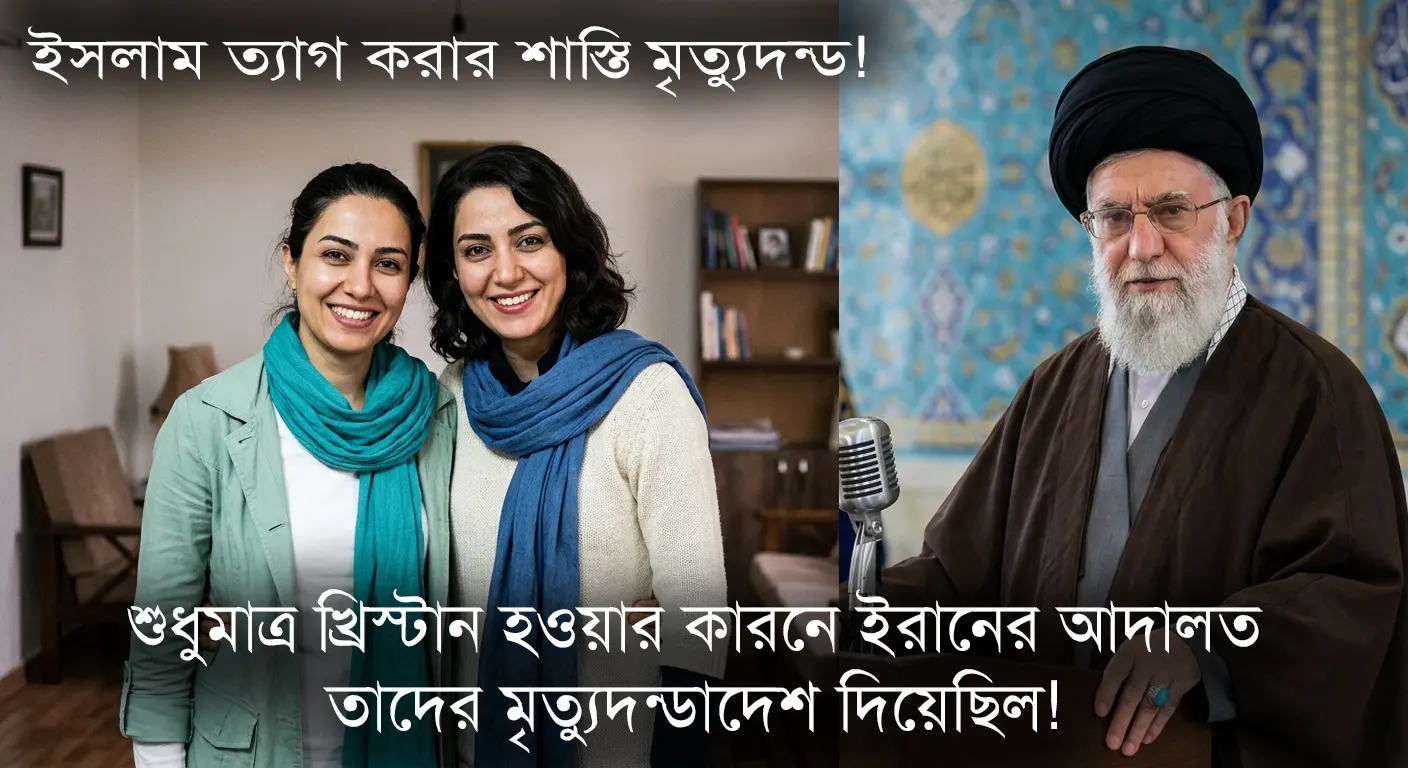
Islam is a Barbaric Cult
The Iranian court sentenced them to death solely because they became Christians!
2009. Two young Iranian women, Marziyeh Amirizadeh and Maryam Rostampour, were sentenced to death by hanging. The only crime: They had left Islam and embraced Christianity, and they refused to deny it. Both were born into Muslim families. After converting, they studied theology and then returned to Iran. In Tehran and other cities, they secretly helped establish house churches, mostly involving women and young people.
In Iran, preaching any religion other than Islam is a crime. A person who leaves Islam for Christianity is not recognized as a Christian; their identity is “murtad,” apostate – and the punishment is death. Only minorities recognized by birth, such as Armenians and Assyrians, are officially permitted to practice other religions.
Someone reported that the two women who had returned from abroad had left Islam and become Christians. In March 2009, the Islamic Revolutionary Guard Corps (IRGC) arrested them. Officials asked, “Are you Christians?” Both replied, “Yes.” They were charged with apostasy and proselytizing. The judge ruled that unless they returned to Islam, they would be executed. They spent 259 days in Tehran’s notorious Evin Prison. There they were interrogated for hours, threatened with execution, and forced to live in inhumane conditions.
They did not know that outside, a campaign for their release had begun. Amnesty International and various church groups were pressuring the government. Pope Benedict XVI also wrote to the Iranian government requesting their release. After nine months, under intense international pressure, they were freed. Later they left Iran. Their story is written in the book Captive in Iran.
The rulers wanted to silence them, but failed; they wanted to kill them, yet the women did not back down from their demand for freedom of religious practice and peaceful evangelism. Iran’s laws have not changed; these brutal Islamic laws remain fully in force. Even today, in Iran, converts are imprisoned on “national security” charges for holding house prayers, baptisms, or possessing a Bible.
Punishment for Apostasy: The Position of Islamic Law
A hadith in Sahih Bukhari says, “Whoever changes his religion, kill him.” Based on this hadith, most scholars of the four classical schools of fiqh have ruled that the punishment for a murtad (apostate) is death, usually after giving a chance to repent. Leaving Islam for another religion also makes one an apostate. States like Iran, Saudi Arabia, and Taliban-ruled Afghanistan apply this interpretation because it is considered the ruling of Islam.
If someone criticizes Allah or holds incorrect beliefs about Him, there is an opportunity for forgiveness through repentance. But in the case of the Prophet Muhammad, this opportunity does not exist. That is, criticism of Allah may be forgiven, but even slight criticism of the Prophet, comparisons, or loving someone more than him – all of these fall under blasphemy against the Prophet (shatime rasul). Even if someone compares the Prophet with another person and considers that person equal or superior, they are considered guilty and become a blasphemer of the Prophet.
Based on this concept, it is said that killing a blasphemer of the Prophet is obligatory for Muslims – a religious duty that must be carried out and supported. Various narratives in Islamic tradition present the actions of the Prophet Muhammad and his companions as examples of this ruling. As a result, there is little disagreement among the Islamic schools – Hanafi, Maliki, Shafi’i, Hanbali – and most Islamic scholars agree that the punishment for insulting the Prophet is death and repentance is not accepted.
Because of this concept of blasphemy, you will see that many Islamists in Bangladesh do not react strongly when someone criticizes Allah. But if someone criticizes the Prophet Muhammad even slightly, or even cites shameful episodes from his life from Islamic sources, they issue death threats. They claim that the Prophet Muhammad himself sent people to kill his critics. Even the brutal killing of a pregnant woman whose womb was slit open, causing the child to fall out, is cited as an incident he approved.
Examples from Different Countries
Sudan (2014): Meriam Ibrahim was sentenced to death for apostasy. She stated that she was Christian by birth, her mother an Ethiopian Orthodox Christian, and she had never accepted Islam. But the court considered her Muslim because of her father. She was pregnant at the time, and the court ruled that her execution would be carried out after she gave birth. She delivered her baby in prison. After international pressure and appeals, she was released in June 2014.
Saudi Arabia: The country’s written penal code has no separate clause for apostasy, but judges apply uncodified Sharia, and apostasy can lead to death. Reports say that in 2014, Ahmad al-Shamri was sentenced to death for atheism and renouncing Islam. In 2012, Hamza Kashgari was arrested and imprisoned for tweets about the Prophet.
Pakistan: There is no separate law for apostasy, but under Penal Code 295-C, the only punishment for insulting the Prophet is death. Asia Bibi received a death sentence under this clause in 2010 and was acquitted by the Supreme Court in 2018. Ahmadis are legally prohibited from identifying as Muslims. People have been killed by mobs over accusations, such as Mashal Khan in 2017. In Pakistan, there are many examples of mob lynching over accusations of insulting religion or the Prophet Muhammad. One believer simply said he loved Imran Khan as much as the Prophet Muhammad, and because he did not love the Prophet above all, an enraged mob beat him to death.
Afghanistan: In 2006, Abdul Rahman faced trial and a death sentence for converting to Christianity. Under international pressure, he was released and took asylum in Italy. Under Taliban rule, apostasy is considered a capital crime. What happens there is largely unknown to the outside world.
Iran: In 2010, Pastor Yousef Nadarkhani was sentenced to death, but he was acquitted in 2012.
Final Words
In this context, it can be said that before criticizing Islamic fanatics on the streets and social media, it is necessary to bring religious sources – the Prophet Muhammad and religious law or the Qur’an and Hadith – under scrutiny. Because the fanaticism, intolerance, and violence practiced by extremists are rooted in religious texts and historical examples of the Prophet Muhammad and his companions. Therefore, alongside punishing fanatic criminals, questioning the root cause, exposing its inconsistencies and inhumane aspects – this is the rational and humanistic position.
On the other hand, those of us who identify as humanists believe that human life is the most valuable thing in this world. To protect human existence, independent thought, freedom of expression, and fundamental human rights, it is necessary to demand accountability for anyone’s – whether Allah, the Prophet, religious leaders, or those considered divine – inhumane actions or injustices. Protecting human dignity is the main point.
If religion truly remained confined to personal belief, there would be no problem. What a person believes or what rituals they practice in their private life is their own matter. But the problem begins when religious ideology or religious authority seeks to control another person’s private life, freedom, choices, or behavior. When personal belief becomes a tool of social control, conflict, discrimination, and oppression arise. In today’s reality, only Islam as a cult is seen interfering with society and the state at every step like a cancer.
This is why it is necessary to criticize religious ideologies, especially Islam, Allah, and the Prophet Muhammad. Their absurdity, contradictions, inhumane aspects, and irrational claims must be repeatedly brought forward. Because through criticism, people move toward free thought, break the chains of blind faith, and establish humanistic values.
Related Posts
শুধুমাত্র খ্রিস্টান হওয়ার কারনে ইরানের আদালত তাদের মৃত্যুদন্ডের আদেশ দিয়েছিল!
২০০৯ সাল। ইরানের দুই তরুণী মারজিয়েহ আমিরিজাদে ও মরিয়ম রোস্তামপুরের বিরুদ্ধে ঝুলিয়ে ফাঁসি দেওয়ার রায়Read More
Spending the night in Umm Hani’s house and then meeting Allah in the heavens – he named it Mi’raj
Mi’raj is a central event in Islamic belief. On the night of Mi’raj, the ProphetRead More
উম্মে হানির ঘরে রাত কাটিয়ে মহাকাশে আল্লার সঙ্গে সাক্ষাত – নাম দিয়েছেন মিরাজ
মিরাজ ইসলামি বিশ্বাসের একটি কেন্দ্রীয় ঘটনা। মিরাজের রাতে নবী মুহাম্মদকে পাওয়া যাচ্ছিল না। সাহাবীরা চিন্তায়Read More
Comments are Closed