
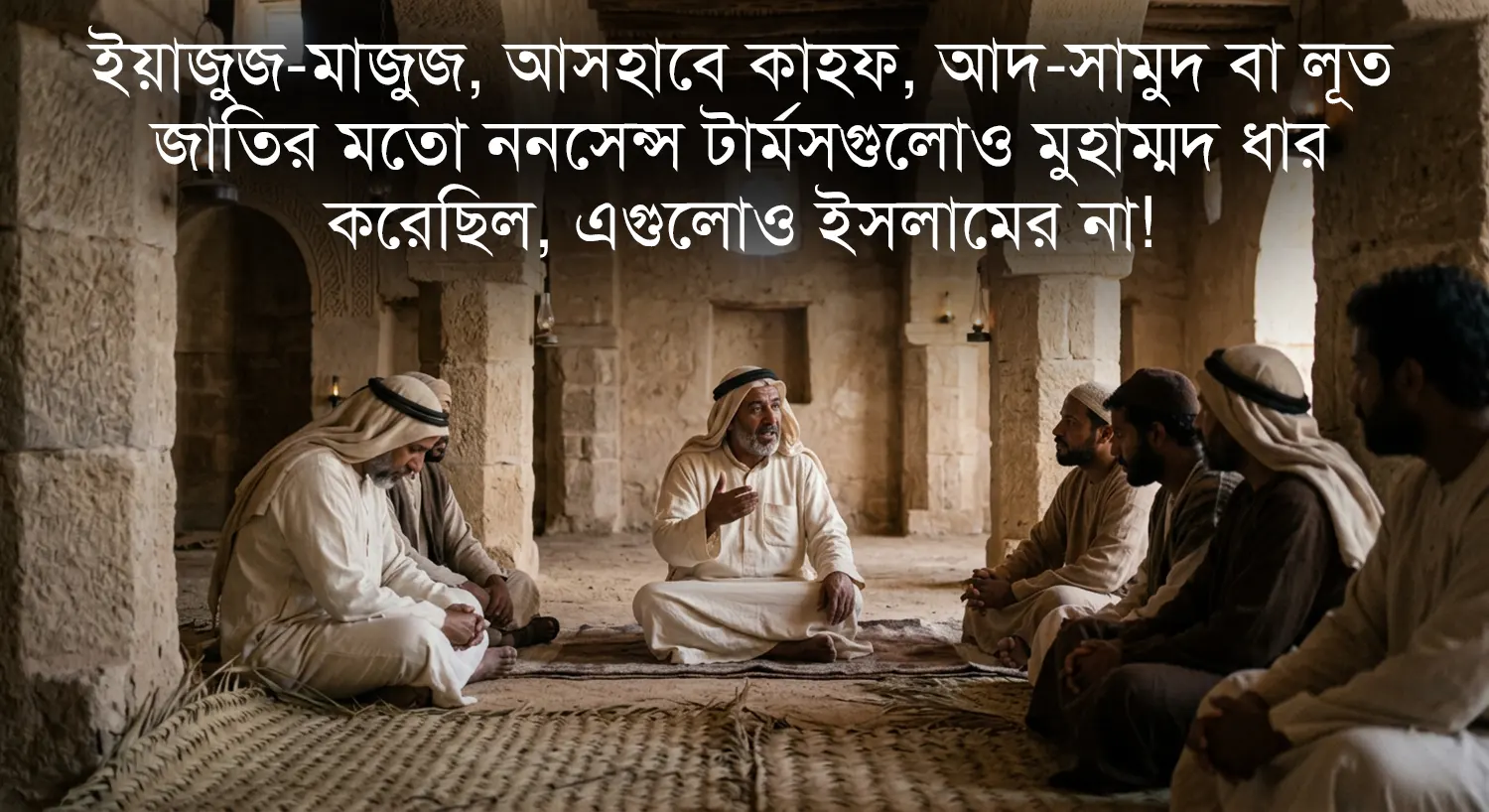
Nonsense Terms and Islam
Islam contains many nonsense terms, and even those are not its own; they are borrowed from neighboring civilizations and mythologies
In English there are many nonsense rhymes, like “Humpty Dumpty sat on a wall.” In Bangla too there are many, such as “Hattima Tim Tim, tara mathe pare dim.” Children may believe these, but any grown person with common sense knows these are just nonsense, child‑pleasing words and tunes. But if you follow religion—especially Islam—then you have to accept many nonsense miraculous pseudo‑science claims, many strange assertions that go against science, along with many nonsense terms. For example—Yajuj‑Majuj, ‘Ad‑Thamud, Lut, Dhul‑Qarnayn, Dajjal, Mahdi! Some of these are people, some are nations.
By the standards of science, history, and logic, none of these can be proven. But if you follow Islam you must accept these; you cannot dismiss them as childish. The point is: in any religious narrative system there are certain elements whose historical or scientific truth cannot be verified, yet to the believer they are not mere metaphors but are regarded as literal truth. The question is—where did such narratives come from, and what does historical‑critical research say about them?
Seventh‑century Arabia and its neighboring civilizations
Seventh‑century Hijaz was not an isolated island. Mecca and Medina were junctions on trade routes, where the influences of Jewish, Syriac Christian, Zoroastrian Persian, and Byzantine cultures regularly entered. Historians like Patricia Crone and Michael Cook have shown in their research that many of the early descriptions of Islam came from the shared oral traditions of the contemporary Middle East, which were not the exclusive property of any one religion.
John Wansbrough, in his literary‑critical approach, argued that many Qur’anic narratives are deeply related to Jewish‑Christian traditions (Midrash, Talmud, Apocrypha) and that they gradually attained their present form through processes of editing. Tom Holland, in his popular history books, has shown how the religious environment of Late Antiquity—where apocalyptic imagination was at its peak—created the backdrop for the early narratives of Islam.
The direction of cultural influence: why was it one‑way?
This exchange was not at all equal—rather it was essentially one‑way. The Byzantine Empire, Sasanian Persia, Jewish and Syriac Christian communities—these were the prosperous, urban‑centered, institutional civilizations of that time, which had states, written literature, theological schools, and extensive trade networks. In contrast, most regions of Hijaz and central Arabia were desert, barren, and sparsely populated—there was almost no surplus agricultural economy to speak of, and there were repeated famines and water shortages. For this reason, before the seventh century Arabia did not develop any indigenous written literary tradition, centralized state system, or institutional knowledge structure—it was mainly a culture based on oral poetry and tribal memory.
As a result, the flow of influence was almost entirely from the outside to the inside—that is, the Arabian Peninsula absorbed the religious‑cultural elements of neighboring civilizations, but could not spread any comparable influence outward. Trade centers like Mecca and Medina were essentially transit points—junctions on the caravan routes from Yemen to Syria—through which, along with goods, stories, legends, and religious ideas also flowed. But this flow was mainly one‑way import, not export. Jewish settlements (such as in Yathrib, i.e., Medina) and Christian centers like Najran locally spread their scripture‑based stories and folk tales, which, instead of remaining in written form, were transmitted orally, becoming distorted, abridged, or transformed, and then blended into local narratives.
This unequal relationship explains why in stories like Yajuj‑Majuj, Ashab al‑Kahf, or the people of Lut, we find almost identical structures of Byzantine‑Syriac or Jewish origin, whereas in the opposite direction—Arab folk tales entering Byzantine or Persian religious literature in the pre‑Islamic era—historians hardly find such examples. Arabia at that time was a recipient, not a source center—and this geographical‑economic marginality explains why the region’s own knowledge reservoir was so limited, and why external narratives were so easily, almost without verification, assimilated into the local belief system.
The possible origins of some specific terms
Yajuj‑Majuj (Gog‑Magog): This pair of names already existed in the biblical books of Ezekiel and Revelation. In Syriac Christian tradition—especially in the writings of Pseudo‑Methodius and in the Alexander Romance literature (where Alexander the Great imprisons barbarian nations behind an iron wall)—this story was widely circulated. In the Qur’an, in the story of Dhul‑Qarnayn, we see this same motif, which scholars consider a direct echo of the Syriac Alexander legends.
‘Ad and Thamud: The descriptions of the destruction of these two nations were already prevalent in pre‑Islamic Arab folk tales, especially as local legends formed around the ruins of ancient civilizations in South Arabia (such as Mada’in Salih). Archaeologists have found remains of Nabataean civilization in this area, which many think were later given mythological explanations.
The people of Lut: This narrative is a direct Islamic reworking of the Torah’s story of Sodom and Gomorrah, which comparative theologians believe entered the Qur’an from Jewish tradition.
Dajjal: The idea of a one‑eyed deceiving anti‑Messiah figure parallels the Christian doctrine of the Antichrist, which was widely prevalent among Christian communities in Asia Minor and Syria at that time. This motif takes detailed shape in hadith literature, where geographical and chronological details are gradually added.
Mahdi: This concept, which is not directly mentioned in the Qur’an, is thought by historians to be mainly a product of hadith literature and later theological development. Its interpretation differs in Shia and Sunni traditions, which shows that it is an evolving theological construct that gained popularity during times of political crisis (especially in the early Abbasid period).
Some more vague or shrouded concepts
This list can be extended further:
- Harut and Marut – two angels who are said to teach magic to humans; the roots of this story can be found in Babylonian and Jewish Midrash literature.
- Ashab al‑Kahf (the youths of the cave) – scholars believe this almost exactly follows the structure of the Syriac Christian legend “The Seven Sleepers of Ephesus.”
- Iblis and the jinn – the idea of invisible beings made of fire is similar to pre‑Islamic Arab and Persian folk beliefs.
- Buraq – the creature described as the mount of the Mi‘raj; its description is not in the Qur’an itself, but is elaborated in hadith and later tafsir literature.
- Sijjin and ‘Illiyyin – described as places where the records of the deeds of sinners and the righteous are kept, whose detailed geography is mainly a later addition of theological literature.
- ‘Arsh and Kursi – the concepts of Allah’s “Throne” and “Seat,” about which theologians themselves debate literal versus metaphorical interpretation.
- The trumpet of Israfil – the idea of this trumpet that announces the beginning of the Day of Judgment is comparable to Zoroastrian and Jewish apocalyptic literature.
- Barzakh – the intermediate state between death and resurrection, whose detailed description is mainly hadith‑based.
- Signs of the Last Day – the sun rising from the west, the beast of the earth (Dabbat al‑Ard) speaking, etc.—these descriptions are thought to be combinations of apocalyptic motifs from various cultures.
- The powers of Solomon – the story of controlling the wind, jinn, and the language of birds is closely tied to Jewish Solomonic folklore and later Middle Eastern magical literature.
Why these narratives raise important questions
The main argument of critics is not that these stories come from “stupidity,” but that they are products of a specific historical‑cultural environment—an environment in which oral tradition, the influence of neighboring religions, and the limited geographical‑scientific knowledge of that era together created a narrative system. For people of that time, their understanding of the earth’s geography, natural history, or cosmic structure was mainly mythological and scripture‑based—they had no framework of modern geology, astronomy, or archaeology. In other words, there is nothing in the Qur’an and hadith that the people of that time in Arabia, including Muhammad, did not already know. They could not bring in anything beyond their knowledge even in imagination; those things too were borrowed tales.
For this reason, modern historical‑critical research tries to read such narratives as documents of literary and cultural history—examining which civilization exchanged ideas with which, and how a story transformed from one language to another, from one religion to another. From this perspective, Dajjal and the Antichrist, Yajuj‑Majuj and Gog‑Magog, Ashab al‑Kahf and the Seven Sleepers—these are seen as different branches of the same broader Middle Eastern narrative family, not as inventions unique to any single religion.
Naturally, this comparative approach may not be acceptable to believers, because from a religious viewpoint, seeing divine revelation as the product of human‑cultural evolution goes against core belief. But from the perspectives of history, comparative theology, and literary criticism, it is difficult to ignore these parallels—and precisely for this reason, academic research on these topics remains an active and contested field.
Related Posts
ইসলামে অনেক ননসেন্স টার্মস আছে, সেগুলোও আবার নিজের না; পার্শ্ববর্তী সভ্যতা, মিথলজি থেকে ধার করা
ইংরেজিতে অনেক ননসেন্স রাইমস আছে, যেমন হামটি ডামটি স্যাট অন এ ওয়াল। বাংলায়ও আছে অনেক,Read More
Except for Muhammad’s sexual life, almost everything in the Qur’an is borrowed! Nobody knew that Muhammad was such a great kutub
1400 years ago, in the harsh, famine‑stricken Arabia, scattered Bedouin people lived there. Because theRead More
মুহাম্মদের যৌন জীবন বাদে কোরআনে প্রায় সবই ধার করা! মুহাম্মদ যে এতো বড় কুতুব কেউ জানতো না সেটা!
১৪০০ বছর আগের রুক্ষ দূর্ভিক্ষপীড়ত আরবে ছড়িয়ে ছিটিয়ে বেদুঈন মানুষের বাস ছিল। মরুভূমির মক্কা ওRead More
Comments are Closed