
Are Social Customs Beneficial?
Custody of Society” – Group News! You will find them all around you
I was in class eight then. That day there was no school, I was probably returning home on my bicycle after buying groceries. There’s a bend on the road, about 70 degrees. Unless you’re face‑to‑face, you can’t tell what’s coming from the other side. So I couldn’t sense anything either, and it was a narrow road, with a record of bus‑truck accidents at that spot. As I got closer, I saw a high‑school teacher coming from the opposite direction. Up to that point everything was fine.
The next day when I went to school, that teacher summoned me. As soon as I went, another teacher started scolding me harshly in front of other teachers and students. Apparently I had become very arrogant, so I didn’t respect poor teachers. The issue was that when I saw him, I didn’t get off the bicycle and stand to give a proper salute — that was my crime. He had never been my direct teacher. Since I always ranked first in class, I was always in the odd section; he taught the B section, the even‑roll students.
Many years later I understood that my real crime in that courtroom wasn’t failing to salute. The real crime was that, while trying to control my bicycle on a dangerous bend, I couldn’t decide which was more urgent — saving myself, or recognizing the gentleman’s rank and stopping in the proper posture. In our society, applying the brake and giving a salute at the same time is probably the true definition of politeness, and I had failed that test. Here respect isn’t measured by behavior, it’s measured by how much the neck bends. A man who had never taught me, who wasn’t even supposed to know my name, felt insulted because I didn’t stop. Yet in this same society, countless people commit real injustices every day and get away effortlessly, simply because they know how to speak in polished language and perform proper greetings.
The roots of this “proper custom” run very deep. In Bengal’s socio‑historical context, the rules of showing respect were never merely expressions of humility; they were strategies for drawing the map of power. During the zamindari era, tenants had to bow before the landlord, stand holding their shoes, speak in a low voice — these customs arose directly from land ownership and power relations, not from reverence but from fear. The Mughal and Nawabi court culture of ornate obeisance, and then the British colonial administration’s own salute‑rituals — these two layers blended into a social habit where showing bodily humility before authority became the most important qualification. That habit passed from police officers to village elders, from school headmasters to office bosses, and survives even today.
Religion isn’t blameless either. In Islamic culture, salam is essentially a blessed prayer, the use of the right hand symbolizes purity, and showing respect to elders is a moral teaching. In Hindu society, touching feet or staying quiet before elders is a similar language of reverence. The intentions behind these weren’t bad. The problem is that over time the real meaning of these customs faded, leaving only the shell. Courtesy is no longer a spontaneous expression of inner respect; it has become a kind of test — if you pass, you’re “polite,” if you fail, you’re “ill‑mannered.” Almost no one asks what kind of person you actually are inside.
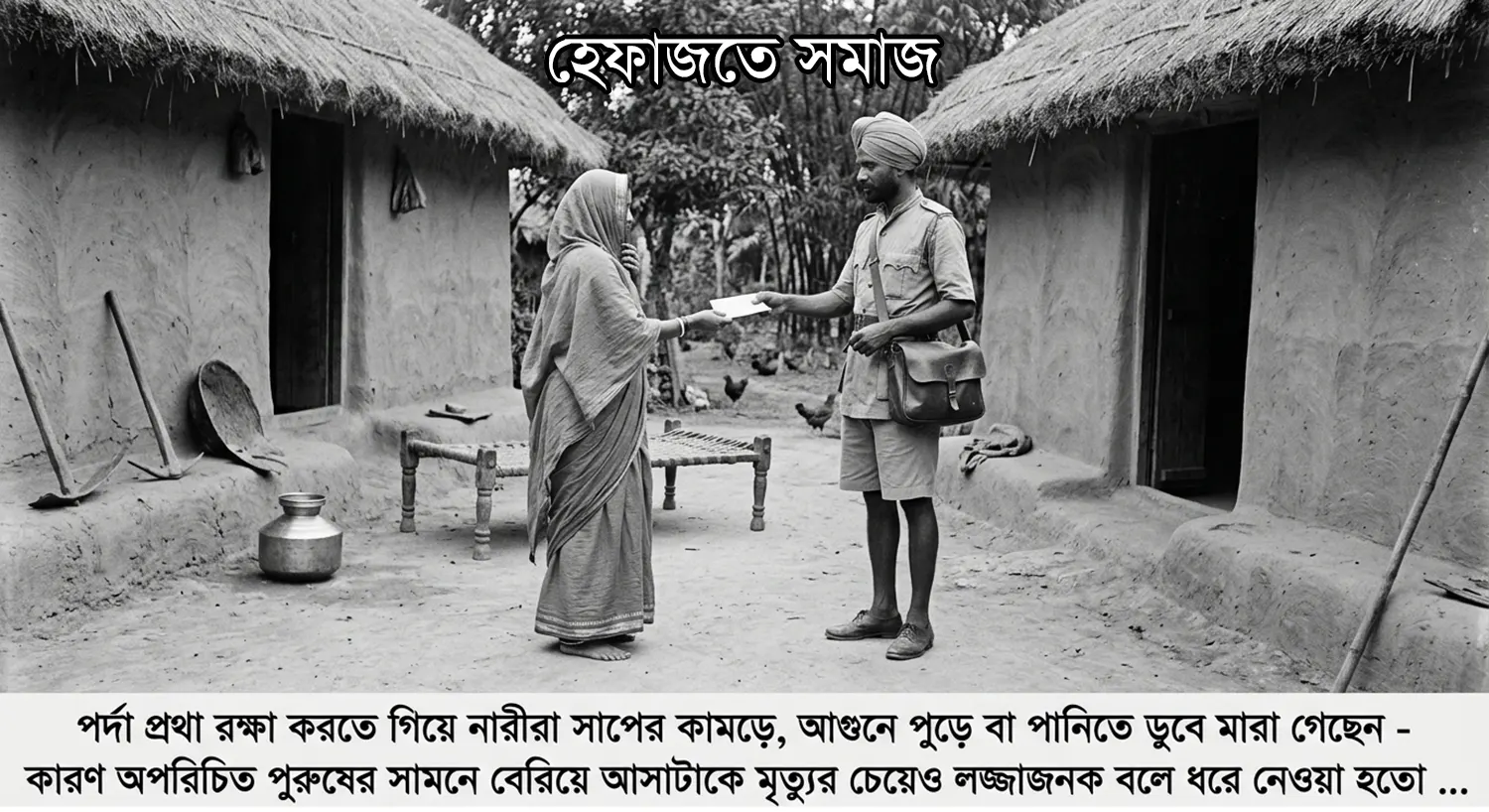
Rabindranath Tagore spent his entire life writing against this hollow ritual‑worship. His objection wasn’t to customs themselves, but to turning customs into substitutes for humanity. Around the same time, Rokeya Sakhawat Hossain revealed an even harsher truth. In her book Abarodhbasini, she describes incidents where women died from snakebites, burned in fires, or drowned — because in order to preserve purdah, stepping out before an unfamiliar man was considered more shameful than death. Here the real difference between custom and character becomes brutally clear. Even if a custom fails to save a person, if preserving the custom becomes the only measure, then letting someone die for the sake of that custom becomes “decent” in society’s eyes.
The same contradiction appears in a recent viral video many of you have seen. A government officer is eating rice. An elderly farmer, long victim of harassment, arrives with a bribe. The officer takes the money, but since the rule is to accept it with the right hand, he doesn’t stop eating — instead he touches the money with the back of his right hand using his left hand, and accepts it in that posture. Such perfect attention to social etiquette! Yet in Bengali society, giving or receiving anything with the left hand is considered extremely rude, whether it’s a bribe or anything else. The man is pocketing the hard‑earned money of a helpless farmer, yet his sense of etiquette remains intact. Here the true nature of custom is exposed — it is not a substitute for conscience; it can coexist comfortably even in the absence of conscience. If a terrible injustice is done with the “correct” hand and the “correct” language, society easily forgives it — but the boy who was embarrassed and forgot to get off his bicycle at a dangerous bend has to carry the label of “arrogant brat” for years.
There are many small examples scattered around us. Smoking in front of elders is rude — this rule doesn’t teach anyone to quit smoking, it only teaches them to smoke secretly. A boy extinguishes his cigarette in front of his father, but finishes it behind a friend’s back moments later. Here custom doesn’t change behavior, it only hides it from sight. The same politics works in how we treat domestic workers. They are called by name, addressed with informal pronouns, given food in separate plates, made to sit on the floor — yet from them we demand perfect “apa” or “bhaijan” address, head bowed, polite language. The person who has cared for the household children like their own for years is not allowed to sit at the same table. The custom is the same — respect is a one‑way street; it doesn’t flow from top to bottom.
Thousands of such “socialities” roam around us — some truly necessary, maintaining discipline and courtesy; some utterly unnecessary, sustaining a culture of fear and shame. The problem is that society often loses the ability to distinguish between the two, and that’s when customs become excessive. And women bear the heaviest burden of this excess. A single mother — her husband has died or left — works day and night to run the household. Neighbors don’t check whether her children have enough to eat. No one easily steps forward to help her with groceries. But if she laughs a little loudly, wears colorful clothes, or stands talking to a male neighbor for two minutes — then a flood of comments and whispers rushes in. Society doesn’t stand by her struggle to survive, but becomes the most active guard when measuring her “decency.” Again the same pattern — there’s no shortage of people checking whether the custom is being followed, but almost no one checks whether the person behind the custom is able to live.
The same story appears in weddings, in different attire. Dowry amounts, turmeric ceremony arrangements, which side visits whose house first, how the gifts were — these “honor” issues break countless marriages before the ceremony, and countless families after. Sometimes this fight to preserve “honor” escalates to violence, even murder. If asked, no one can clearly explain when or why these rules were created. Most of them survive simply because “everyone does it,” and whoever doesn’t must pay a social price.
So what’s the solution? Throw away customs entirely, or follow them unquestioningly? Neither. Customs connect people, create cultural identity — this cannot be denied. The danger begins the day we start treating custom‑following as the only proof of character. The officer who takes bribes with the right hand follows custom but loses character. The boy who forgot to salute while managing his bicycle on a dangerous bend broke custom but had no flaw in character. The day Bengali society learns to see these two things separately, perhaps no teacher will call a student “arrogant rich brat” for a missed salute — instead he will ask whether the boy reached home safely.”
Related Posts
‘হেফাজতে সমাজ’ – গ্রুপ সমাচার! আপনার চারিদিকে আপনি এদের দেখা পাবেন
আমি তখন ক্লাস এইটে পড়ি। সেদিন স্কুল ছিল না, সম্ভবত বাড়ির জন্য বাজার করে সাইকেলেRead More
The Birth of Conscience: How Humans Became Moral Without Allah or Religion
It was almost seventy-five thousand years ago. A group of Neanderthals lived in the ShanidarRead More
বিবেকের জন্মঃ আল্লাহ ও ধর্ম ছাড়াই মানুষ কীভাবে নৈতিক হয়ে উঠল?
প্রায় পঁচাত্তর হাজার বছর আগের কথা। ইরাকের শানিদার গুহায় বাস করত এক দল নিয়ান্ডারথাল। সেইRead More
Comments are Closed