
The Rise of Extremism
Threats of being burned to ashes in public: The shrinking of Bangladesh’s cultural sphere and the frightening spread of extremism
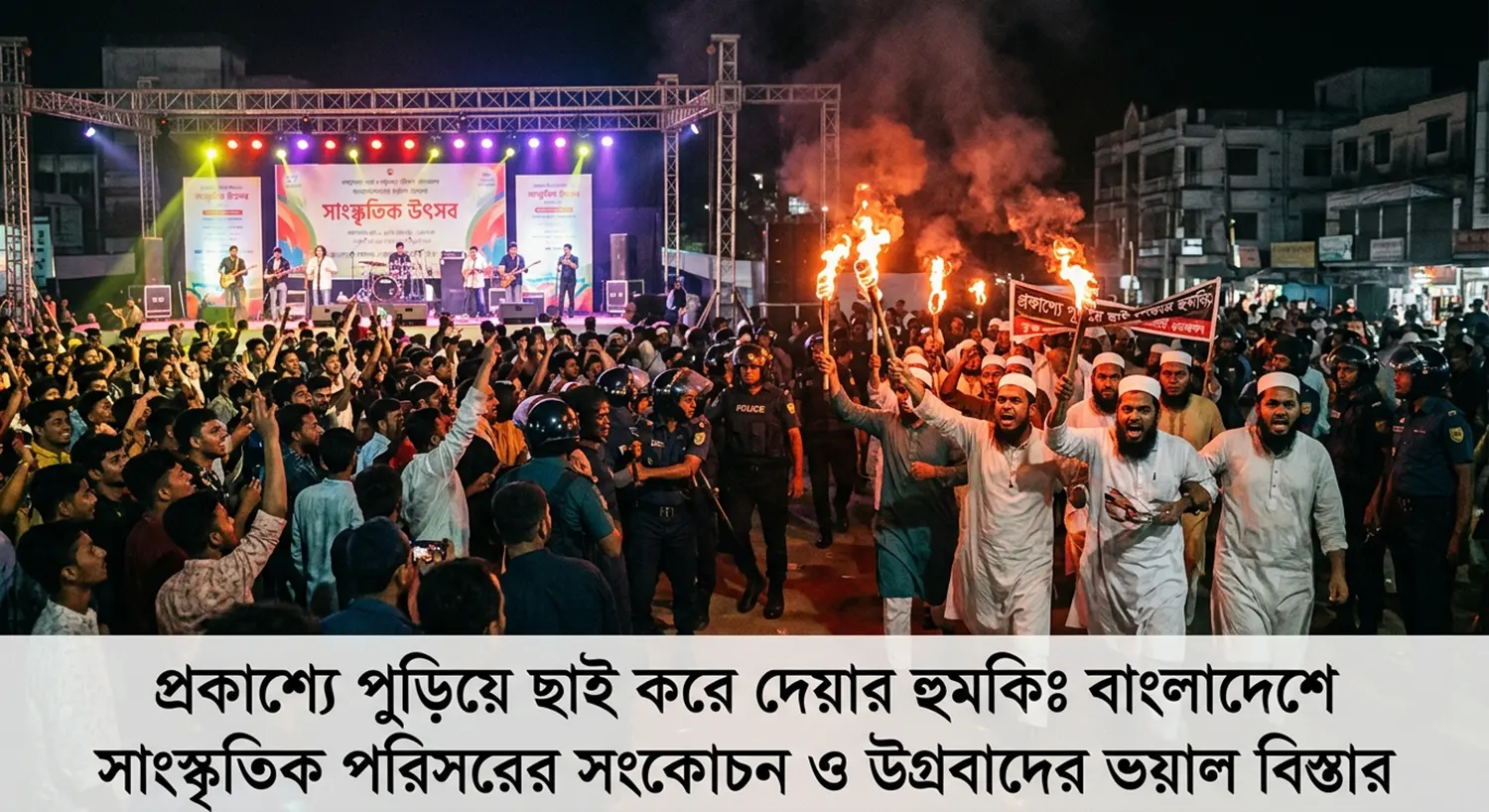
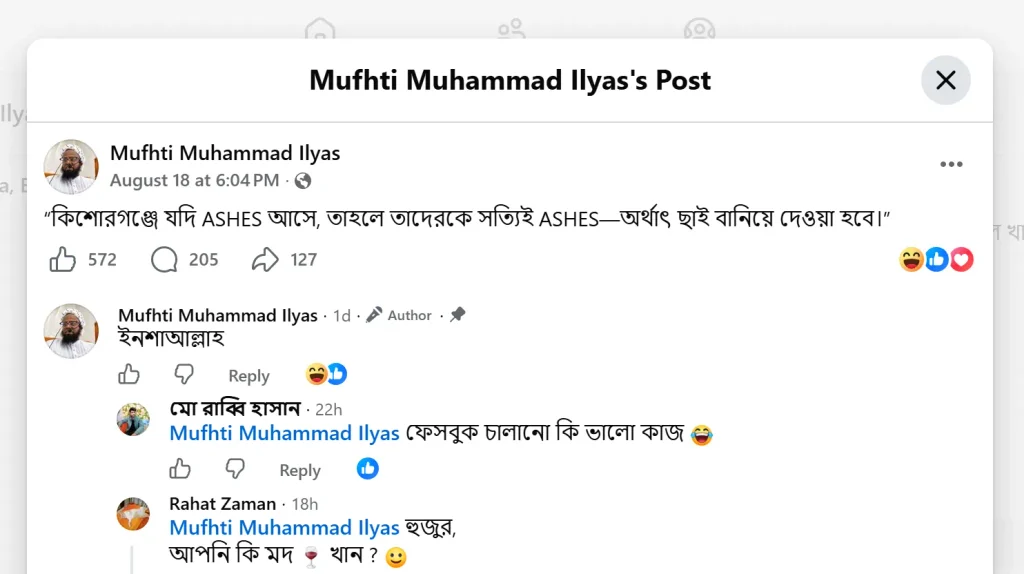
19 August 2026. That afternoon, a concert by popular rock bands Ashes and Nobelman was scheduled to be held at Kishoreganj Old Stadium. This event, organized at the initiative of a local restaurant, had generated extra excitement among the youth. But just a few days before the event, the Kishoreganj Sadar Upazila Imam-Ulama Parishad submitted a memorandum to the district administration, claiming that musical concerts are against Sharia and could create resentment among the religious people of the area. At the same time, a warning spread on social media – if Ashes came to Kishoreganj, they would be burned and turned into real ashes. In the end, the district administration postponed the event, citing complications related to hotel registration and licensing, and the Imam-Ulama Parishad withdrew their pre-announced protest program. Whatever administrative reasons were stated, the reality is this – a musical event was halted this time under pressure from religious groups and in the face of open threats.
Just one day before this incident, on the night of 18 August, students of Darul Arqam Madrasa clashed with the police over objections to a cultural program organized at the Brahmanbaria Police Lines, in which at least thirty people were injured. Around three in the night, the madrasa students gathered a mob and presented a five-point demand to the Superintendent of Police, including a ban on any future cultural programs at the Police Lines. These two incidents are not isolated – a few months earlier in Brahmanbaria itself, the screening of the film “Bonolota Express” was cancelled under pressure from an organization called Qaumi Oikko Parishad. According to information from the human rights organization Ain o Salish Kendra, a Baul music gathering in Madan Upazila of Netrokona was also shut down under similar pressure, and in April, a pir was killed and his shrine vandalized in Daulatpur, Kushtia.
Open threats from religious leaders
The incidents in Kishoreganj or Brahmanbaria are not some isolated flare-ups, but part of a broader trend in which some influential religious speakers in the country are openly trying to legitimize violence. In February 2025, at a rally organized under the banner of “Tauhidi Chhatra-Janata” after Friday prayers in the courtyard of Baitul Mukarram National Mosque in Dhaka, Dr. Enayetullah Abbasi, who claimed himself to be the Grand Mufti, declared that there would be no more processions – they would themselves carry out the punishment of so-called “apostates” by killing them with their own hands. In protest against this statement, 223 writers, journalists, Islamic scholars and researchers, including poet Farhad Mazhar and intellectual Salimullah Khan, issued a joint statement demanding his trial. Even before this, a case had been filed against Abbasi under the Digital Security Act for allegedly comparing the freedom fighters of 1971 with militants, and he had also been accused of openly propagating Al-Qaeda. Despite so many allegations and statements, he still regularly delivers speeches at religious public gatherings.
Not only Abbasi, according to documented observations by activists and human rights workers, the speeches of more than a hundred religious speakers including Mahmudul Hasan Gunbi, Maulana Mamunul Haque, Maulana Mufti Kazi Ibrahim, Abu Taha Adnan are regularly spread on social media, where violence against “shatime Rasul” or critics of the Prophet is presented as a religious duty. It is noteworthy that Maulana Mamunul Haque contested the 2026 national elections as a Jamaat-e-Islami–backed candidate and he is a top leader of Hefazat-e-Islam. The entry of such leaders into the political mainstream shows how extremist rhetoric is gradually moving closer to institutional power.
Repetition of a bloody history
Bangladesh has a long history of violence in the name of religious sentiment. During the Shahbagh movement in 2013, a list of bloggers was drawn up for killing, branding those who demanded the trial of war criminals and perpetrators of crimes against humanity in support of the Liberation War as “atheists”. Then one after another – Rajib Haider, Avijit Roy, Washiqur Rahman Babu, Ananta Bijoy Das, Niladri Chattopadhyay, Faisal Arefin Dipan – were killed by machete attacks, for which the militant Islamist group Ansar al-Islam and Al-Qaeda in the Indian Subcontinent claimed responsibility. This violence was not confined only to organized militant groups. In 2020, a school employee in Lalmonirhat was beaten unconscious in public and then burned alive over allegations of desecrating the Quran. In September 2024, in Khulna, a student named Utsab Mondal was attacked by several thousand people in the presence of police and army over a Facebook post, although he was eventually rescued alive. And in December 2025, in Valuka, Mymensingh, a Hindu garments worker named Dipu Chandra Das was beaten and then tied to a tree and burned to death over baseless allegations of blasphemy – subsequent investigations found no evidence supporting the accusations. According to the human rights organization Human Rights Congress for Bangladesh Minorities, between June and December 2025 alone, at least 71 incidents of blasphemy allegations against Hindu minorities were documented, spread across more than thirty districts.
Ordinary people have also been victims of this violence. Because of writing about science, exposing the nature of religious bigotry, human rights, LGBTQ and women’s rights, I myself have been facing continuous death threats since 2012. In 2017, a mob gathered in front of my house in Dhaka and attempted to kill me, and in June 2022, a direct physical attack severely injured both of my arms, the consequences of which I still carry. There were threats against me that hundreds of worshippers would be brought from the mosque to drag me out and kill me, and no one would stand by my side. Out of fear for my life, I had to leave for India the very next day, and later I was forced to leave the country altogether. I am not alone – many humanist free-thinkers such as Taslima Nasrin, Bonya Ahmed, Asad Noor, Asif Mohiuddin, who have faced more frequent threats and attempts on their lives than I have, are now living abroad and continuing their writing, because staying in the country means facing death threats every day, being subjected to repeated attacks and becoming victims of the brutality of fundamentalist militants.
State denial versus international warnings
The most worrying aspect of all these incidents is that at the state level, the risk of extremism has been repeatedly denied. In an April 2025 report by The New York Times, it was stated that after the fall of Sheikh Hasina, Islamist extremism has increased in Bangladesh and the interim government is reluctant to suppress it. In response, then Home Affairs Adviser Md. Jahangir Alam Chowdhury claimed that there had been no resurgence of militancy since they took office. In July of the same year, he reiterated the same position in the context of reports of suspected extremists being deported from Malaysia. In a recent report, the UN Security Council’s sanctions monitoring team warned that Al-Qaeda in the Indian Subcontinent (AQIS) has information suggesting it is trying to establish small, covert cells in Bangladesh – although they did not claim that any such cell had already been established. Responding to this report, on 17 August, Home Minister Salahuddin Ahmed told journalists that he had not yet read the report and that it seemed to be based on speculation, so the government was not taking any steps based on it. At the same time, a series of bomb and explosive recoveries in and around Dhaka has forced the police to increase their alertness. A report in The Diplomat shows that even after arrests on suspicion of links with banned organizations, the Home Minister has described the term “terrorism” as a political tool of “fascist regimes”, while one of the government’s own advisers has admitted that militancy existed in the past and still exists.
Assessments at the international level point in the same direction. At a side event of the 58th session of the UN Human Rights Council, human rights activist Rehman Afridi warned that in the past seven months, extremist forces have risen in Bangladesh, the justice system has effectively turned into the law of the jungle, and journalists are being harassed by being branded conspirators. In Article 19’s Global Expression Report, Bangladesh has been identified as a “crisis” country in terms of freedom of expression. In the index of Reporters Without Borders, Bangladesh’s position was 165th out of 180 countries in 2024, and in 2025 it improved slightly to 149th – yet it still remains in the “very serious” category. Freedom House has consistently classified Bangladesh as a “partly free” country. In the US State Department’s human rights report, cases, arrests and violence against journalists, bloggers and political critics have been described as a “serious problem”.
Legal framework: protection or enabling weapon
An alarming issue is that while allegations of hurting religious sentiments are taken up by the police very quickly, complaints against violent incitement by Islamic religious groups do not receive the same level of importance. Under Section 28 of the 2018 Digital Security Act and subsequently the Cyber Security Act, there is a provision of up to ten years’ imprisonment for hurting religious sentiments, which, according to Human Rights Watch and Amnesty International, has repeatedly been misused against free-thinkers. Even the High Court Division of the Supreme Court, in one judgment, advised the government to enact a new law making offences of hurting religious sentiments non-bailable and punishable by the maximum penalty of death. In this reality, victims like Jhumon Das from Sunamganj themselves were arrested and denied bail for a long time, while effective action against the complainants is almost never seen.
Where questions come to a halt
The cancellation of the Kishoreganj concert or the clashes in Brahmanbaria are not isolated incidents – they are the latest examples of a broader pattern in which the cultural sphere, minority rights and free expression are continuously shrinking, while state institutions have repeatedly either remained silent or denied the very existence of the problem. In contrast to the warnings from the UN, international human rights organizations and researchers, repeated denials at the governmental level are creating a dangerous gap between reality and the state narrative. The personal experience of a minor activist like me shows that this crisis is not just statistics – it is a daily risk to the lives, families and futures of real people. When fundamental issues such as culture, music, cinema or the right to free expression are repeatedly forced to bow to mob pressure, the question arises – where will the limits of this shrinking space end in the coming days, and how prepared is the state to confront it?
[Image: Symbolic]
Sources: Jago News24, The Business Standard, Dhaka Tribune, Prothom Alo, Samakal, Ittefaq, The Daily Star, The Diplomat, Tribune India, Reporters Without Borders, Freedom House, Article 19, the US State Department, and my own essay “Freedom of Thought and Freedom of Expression in Bangladesh: Will It Remain a Mere Illusion?” (smsaif.me).
Related Posts
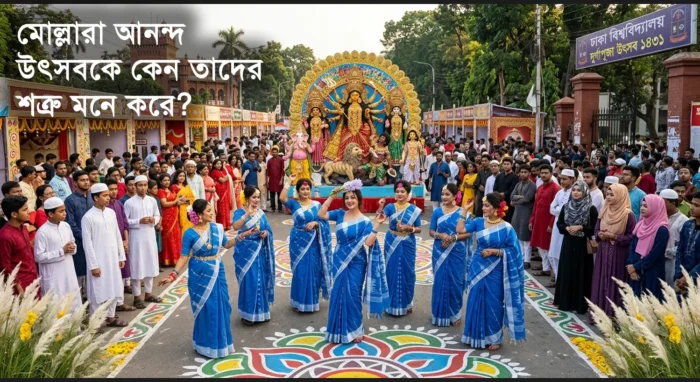
Why do Islamist clerics consider Bengali cultural festivals their enemy?
This year, unlike many previous years, the major Hindu religious festival Durga Puja in BangladeshRead More
ইসলামিস্ট মোল্লারা কেন বাঙালিদের আনন্দ উৎসবকে তাদের শত্রু মনে করে?
এবার বাংলাদেশে অন্যবারের তুলনায় বেশ শান্তিপূর্ণ, উৎসবমুখর পরিবেশে হিন্দু ধর্মের বড় ধর্মীয় উৎসব দূর্গাপূজা হয়েRead More
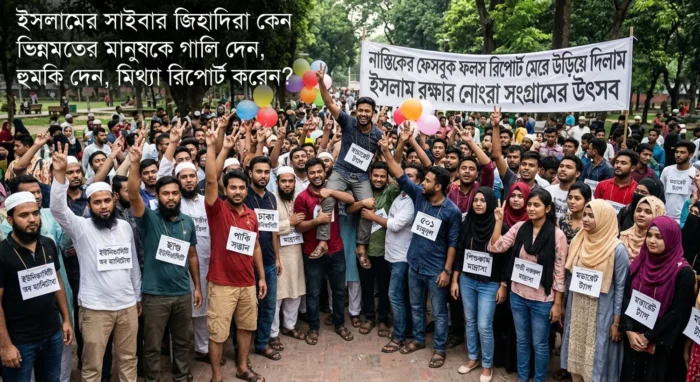
Why do Islamist cyber‑jihadis insult, threaten, and file false reports against people with different opinions?
Maulana Azhari once advised Islamists that sharing his Facebook posts is also an Islamic act;Read More
Comments are Closed