
Development Disaster - Salton Sea
When Development Becomes Disaster: From Beel Dakatia to the Salton Sea
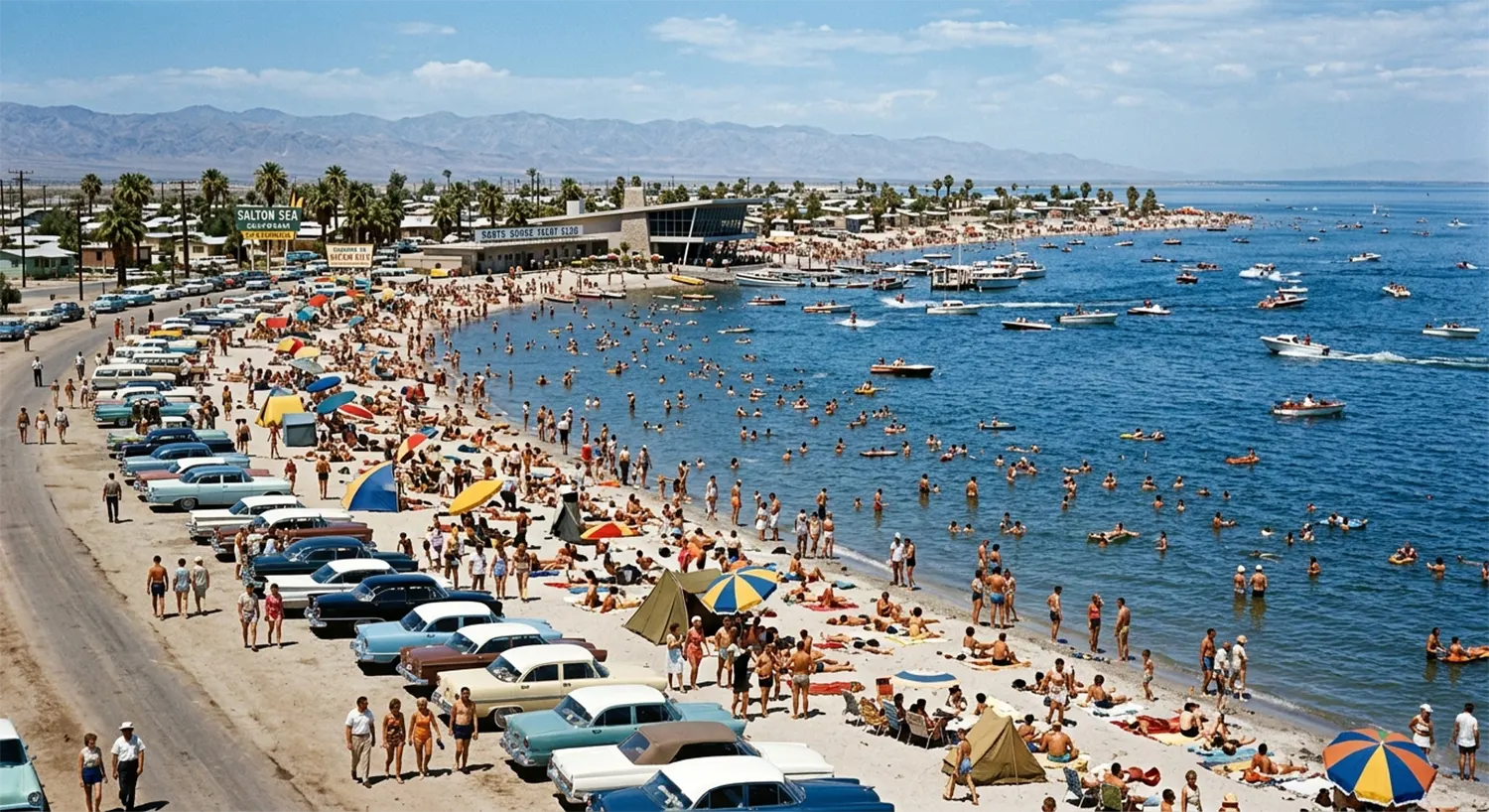
During my undergraduate years, a friend of mine wrote her thesis on the people of the Beel Dakatia region in Khulna, where she documented the harsh struggle of how once-golden croplands had been transformed into a so-called “development disaster,” forcing farmers to radically alter their livelihoods. Later, while pursuing my master’s degree, I had to read her thesis in its entirety. But Beel Dakatia is far from an isolated case. Across Bangladesh and around the world, there are countless examples of ambitious billion-dollar projects that gradually became burdens rather than blessings. One notable example is California’s Salton Sea, a place that was once bustling with tourists and surrounded by sky-high real estate values, but which today stands as a silent “ghost town” born of flawed planning, where the ruins of a luxurious lifestyle remain like skeletal reminders of the past and the lands have become some of the cheapest properties in California.
Beel Dakatia: When Embankments Become Prisons
Located on the border of Dumuria and Phultala upazilas in Khulna District, Beel Dakatia was once a symbol of agricultural abundance. This wetland area, covering approximately 9,500 hectares, produced three crop harvests a year even into the 1980s. However, the story behind that prosperity is complex, and its complications began in the 1960s.
At that time, the Bangladesh Water Development Board implemented the Coastal Embankment Project to protect coastal communities from cyclones and storm surges. Under this initiative, rivers and canals throughout the Khulna region were enclosed by embankments, creating numerous polders. Borrowed from Dutch engineering philosophy, the polder system had proven effective in the Netherlands for reclaiming land from the sea. However, in the tide-driven river systems of a deltaic landscape, the outcome was entirely different. Beel Dakatia became Polder 25.
In the short term, the embankments appeared successful. With saline tidal water prevented from entering, farmland remained cultivable and flood risks were reduced. But the rivers trapped within the embankments, whose natural function had been to carry sediment downstream, lost contact with the tidal system and gradually began to silt up. Over time, the riverbeds rose so much that they eventually became higher than the surrounding agricultural land. As a result, there was no longer any route for monsoon water to drain away. During the floods of 1984, Beel Dakatia became completely inundated, nearly seventy-six thousand acres of crops were destroyed, and the resulting waterlogging persisted for twelve years. Residents were forced to abandon their homes and seek refuge on the embankments.
In an effort to address the crisis, engineers proposed what was essentially more engineering: additional embankments, regulators, and pumping systems. However, attempts to solve the problem mechanically without restoring the natural tidal processes of the rivers repeatedly failed. Eventually, under pressure from local communities and experts, a method known as “Tidal River Management” was introduced in certain areas. This approach involved temporarily cutting embankments to reconnect rivers with tidal flows, allowing sediment to accumulate naturally and raise the elevation of land inside the beel. While the method produced some positive outcomes, it was expensive, long-term, and politically complicated because landowners whose property was used temporarily for sediment deposition needed to be compensated.
The result has been nearly permanent waterlogging over the past one to two decades. Farmers who once cultivated triple-crop farmland have either converted their land into shrimp farms, turned to fishing for a living, or migrated to urban areas for day labor. This transition from farmer to fisherman was not a matter of choice; rather, it was the long-term cost of an engineering decision, borne by people who had no role in making that decision in the first place.
Salton Sea: From Accident to Resort, from Resort to Ghost Town
The story of the Salton Sea also begins with an engineering disaster. In 1905, irrigation canals were being constructed to bring Colorado River water to agricultural lands in California’s Imperial Valley. However, spring floods caused the canal system to fail, and for nearly two years the entire flow of the Colorado River poured uncontrollably into a natural basin known as the Salton Sink, which had remained dry for centuries. In this way, California’s largest lake, the Salton Sea, was born by accident.
At first, it was simply an engineering mistake. But during the 1940s and 1950s, an ambitious vision emerged around the lake. Investors and urban planners sought to transform it into the “Riviera of California.” Glittering motels, yacht clubs, golf courses, and water-skiing competitions attracted everyone from Hollywood celebrities to middle-class American families. New communities such as Salton City sprang up around its shores, land prices soared, and promotional campaigns compared the area to Miami, Florida.
Yet this dream rested on a fundamental misunderstanding. The Salton Sea was not a naturally sustained lake fed by river systems. Its only source of water was agricultural runoff from nearby farms, carrying residues of fertilizers and pesticides. The lake had no natural outlet, meaning water could leave only through evaporation. As a consequence, salts and chemical pollutants accumulated year after year. Decades of this process steadily increased the lake’s salinity until it became even saltier than the ocean. Agricultural pollution contributed to eutrophication, triggering repeated algal blooms and oxygen depletion, which caused massive fish die-offs. Millions of dead fish periodically washed ashore, spreading foul odors for miles.
By the late 1960s, tourists had begun turning away. The stench of rotting fish and birds, polluted water, and a shrinking shoreline transformed what had once been a desert paradise into an abandoned nightmare. Hotels and luxury homes that had once welcomed streams of visitors now stand like skeletons, with shattered windows and sand-covered ruins. Land in Salton City that once sold for thousands of dollars now ranks among the cheapest real estate in California, yet buyers remain scarce. In recent years, climate change and shifts in agricultural water use have accelerated the lake’s decline, exposing vast stretches of toxic lakebed dust that have become a new source of respiratory illness for nearby residents.
A Shared Theme in Two Disasters
Geographically, these two cases lie on opposite sides of the planet, and their cultural and historical contexts are quite different. Yet the stories of Beel Dakatia and the Salton Sea share a profound similarity: both are consequences of attempts to interrupt or oppose natural environmental processes. In Beel Dakatia, river tides were blocked and sediment transport disrupted. In the Salton Sea, a closed basin was converted into a body of water with no natural outlet. In both situations, short-term engineering successes concealed long-term ecological decline, at least until nature began to reassert its own rules.
Another common characteristic of such projects is that the decisions are often made by people far removed from those who ultimately bear the consequences. The polder system in Beel Dakatia was designed by distant engineers with limited consideration for the river-dependent lifestyles and local knowledge of farmers. The resort dream of the Salton Sea was promoted by investors who failed to fully understand the long-term trajectory of the lake’s water chemistry. In both cases, natural mechanisms of ecological balance were disrupted for short-term human benefit. And when that balance eventually collapsed, the greatest burden fell on those in the most vulnerable positions: farmers, fishermen, and ordinary residents.
This pattern is hardly unique. The shrinking of the Aral Sea, delta degradation along the Mississippi River, sedimentation challenges behind the Three Gorges Dam, and even changes in Bangladesh’s river systems following the Farakka Barrage all reflect a similar mistake: treating engineering triumphs as final solutions while overlooking the fact that ecosystems are not static structures but dynamic processes. When those processes are interrupted, they respond in ways that are often unexpected and difficult to control.
Conclusion
Beel Dakatia and the Salton Sea remind us that the true measure of a development project’s success is not its inauguration ceremony or even its first few years of apparent achievement. The real test comes decades later, when nature begins to respond according to its own laws. Any project that disregards natural flows, sediment cycles, or water chemistry may cost billions of dollars, yet eventually either collapse under its own contradictions or survive only through endless artificial maintenance. By then, however, the lives of those least responsible for the problem—local farmers, fishermen, and ordinary residents—may already have been changed irreversibly. The history of development, therefore, is not merely a story of progress; it is also a long and continuing story of the tension between human ambition and nature’s patience.
Related Posts

Zamzam water can be contaminated just like ordinary water. It is purified using technologies developed by non-Muslims before being distributed
Zamzam well water is regarded as highly sacred and religiously significant in the Muslim world.Read More
জমজমের পানি কিন্তু অন্য সাধারন পানির মতোই দূষিত! বিধর্মীদের প্রযুক্তি ব্যবহার করে তা বিশুদ্ধ করা হয়!
জমজম কূপের পানি মুসলিম বিশ্বে অত্যন্ত পবিত্র ও ধর্মীয়ভাবে গুরুত্বপূর্ণ হিসেবে বিবেচিত। এই পানি নিয়েRead More

After Being Arrested on Child Rape Charges, Madrasa Teacher Says He “Does Not Like Women”
Recently in Bangladesh, after a madrasa teacher was arrested on allegations of child rape, aRead More
Comments are Closed