
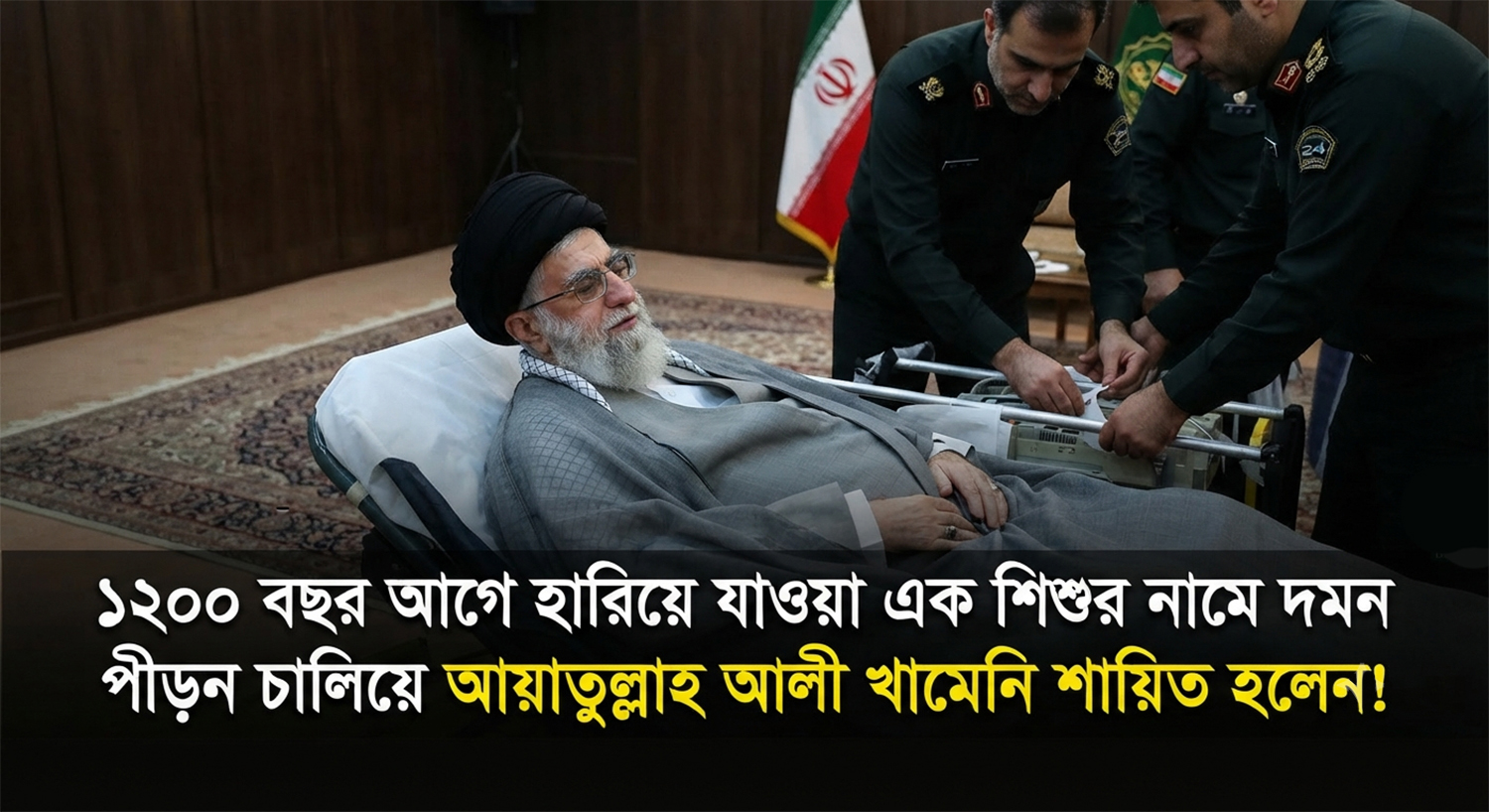
The Despotism of Superstition
Ayatollah Ali Khamenei was laid to rest after carrying out repression in the name of a child who disappeared 1,200 years ago
Around Ayatollah Ali Khamenei’s funeral, the world is now witnessing a grand display of state pomp, behind which lies a governance structure that, built on religious belief, has placed state power beyond civic accountability — at the root of that system is a child who disappeared 1,200 years ago. All the brutal repression carried out by Iran’s Islamic rulers is legitimized in the name of that vanished “Hidden Imam.” That child is, indirectly, responsible for the killing of hundreds of thousands of people.
Mention of the Hidden Imam and Velayat-e Faqih in the Constitution
This concept is explicitly recorded in several places in Iran’s constitution adopted in 1979:
Preamble: Right at the beginning of the constitution, in the section titled “Method of Governance in Islam,” it is stated that the ideological foundation of the revolution is “Velayat-e Faqih” — that is, in the absence of the Hidden Imam, the reins of governance are entrusted to a qualified faqih (Islamic jurist). In the preamble, Khomeini is directly addressed as “Imam,” and this theory of governance proposed by him is declared the central basis of the constitution.
Article 5 – This is the core clause, where it is directly written that during the occultation of the Hidden Imam (referred to as “Hazrat Wali-ye Asr”), the responsibility for the leadership and governance of the ummah falls upon a just, God-fearing, contemporary, courageous, and administratively capable faqih, who will be appointed according to Article 107. In other words, the constitutional source of state power’s legitimacy is the representation of an absent religious figure during his occultation.
Article 4 makes it clear that all laws, regulations, and directives of the country must conform to Islamic criteria — and since this article is part of the preamble, it takes precedence over any other provision of the constitution.
Articles 107–112 define the procedure for selecting the Supreme Leader and list his powers — ultimate control over the armed forces, the judiciary, state broadcasting, and the vetting of electoral candidates is vested in him.
Khomeini himself went a step further in 1988 by introducing the theory of “Velayat-e Motlaqeh-ye Faqih” (absolute guardianship of the jurist), which states that, in the public interest, the faqih’s decisions can even override Islamic legal provisions. Khamenei later said that the Supreme Leader’s decisions take precedence even when they go against the will of the people.
It is noteworthy that many senior ayatollahs in Najaf (Iraq) and Qom (Iran) — the most influential centers of Shia Islam — such as Ayatollah Ali Sistani, do not agree with this political interpretation. As a result, many scholars consider this theory not a universally accepted Shia theological doctrine, but rather Khomeini’s own political reconstruction.
Historical mass killing – the 1988 prison massacre
In the summer of 1988, in the final phase of the Iran–Iraq war, thousands of political prisoners were secretly executed without due process, on the basis of a direct fatwa from Khomeini. Different sources give different figures for this incident:
- According to conservative estimates by Human Rights Watch and Amnesty International, 2,800 to 5,000 people were killed, in at least 32 cities.
- Then–Deputy Supreme Leader Ayatollah Hossein-Ali Montazeri mentions the figure as between 2,800 and 3,800 in his memoirs.
- The opposition organization People’s Mojahedin (MEK/NCRI) claims the number could be as high as 30,000 to 34,000 — although these highest estimates are largely the group’s own calculations, not figures documented by independent human rights organizations.
In a 2024 report, UN Special Rapporteur Javaid Rehman characterized this massacre as a crime against humanity and genocide. Notably, one of the members of this “Death Commission” was Ebrahim Raisi, who later became Iran’s president. Even today, families of the victims are not allowed to visit the burial sites of their loved ones; Amnesty International has reported in a recent publication that part of Tehran’s Khavaran cemetery has been demolished and turned into a car park.
Recent executions – alarming rise in numbers
According to human rights organizations, the use of the death penalty has increased dramatically in recent years:
- In 2024: At least 972–975 people were executed (joint report by Amnesty International and Iran Human Rights/ICPM).
- In 2025: Although figures vary among organizations, all of them describe it as “the highest since 1989” — Iran Human Rights and ICPM recorded at least 1,639 executions (a 68% increase compared to 2024), Amnesty International recorded at least 2,159, and Iran-based human rights organization HRANA recorded 1,922. The discrepancy arises because the Iranian government does not publish official data — according to HRANA, about 95% of executions are never reported in state media.
- Among those executed in 2025 were at least 48 women — the highest in two decades. In addition, at least 84 Afghan nationals and 3 Iraqi nationals were executed.
- In November 2025 alone, at least 336 people were executed — the highest number in a single month in 37 years.
- UN human rights experts have warned that the use of the death penalty is no longer merely a criminal justice tool, but has become a state instrument for crushing dissent.
Crushing protests – brutality in numbers
The 2022 “Woman, Life, Freedom” movement
Twenty-two-year-old Mahsa (Jina) Amini died in custody in September 2022 after being detained by the “morality police” for allegedly not wearing her hijab properly. The movement that followed saw:
- According to human rights organizations, at least 551 people (including children) were killed.
- In the first 20 days alone, HRANA recorded around 5,500 arrests; overall, various organizations reported that thousands of people were detained.
- At least 8–10 people were later executed on charges related to this movement.
- A UN independent Fact-Finding Mission, after reviewing testimony from 300 people and more than 38,000 pieces of evidence, reported that security forces used rape and other forms of sexual violence against detained women, even against children as young as 12.
The 2025–26 economic protests and repression
In December 2025, protests erupted over currency collapse and inflation, and according to Amnesty International, by January 2026 they had turned into the bloodiest crackdown in Iran’s history:
- HRANA recorded at least 2,615 deaths (including 2,435 protesters, 153 government/military-affiliated individuals, and 14 ordinary citizens not participating in the protests).
- Norway-based Iran Human Rights (IHR) reported at least 3,428 people killed.
- HRANA documented at least 18,470 arrests in 617 protest incidents across 187 cities.
- Iranian state television claimed only 300 deaths — indicating sharp disagreement over the actual figures, though multiple independent human rights organizations speak of thousands killed.
- This period also saw one of the longest internet shutdowns, making verification of information even more difficult.
Punishments under hijab laws for women
After the 2022 movement, state repression against opposition to the hijab has intensified rather than diminished:
- On the very first day of implementation of the “Noor Plan” launched in April 2024, Iranian media reported that around 500 women and girls were arrested for not wearing the hijab.
- In Qom province alone, the provincial police chief stated that from March 2023 there had been at least 1,986 criminal cases related to hijab.
- A legal aid organization reported that since September 2022, each court has been receiving 2,000–3,000 hijab-related cases per month, whereas previously the numbers were negligible.
- Under the new “Hijab and Chastity Law” (74 articles), implemented in December 2024, punishments include fines (equivalent to 24 to 2,380 US dollars), up to 5 years’ imprisonment, travel bans, internet use bans, and, in cases of hijab-related activism, even the death penalty.
- Several women have been sentenced to flogging (74 lashes) for public anti-hijab activities — for example, singer Parastu Ahmadi and her fellow performers, who were punished in 2026 for participating in a virtual concert without hijab.
- The UN Fact-Finding Mission has characterized this overall trend as a crime against humanity, namely “persecution on grounds of gender.”
Exile and flight – how many have fled
According to data from the UN Refugee Agency (UNHCR), from 1980 (starting roughly a year after the Islamic Revolution) until now:
- More than 5 million Iranian citizens have been registered as refugees or asylum seekers — an unusually high number for a country not continuously at war.
- In the 1980s (the first decade after the revolution), more than 312,000 Iranians were registered as refugees; the highest single-year figure was around 88,000 in 1985.
- In the 1990s (during the economic crisis under Rafsanjani’s government), about 1,060,000 Iranians were registered as refugees.
- From 2000 to 2009, a further around 1.1 million were registered.
- After the 2009 Green Movement protests, refugee registrations reached the highest level of that decade.
- As of December 2025, 1.6 million Iranians were registered worldwide as asylum seekers (though not all Iranians living abroad are asylum seekers).
- According to Iran’s own Foreign Ministry data from 2021, the total number of Iranians living abroad is about 4 million, although this includes families who emigrated long before the revolution.
- In addition, immediately after 1979, around 30,000 of Iran’s 80,000-strong Jewish community left the country within a few months; today only about 9,000 Jews remain.
- In terms of brain drain, Iran ranks among the top countries in the world according to the International Monetary Fund (IMF), with an estimated 150,000 to 200,000 highly educated professionals leaving the country each year.
Contrasting perspectives – what supporters and critics say
For the sake of neutrality, it is important to note:
- Supporters of this system believe that “Velayat-e Faqih” is a legitimate Islamic theory of governance that offers an alternative to Western liberal democracy, in which a limited electoral process (presidential and parliamentary elections) coexists with religious leadership.
- Many devout Iranian citizens genuinely revere the Supreme Leader — although a 2024 survey by the University of Maryland showed that public opinion in Iran is increasingly divided over enforcement of the hijab (in 2024, about 42% believed action should be taken against those who disobey hijab rules, while about 38% believed they should not be confronted even if they disobey).
- Supporters argue that Iran’s political system should be judged in the context of historical Western intervention (such as the 1953 coup against Mossadegh) and ongoing sanctions and military threats.
- The Iranian government has repeatedly rejected many of the figures published by human rights organizations as “exaggerated” and “misleading propaganda,” and, given that independent journalism and fact-checking are restricted inside Iran, it is difficult to determine the exact numbers — this limitation must be kept in mind.
A regime standing on such myths even in this era!
The concept of the Hidden Imam explicitly recorded in Article 5 of the constitution, and the absolute authority of the faqih built upon it — this theoretical framework is what sets Iran’s system of governance apart from other modern states. And the numbers tell a story: the secret killing of thousands of political prisoners in 1988, record executions in 2025, thousands killed and arrested in the protests of 2022 and 2025–26, hundreds of thousands of criminal cases against women over hijab, and more than five million people leaving the country over four decades — all point toward one question: when a state chooses an unverifiable religious claim as the source of its legitimacy, how institutionally secure can its accountability to the people really be?
Sources: The statistics in this article are drawn from Amnesty International, Human Rights Watch, Iran Human Rights (IHR/Oslo), Human Rights Activists News Agency (HRANA), the UN Fact-Finding Mission on human rights in Iran (UN FFMI), UNHCR, and the official English translation of the constitution. Since the Iranian government does not publish much of this data itself, the relevant organizations have warned that in almost every case the real numbers may be higher than those reported. Where figures differ among organizations, multiple sources have been cited for each case.
Related Posts
Government Employees’ Salaries Are Rising by 100% to 142%: Will Corruption Decrease? How Can the Inhumane Living Conditions of Private-Sector Workers End?
When I was at university, I dreamed of getting a job with a salary ofRead More
সরকারী কর্মচারীদের বেতন বাড়ছে ১০০-১৪২% পর্যন্ত, দুর্নীতি কমবে? বেসরকারীদের মানবেতর জীবনযাপনের অবসান কীভাবে হবে?
আমি ইউনিভার্সিটিতে থাকতে স্বপ্ন দেখতাম পাশ দিয়ে ১০০০০ টাকা বেতনের জব নিবো। তখন সবার কাছেRead More
Why is the rate of rape low in Islamic Sharia‑ruled countries? Is it real?
Because of my writing and as an outspoken activist against sexual violence against women, IRead More
Comments are Closed